Daily insights for city builders, delivered every morning at 6 AM ET. I’m Brandon Donnelly — a Toronto-based real estate developer and founder of Globizen. I’ve been writing here since 2013.
Groceries have relatively low online penetration, which makes them great for brick-and-mortar retailers. I’ve written about this topic before in the context of big box stores and online shopping. But I clearly didn’t realize that it had become such a big segment for Walmart.
What’s also noteworthy about grocery shopping though, is that customers appear to be less likely to travel far distances for it, even for lower prices. This means that the radial impact of Walmart the supermarket is less significant and far tighter (~2 miles) than Walmart the discount store. Click here for that study.
This is important because a big catchment area has been central to the Walmart model. They consume cheap land on the outskirts of cities and then offload the transportation costs (indirect costs) to consumers in exchange for everyday low prices (direct costs). Studies show that we, consumers, typically undervalue indirect costs.
Charlie argues in his post that this does not mean that we should write off big box retailing. And I would agree. The Walmart Express concept may have failed, but they are clearly looking for ways to rethink their model. Urban stores will need to form part of that.
A few days ago, Bill Gurley – who is an investor in Uber – wrote a really fascinating blog post called, Uber’s New BHAG (Big Hairy Audacious Goal): UberPool. Bill doesn’t update his blog very often, but when he does it’s incredible stuff.
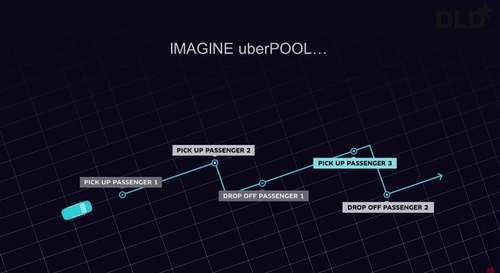
I’ve touched on UberPool briefly before. But basically it’s a true “ride sharing” service where people with overlapping routes can easily share the same car – much like people do today informally. The obvious advantage of this is cost. It’s cheaper to share.
What’s most fascinating about this service though is how it fits into Uber’s larger mission to drive transportation costs down. And there’s a specific reason for that (via Bill Gurley):
When Uber launched its low-cost UberX offering in the summer of 2012, the company quickly realized that the demand for its transportation services is HIGHLY elastic. As the company achieved lower and lower per-ride price points, the demand for rides increased dramatically. A lower price point delivered a much better value proposition to the consumer, yet still remained a great business decision due to the remarkable increase in demand.
So what Uber quickly figured out was that if they could increase the utilization rate for drivers (the time actually spent with passengers), they could charge consumers lower prices while at the same time maintaining driver salaries. Prices went down, but volume went up.
One way to do that is to obviously decrease driver downtime by improving liquidity on the marketplace. But another way is to simply increase the number of passengers being transported at one time. Hence the creation of UberPool.
But it doesn’t stop there.
Because of all the transportation data that Uber now has (the company has a data group called the “math department”), they can fairly accurately predict what a price cut will do to their ridership levels. This allows them to “forward invest” their capital in new services – such as UberPool – before they even have the revenue from the anticipated increase in ridership.
So what does this all mean?
It means that Uber is going to get cheaper and cheaper and cheaper. Uber is trying to get to what they call “The Perpetual Ride”, which basically means that drivers will always have customers (100% utilization). That’s quite a goal, but it would mean the absolute lowest prices for consumers (barring any other changes to their cost structure).
Dirt cheap transportation is a pretty compelling value proposition, which is why I continue to believe that cities should be hard at work trying to figure out how to harness this transportation shift.
If you’re interested in this topic, I would encourage you to give Bill Gurley’s blog post a read.
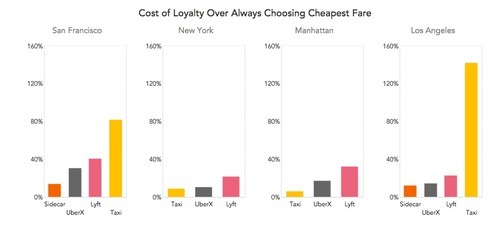
This morning I woke up to a post from venture capitalist Fred Wilson talking about the cost of loyalty when it comes to local transportation markets. More simply, it was a cost comparison between regular city taxis and ride sharing services such as a UberX, Lyft, and Sidecar in San Francisco, Los Angeles, and New York.
The way to understand this chart is to think about it as the answer to this question (from whatsthefare.com): If I were to take 1,000 rides over my lifetime with one individual service, how much more would I pay than if I compared prices and always picked the cheapest option?
What you should immediately see is that regular taxis are far more expensive in San Francisco and Los Angeles compared to all of the ride sharing services. In the words of Fred Wilson: “That is crazy. They are going to go out of business in those markets with that pricing.”
In my words: They are fucked.
I wonder where Toronto would place against these cities. My gut tells me that we would be closer to San Francisco than New York. And if that is the case, I think you can figure out what that means.
I thought this would be an interesting post given yesterday’s point about our cities being multi-modal. We urbanites have many more options at our disposal than we did only a few years ago. And if they’re cheaper and more convenient, we’re going to use them. I think that’s a good thing.
Smart Growth America released a report this month called Measuring Sprawl 2014. It’s an update to a report they did back in 2002 and it’s worth a read if you’re into urban planning. You can download it here.
The report looks at 221 metro areas in the US and develops a “sprawl index ranking.” The higher the number, the more compact the metro area. Not surprisingly, New York tops the list with San Francisco coming in second. But more interesting are the correlations they discovered. As you go up their sprawl index ranking (that is, as the cities become more compact), they found the following:
People have greater economic opportunity in compact and connected metro areas.
People spend less of their household income on the combined cost of housing and transportation in these areas.
People have a greater number of transportation options available to them.
And people in compact, connected metro areas tend to be safer, healthier and live longer than their peers in more sprawling metro areas.
If you’re a follower of smart growth, then some of these will sound familiar. But they’re worth repeating and I’d like to focus on the second one for a minute (not to undermine the importance of living longer). Conventional wisdom dictates that as you sprawl out from the center of a city, the cost of housing drops. And indeed, that’s what they found. There’s a correlation between density and housing costs, and more compact cities generally have more expensive housing.
However, they also found that the percentage of income spent on transportation is much less in compact metros:
Each 10 percent increase in an index score was associated with a 3.5 percent decrease in transportation costs relative to income. For instance, households in the San Francisco, CA area (index score: 194.3) spend an average of 12.4 percent of their income on transportation. Households in the Tampa, FL metro area (index score: 98.5) spend an average of 21.5 percent of their income on transportation.
But here’s where it gets interesting: they found that transportation costs dropped faster than housing costs increased as metro areas became more compact. Meaning if you consider both housing costs and transportation costs in aggregate, it’s actually cheaper to live in more compact areas. From what I can tell, they’re also only considering direct transportation costs and not indirect costs such as the time people waste sitting in traffic.
Either way, it’s something to consider the next time you’re thinking about where to live and how much you should be willing to spend on housing. That cheaper suburban home may not be as cheap as it seems.
Urban Capital has just unveiled its new Smart House condo project here in Toronto. With units starting at 289 square feet, the project is all about ultra-compact and ultra-smart living.
Tokyo, of course, is a unique example. There you have the entire population of Canada living in one city. But that doesn’t mean that Toronto isn’t feeling the pressures of urban intensification. Apartments are getting smaller.
But the interesting thing about space is that it’s a relative thing. I personally live in 650 square feet and find it more than enough space. Though I also place a huge value on my time and try to minimize the amount of traveling I need to do.
And this is really the trade off you make with space. As you move further away from a city (and housing costs drop), you’re effectively shifting those housing costs to transportation costs. Which includes real costs like gas and time, as well as more intangible costs like quality of life.
However, I know many people that are willing to make that trade off for more space. But I wonder sometimes how much of that incremental space is necessity versus perceived necessity.