Daily insights for city builders, delivered every morning at 6 AM ET. I’m Brandon Donnelly — a Toronto-based real estate developer and founder of Globizen. I’ve been writing here since 2013.

Tag: transport

  • Canada announces high-speed rail between Quebec City and Toronto — finally!

    The train from Paris to Marseille takes just over 3 hours:

    To drive this same distance, it would take just over 8 hours:
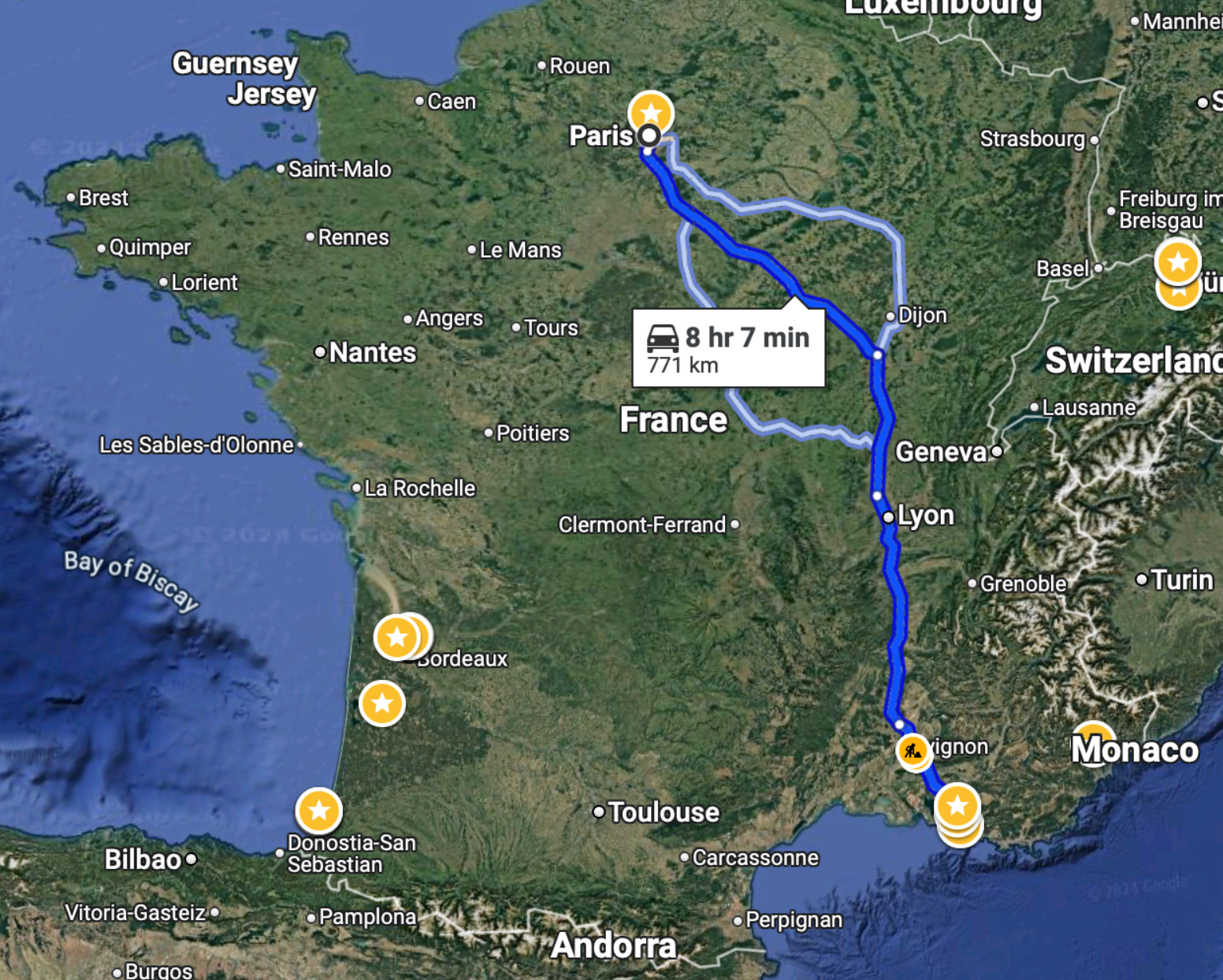
    So unless you had a very specific reason, I don’t know why you’d ever want to drive this route. I certainly hate long drives and would avoid this at all costs.

    On a related note, the Canadian government announced this week that it will actually be moving forward with a high-speed train linking Québec City to Toronto, stopping in Peterborough, Ottawa, Montréal, Trois-Rivières, and Laval. And unlike previous announcements, it will actually go pretty fast — upwards of 300 km/h, which is comparable to what the TGV does on the above route.

    There are three consortia currently competing for this contract, but apparently the federal government has already chosen a winning bidder. An announcement is expected next month. At the same time, the project office owns all of the bids, and so there’s a chance that elements from each of them could be used in the final project.

    According to official messaging, the design alone is expected to take some 4 to 5 years, which is an eternity and way too long. But at least we seem to be moving forward. This rail link is a no brainer. It will compress the geography of an importantly bilingual corridor with nearly 20 million people — about half the population of Canada! It’s our megalopolis.

    Now we just need to move forward with urgency and with an unwavering commitment to creating the best high-speed rail service in the world. Let’s not accept mediocrity. And let’s not cancel it once we’ve already sunk millions into it. That would be a terrible outcome for such an obviously important nation-building project.

    LFG.

  • Development charge litmus test

    Development charges are a topic that is near and dear to this blog.

    In theory, development charges are supposed to be “growth paying for growth.” In other words, they are intended to pay for the incremental services and infrastructure required strictly because of new development. This, of course, sounds right. More people will equal more demand on city services.

    However, development charges also increase the cost of new homes and there is a growing concern that development charges now pay for more than they should. Meaning, they have become a “housing tax”, which is more or less the opposite of what you want if you think there’s a shortage of new homes.

    Frances Bula recently wrote about this in the Globe and Mail.

    Part of the challenge, I think, is that city budgets are complicated. As far as I know, it’s largely impossible for the average person to try and figure out which municipal costs are associated with growth and which are associated with ongoing operations (i.e. they should be paid for through things like property taxes).

    That said, I think this current market environment could create a bit of a litmus test for development charges. As most of you know, new home sales in Toronto have fallen to levels not seen since the global financial crisis and the early 90s.

    This means that construction activity has now also fallen and that, in turn, fewer developers are paying development charges. I haven’t seen the exact numbers, but intuitively the drop in development charges paid should be precipitous.

    Now, if these charges are strictly paying for growth, then in theory, cities should be completely agnostic to this decline. Sure, they’re collecting less revenue, but they also don’t have the new growth. Any growth that is still in the pipeline (i.e. under construction) would have already paid for their impacts.

    However, if this is not the case, and municipal budgets start getting negatively impacted by this drop in development charge revenue, then it suggests that one of two things could be going on.

    Either development charges aren’t enough to cover the true cost of growth and the whole thing is a bit of a Ponzi scheme. That is, we need a constant flow of new developments to pay for the shortfalls of the last. Or, we’re overtaxing new homebuyers for the benefit of incumbent ratepayers.

    I’m sure it’s more complicated than I’m making it seem right now. But this is the crux of this debate: Are we equitably levying development charges on new homes? This current market could offer a clue. If cities start running out of money, it might suggest the answer is no.

  • Cities in the 2020s

    Since the beginning of this year, the London School of Economics has been running a debate series called, Cities in the 2020s: How are cities responding to profound global change? The next event is about localizing transport and it’s scheduled for May 20, 2021. If you’d like to attend, click here. It’s free and open to all. The one thing I would add is that I am getting the strong sense right now — as cities, other than Toronto, begin to reopen — that people are starting to remember just how much more fruitful in-person interactions are compared to being on screen. There’s no comparison. In fact, earlier today I had in-person work interaction that resulted in a positive outcome that I am certain would not have happened otherwise. And as an ENTJ (business school made me take these personality tests), I find that I derive a lot of my energy from being around other people. As long as these sorts of things remain true, I believe that we will stay tethered to our cities and reliant on things like mass transit.

  • How coffee grew São Paulo

    For all of us who are involved in the building of cities, it is important to remember that cities emerge and thrive as a result of economic purpose. Take, for example, Sao Paulo. Once one of the poorest of Portuguese colonies, it is today the largest city in the southern hemisphere and one of the largest and most diverse urban agglomerations in the world.

    How did all of this happen? It was probably because of coffee.

    Brazil is the largest producer of coffee in the world. And it has owned this title for some 150 years. The best areas to grow coffee (as a result of climate, I’m told) are in the southeast part of the country, in and around Sao Paulo and Rio de Janeiro. The inland state of Minas Gerais is the biggest producer.

    But here’s the thing. Rio de Janeiro is along the coast and Sao Paulo is not, though as of 1869 it had been connected to the port of Santos by rail. This geographical feature made Sao Paulo a logical place for rail to converge as it made its way from the coffee plantations in the interior of the country to the coast, and then out to the rest of the world.

    Coffee was the economic purpose. And it was facilitated by Brazil’s longstanding use of slave labor.

    In 1888 that changed. Slavery was abolished, giving Brazil the dubious distinction of being the last country in the Western world to do so. The problem is that the coffee industry relied heavily on this labor. So to fill this void and keep the coffee industry happy, a deliberate effort was made to increase immigration.

    From 1870 to 2010, about 2.3 million immigrants settled in the state of Sao Paulo, many from Italy and Japan. Today, about half of the city is thought to have at least some Italian ancestry. And it is generally believed that it was this significant influx of immigrants that helped the city to industrialize in the way that it did.

    Big and diverse. And coffee probably had a lot to do with it.

    Photo by ViniLowRaw on Unsplash

  • Comparing ICE vehicle and electric vehicle travel times

    While we were doing our West Palm Beach to Toronto road trip last weekend, I started wondering how much longer the trip would be taking had we been driving a Tesla. The drive, according to Google Maps, is normally about 20 hours and 46 minutes. It’s a long one. About 2,288 km. The mountains in Virginia are nice, though.

    The route I threw in is West Palm Beach to Junction House (2720 Dundas St W, Toronto):

    According to Tesla, this same route using a Standard Range (400km) Model X SUV is now estimated to take 34 hours.

    The additional travel time is a result of charging time (anywhere from 20 – 70min per charge depending on the device) and the fact that you need to go where the chargers are. In this scenario, you end up driving an additional 155 km. However, you will end up saving money on gas.

    This reminds me of something that Bill Gates argued in the talk I recently posted. Electric vehicles are the future of personal transport, but they’re not great for commercial applications: planes, boats, and so on. The battery capacity simply isn’t there, and it’s unlikely to be there anytime soon. But perhaps the charging times can be brought down. That would help.

    I’m not planning on doing this drive again anytime soon. But if any of you are, you may want to leave the Tesla at home if you’re in a rush. However, using an EV would, of course, be the right thing to do for our planet.

  • Scooter trips surpassed bike share last year

    According to the National Association of City Transportation Officials (NACTO), scooter trips in the US surpassed station-based bike share trips for the first time in 2018. Here is a chart taken from Streetsblog:

    Dockless electric scooters have created a public nuisance in many of our cities, but what is clear is that the demand is there. Which perhaps isn’t all that surprising given that they require less effort than traditional cycling.

    The other interesting takeaway from NACTO’s analysis, which is likely also not that surprising, is that bike share trips are heavily concentrated in a select few cities.

    In 2018, there were about 36.5 million bike share trips across the US. And about 84% of them took place in just 6 cities: New York, Boston, Chicago, DC, Honolulu, and San Francisco.

    Almost half of the 36.5 million trips were on NYC’s Citi Bike network.

  • Electric scooter startup Lime raises $310 million series D round

    Earlier this month it was announced that the on-demand electric scooter and bike startup, Lime, had closed a $310 million series D round. This values the 18-month old company at around $2.4 billion and brings its total raise to $867.1 million. For comparison, Bird — its main competitor — has raised around $400 million.

    These numbers should tell you about the kind of growth that the “micromobility” startup is seeing. They are now in 15 countries and its riders have taken over 34 million trips. In the last 7 months alone, the company reports that it has seen a 5.5x increase in ridership. They are seen as an affordable last-mile solution. Supposedly 1/3 of its users report an income of less than $50,000 per year.

    Lime entered the Canadian market last fall via Waterloo. They have yet to expand anywhere else, though I suspect we’ll see them in Toronto this spring/summer. One of the barriers is that their scooters (with airless tires) aren’t equipped to deal with snow, so they currently pack them up during the winter months.

    This is in addition to the regulatory challenges they are facing in cities all around the world. But like Uber, I am sure there is a compromise to be had.

  • To invest or not invest

    We used Uber to get pretty much everywhere when we were in Rio de Janeiro. For reasons of convenience, cost, and safety, it just made the most sense. I can tell you that it felt a lot more valuable in place where you don’t speak the language and you’re acutely aware of being in the wrong place at the wrong time.

    And since Uber is going public later this year (along with Lyft), it got me thinking about whether or not it is a stock that I would want to own. Are they destined for monopoly profits? Do they have a defensible business model? How powerful are their network effects? Having first-mover advantage doesn’t guarantee anything.

    My initial thoughts are that the network effects for their core offering – single rides – don’t feel that strong. Sure you need a critical mass of drivers so you’re not waiting around too long, but at a certain point the response time is likely good enough. Rides are a commodity.

    This arguably changes as you get into services like Uber Pool and Uber Commute, because more users on the network in close proximity to you can mean lower costs and higher service levels. But is there any sort of lock-in effect?

    Many passengers and drivers seem to “multi-tenant.” In other words, many (or maybe most) people have multiple ridesharing apps installed on their phone and they will switch back and forth when it makes sense to do so. I do that when prices are surging. And drivers appear to be doing the same based on the Uber and Lyft emblems in their cars.

    For a long time, Uber was the only show in town here in Toronto. Hailo only lasted about two years or so. But as soon as Lyft entered the market, both companies moved to aggressively discount their rates, and that is still going on to this day. This suggests certain things to me.

    Among other things, it is a reminder that the demand for (commoditized) transportation services is highly elastic. We are price sensitive. We will use whatever is cheaper. So one way to win is to obviously create a cost structure advantage. Hence the current autonomous vehicles “arms race.” 

    Lyft is also trying to establish itself as a multimodal transportation solution. (When are scooters coming to Toronto?) Perhaps that will make them less of a commodity. But again, how defensible is that approach? I suppose the market will tell us what it thinks later this year.

  • Fixing the MTA

    Fred Wilson wrote a great post on his blog today about New York City’s “transit mess.” 

    In it he talks about congestion pricing (which, as you all know, I support); the mess that is the Metropolitan Transportation Authority (MTA); and this 37-page report on how to improve the MTA.

    Here is an excerpt from his post that I liked, but that won’t be popular with everyone:

    That is an idea [congestion pricing] that has been proposed a number of times over the years, most notably by Mayor Bloomberg during his tenure. It is a good idea and long overdue. A dense urban environment should have excellent mass transit and incentives to use it and should have disincentives to drive cars. Taxing cars in Manhattan and using the revenues to maintain and improve our subways seems like an obvious thing to do.

    I would encourage you to give his post a read. The New York Times also reported on this topic (and the above recommendations) this week. They called it, 7 ways to fix the MTA (which needs a $60 billion overhaul).

    Photo by Joren on Unsplash