Daily insights for city builders, delivered every morning at 6 AM ET. I’m Brandon Donnelly — a Toronto-based real estate developer and founder of Globizen. I’ve been writing here since 2013.
The New Consumer has just published its 2022 mid-year update. Some of you might remember that I wrote about their inaugural consumer trends report at the end of last year.
It’s interesting, but not surprising, to see a lot of things returning to their means. Spending on home furnishings, for example, is coming down, whereas luggage and bag sales are up. Home fitness has also come way down as people return to gyms. It’s time to leave home.
At the same time, it has become a lot more expensive to leave home, assuming you need to drive. Motor fuel increased 49% year-over-year as of May 2022. It’s the CPI category with the biggest change. But even with this, transit ridership has yet to fully rebound. NYC is sitting at around 60%.
To download a free copy of the full presentation, click here.
Those previous decades saw a surge of people and jobs locating downtown, with consequent escalation in rents and prices of offices and housing. Why? Partly demographic, as the well-educated children of the baby boom reached adulthood, and partly lifestyle and work style. Young people go to big cities not just to work and live, but for sex, style, money and power. For ambition and anonymity. And for risk. All in the petri dish of downtown density. These drives have always been as powerful as their subsequent search for suburban security and community.
The structure of the modern megalopolis is not an accident – the dramatic rise of tech employment, two-earner families, the decline of manufacturing, the later date of marriage, smaller households, lifestyle consumerism, teamwork cultures, serial re-education and training – none of these societal trends looks to be diminished by COVID-19. All of them seem to prefer high-density, high-interaction environments.
For those of us in Toronto, it’s also important to remember just how quickly this city region was growing pre-COVID-19. That is unlikely to change on the other side of this.
But Berridge does also point out some of the potential fallouts from this pandemic. The economics of urban transit, for example, could remain a problem for quite some time. This will strain public purses. (Car usage rebounded quickly, but transit ridership has not.)
We are also likely to see increased traffic congestion as a result of people eschewing transit (and probably a bunch of other factors). Like Berridge, I am a supporter of road/congestion pricing, and have been writing about that on this blog for many years.
The best things to tax/price are things that are generally viewed as bad and where demand is largely inelastic. That is, even if you increase the price, many or most people will probably still do it anyway. Think of things like smoking.
Up until now, Toronto hasn’t had the moxie to make difficult (political) decisions like this one. Perhaps this pandemic will leave us no other choice.
I am writing this post on a Porter flight from New York back to Toronto.
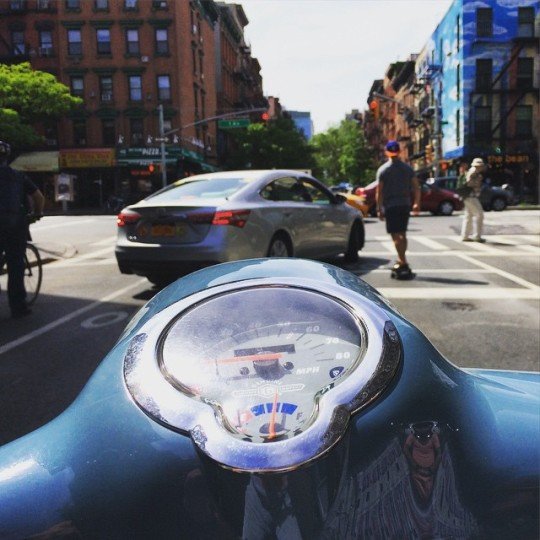
For my last day in New York, my close friend and I rented scooters and rode all around Manhattan and Brooklyn. It was a great way to cover a lot of ground, but also a great way to still absorb the city. It’s harder to do the latter in a car and I never have any desire to drive in New York.
Because the great thing about New York is that as a pedestrian you feel like you control the streets. When you’re waiting at a crosswalk, you’re never actually waiting. You walk off the sidewalk and onto the street so that you can assert yourself in front of the cars and wait for an opening. This serves to narrow the portion of road that the cars can actually drive on and reminds the drivers who is boss.
At the same time, there are many instances throughout the city where New York has purposefully reallocated the space dedicated to pedestrians (and cyclists) and the space dedicated to cars. They’ve created new public spaces, widened the areas where people can walk, and seemingly blanketed the city with bike lanes. And that makes a lot of sense given that in many (most?) areas of the city, pedestrians greatly outnumber cars.
So does that mean New York is at war with the car? (I’d be curious to know – in the comment section below – if those kinds of discussions take place in the city.)
I suppose you could spin it that way. But New York also does things for cars. While riding around on the scooter today, I was so impressed by how well timed the streetlights were along the avenues. It made it incredibly easy to go downtown or uptown. In Toronto, I often feel like we time our lights to make driving as slow as possible.
But make no mistake; New York is not a driving city.
New York is about walking, biking, taking transit, and hailing cabs. There is a reason they have the highest transit ridership in the US. The city is built for it. And unless driverless cars and ride sharing completely changes the equation, I will continue to believe that transit is the most efficient backbone for any big city.
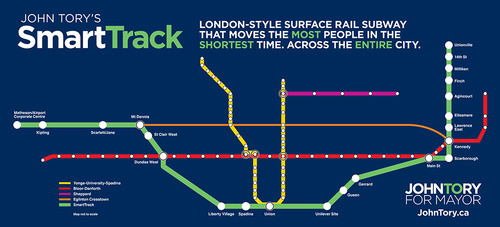
Yesterday Toronto mayoral candidate, John Tory, proposed a transit line called SmartTrack. It’s part of his One Toronto transit plan. If you’re interested in watching the full 30 minute announcement, click here.
As somebody who came out of the gate as a strong proponent of the “Yonge Relief Subway Line” (and as somebody I immediately supported for that reason), this proposal first hit me yesterday as a disappointment. Not because I don’t think we need a regional express rail network in the region (we do), but because I feel that he is backing away from that initial commitment and depriving the core of the transit infrastructure it needs.
As soon as I found out about the plan, I immediately emailed one of my friends at Metrolinx. I told him I thought it was an “epic fail”. He pushed back and asked me to consider the merits of Tory’s plan. After having slept on it (and calmed down), I’m now prepared to talk about both the benefits of SmartTrack and why I was disappointed.
SmartTrack is basically a regional rail plan, intended to move people from the outer and inner suburbs to and from downtown using an integrated fare system. That is, riders will not have to pay a separate fare to transfer from subway to SmartTrack. 90% of the track needed for the plan is already existing, which means it will be cheaper and quicker to build compared to the full relief subway line. It will also bring employment centers such as Airport Corporate Centre in Mississauga into the transit network. For these reasons, the SmartTrack plan would certainly be beneficial for the region.
But, there’s a densities mismatch.
If you look at the number of stops proposed in Scarborough and Markham, and compare it to the number of new stations proposed for downtown (1 – Spadina station) and the downtown shoulder neighborhoods (2 – Liberty Village and the Unilever site), the plan starts to look lopsided. SmartTrack would help residents of downtown get out to the suburbs, but it would do little to help them move in and around the core.
If you look at the way Toronto is intensifying on a map, it looks like an upside down letter T. Density now hugs the waterfront and then follows our subway lines up north. I believe that the SmartTrack plan would help to relieve the pressures on those subway lines, but I don’t think it adequately addresses the bar of the T that now runs parallel to the lake.
So while I do think that the Toronto region would be well served by regional express rail, I don’t think we can forget about the central part of the city. This shift in focus may have something to do with where Tory believes his voter base now sits, but let’s not forget that there’s a strong correlation between population density and transit ridership levels.
Now, let’s hear from you. What do you think of Tory’s One Toronto plan and SmartTrack proposal?