Daily insights for city builders, delivered every morning at 6 AM ET. I’m Brandon Donnelly — a Toronto-based real estate developer and founder of Globizen. I’ve been writing here since 2013.

Tag: transit oriented

  • Too much low-rise — Theresa O’Donnell in conversation with Larry Beasley

    I attended the above talk last night over Zoom. (Shoutout to Michael Mortensen for inviting Slate’s development team and for helping to moderate the Q&A.) The talk was a conversation between Larry Beasley (former Director of Planning for the City of Vancouver) and Theresa O’Donnell (the newly appointed Director of Planning for the City of Vancouver). Prior to this, Theresa was the director of planning for cities such as Las Vegas, Nevada, and Arlington, Texas.

    I’d like to point out two comments that she made last night that I found interesting.

    The first is that community meetings over Zoom actually aren’t all that bad. And the reason that they’re not all that bad is that they tend to draw out larger crowds (they are easier to attend), and so the feedback on development applications tends to be a bit more inclusive / representative. I agree with this overall view and I’ve been arguing for years (here on the blog) that the typical approach to community engagement is pretty much broken. The opinions become lopsided when you erect too many barriers to participation.

    The second point has to do with the amount of land in Vancouver (and other North American cities) that is dedicated to low-rise housing. It’s too much and it’s going to need to be addressed in order to increase overall housing supply and to chip away at the housing affordability problem. This won’t be news to this audience, but it’s interesting to see how widespread this belief has become. Of course, the big questions remain: How gentle should gentle density be? How much intensification should these neighborhoods see?

    I also appreciated her comment that it’s pure lunacy (my words, not hers) to have higher order transit lines running through mostly low-rise neighborhoods. We need much higher densities to sustainably support these kinds of investments in infrastructure. For us Torontonians, a good example would be (most of) the underdeveloped Bloor-Danforth subway line, though there are other culprits.

    Welcome Theresa.
  • One hour drive

    I’m taking next week off so that I can respond to emails from various places in Ontario and Quebec instead of from my desk. The out of office messages really fly at this time of year, so it’s usually a pretty good time to try for a recharge.

    Because of that, this post feels appropriate. 

    Sahil Chinoy of the Washington Post recently looked at anonymous cell phone and vehicle data (from Here Technologies) to see how far you could drive in one hour if you were trying to escape the downtown of various U.S. cities on a Friday afternoon in the summer.

    This exercise was done for 3 departure times on July 28, 2017: 4pm, 7pm and 10pm. The mappings all leverage 3 years of historical speed data.

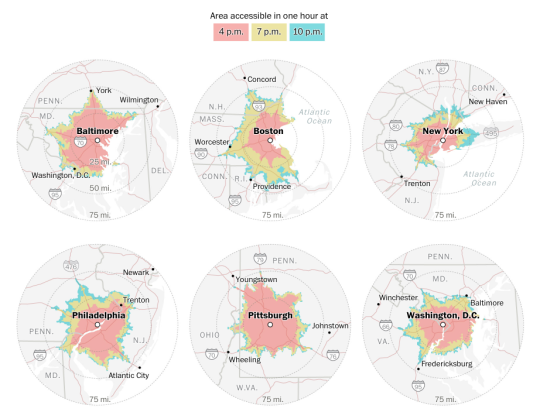
    Here is a first set of maps showing a few cities in the northeast and in the mid-atlantic. Every city is shown at the same scale so that they can be easily compared.

    image

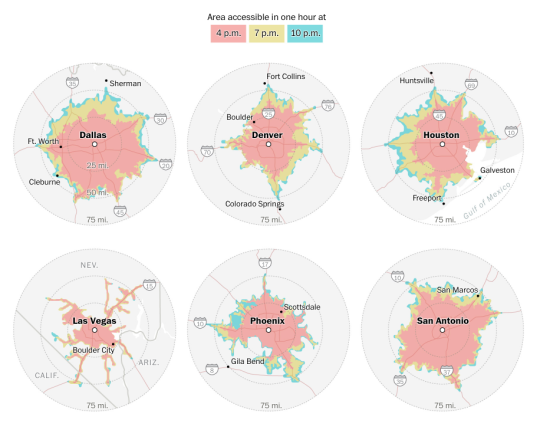
    And here is a second set of maps showing a few, more car-oriented, cities.

    image

    Not surprisingly, older transit-oriented cities like New York don’t do well in this contest. No matter what time you leave, it’s hard to make it past 30 miles. Whereas in the case of Vegas, it doesn’t really matter what time you leave. You should be able to clear 50 miles.

    That’s the other interesting thing to note about these maps – the spread between distances at the various times.

    I’m sharing these because I’m a sucker for diagrams, but I don’t think they tell the whole story. The modal splits and the population and employment densities are all very different across these cities. New York’s core competency is in moving lots of people in trains, not in cars.

    Although, perhaps the ironic thing about these diagrams is that a tighter drive radius might actually say something about how efficiently land is being used.