Daily insights for city builders, delivered every morning at 6 AM ET. I’m Brandon Donnelly — a Toronto-based real estate developer and founder of Globizen. I’ve been writing here since 2013.

Tag: transit oriented development

  • Urbanizing the suburbs

    Commuter rail has typically functioned as a way to bring people from the suburbs into downtown for employment, and sometimes recreation. That has typically translated into good inbound service in the mornings, good outbound service in the evenings, and mediocre service the rest of the time. It has also historically meant lots of subsidized surface parking. Free parking was (and still is) often thought of as the key to putting bums in seats and increasing ridership.

    Here in the Toronto region, this service is provided by GO Transit, which, since 2009, has been owned by Metrolinx. But as one of the fastest growing regions in North America, this kind of service and thinking has become increasingly antiquated. That’s why Metrolinx and the Government of Ontario are working to profoundly change the economic geography of this region by both electrifying the lines and implementing 15 min, all-day two-way service. 

    This may seem like an incremental improvement, but it is not. It is a significant change that will transform the service from commuter rail to regional express rail. Of course, this now means that it is time to rethink the land use policies and built form that surround these key transit nodes. One of the places where this is happening today is at the Clarkson GO Station. The City of Mississauga is in the midst of a planning study that will ultimately guide future development around the station. 

    I think this one of the most important shifts taking place right now in this region and elsewhere. It is the maturation of our suburbs and it is going to result in more walkable and vibrant urban places across our cities. So if you have a few minutes, I would encourage you to complete this survey that the City of Mississauga recently put out. The results will help to guide their Clarkson Transit Station Area Study. 

    I also think think it is worth completing the survey even if you aren’t local to the area. How to urbanize the suburbs is a universal problem.

  • Microsoft Canada moving to CIBC Square

    image

    Today, Microsoft announced that it will be moving its Canadian headquarters from Mississauga to the new CIBC Square development that is currently under construction in downtown Toronto (and rendered above). 

    According to RENX, Microsoft will occupy 132,000 square feet across 4 floors in the first tower. Occupancy is scheduled for September 2020.

    I love this project. The design architect is WilkinsonEyre. And there’s going to be an elevated one-acre park spanning the rail corridor between the project’s two towers.

    But it’s also noteworthy because it is an example of a major suburban tenant deciding to relocate to a transit-oriented urban environment. (I have a post on this somewhere.) 

    Image: WilkinsonEyre

  • RioCan REIT announces new residential group

    On Monday, RioCan REIT announced its new residential brand: RioCan Living. This is the group that will now be responsible for redeveloping the 43 properties within their portfolio that they have identified as having intensification potential. Here’s how they are describing the new brand: “RioCan Living delivers best in class purpose-built rental units and condos along Canada’s most prominent public transit lines.”

    It has been interesting watching RioCan over the last 6 months. In the fall they announced that they would be selling off somewhere around $1.5 billion of their portfolio to rebalance toward Canada’s six largest markets, and in particular the Toronto market. And with this recent unveiling it is clear that they are doubling down on transit-oriented mixed-use communities as a way to future-proof their retail portfolio against disruption.

    Major markets. High-density. Transit-oriented. This shouldn’t surprise any of you. Here is a link to their latest investor presentation in case you’re curious.

  • Los Angeles Councilman says upzoning near transit is the worst idea he’s ever heard

    Earlier this month I wrote about California Senator Scott Wiener’s bill to increase housing supply and mandate greater land-use intensities adjacent to transit. Here is that post.

    Judging by the comments, many of you seemed to think this was a fairly sensible proposal. I know I certainly did. Senator Wiener called it a housing-first agenda, as opposed to a housing-last agenda.

    So I thought it would be interesting to share how some people have responded to the proposal. 

    Los Angeles City Councilman Paul Koretz called it both “devastating” and “the worst idea [he’s] ever heard.” He went on to tell the LA Times that, within 10 years, people should expect their neighborhoods to be transformed into Dubai. 

    His conclusion: “I don’t think people want to see significant rezoning around single-family neighborhoods whether they’re near transit or not.”

    I don’t agree with his first set of remarks, but I agree with his second one. And that, of course, is the challenge. If you own a single-family home down the street from transit, what great incentive do you have to support intensification?

    Paul is the messenger.

  • California State Senator wants to mandate denser and taller zoning near transit

    California State Senator, Scott Wiener, introduced 3 new bills at the beginning of this year intended to address the statewide housing shortage and continue the pivot from a housing-last agenda to a housing-first agenda.

    Here is a summary of the 3 bills:

    These three bills (1) mandate denser and taller zoning near transit; (2) create a more data-driven and less political Regional Housing Needs Assessment process (RHNA provides local communities with numerical housing goals) and require communities to address past RHNA shortfalls; and (3) make it easier to build farmworker housing while maintaining strong worker protections.

    And here is a bit more information about the first one:

    SB 827 creates density and height zoning minimums near transit. Under SB 827, parcels within a half-mile of high-connectivity transit hub — like BART, Muni, Caltrain, and LA Metro stations — will be required to have no density maximums (such as single family home mandates), no parking minimums, and a minimum height limit of between 45 and 85 feet, depending on various factors, such as whether the parcel is on a larger corridor and whether it is immediately adjacent to the station. A local ordinance can increase that height but not go below it. SB 827 allows for many more smaller apartment buildings, described as the “missing middle” between high-rise steel construction and single family homes.

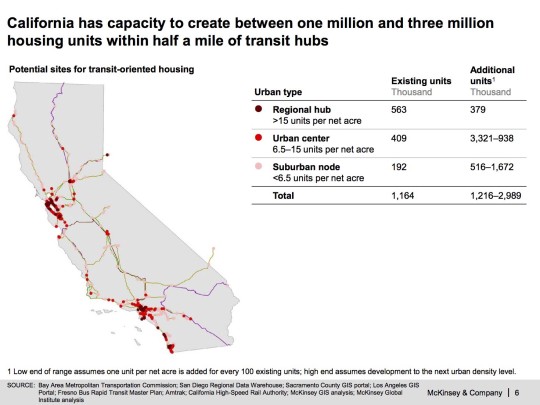
    The belief is that transit-oriented sites in the state of California have the potential to accommodate up to 3 million additional housing units.

    Fewer barriers to creating new housing. More data. And less politics. You can read more about Wiener’s 2018 housing package over on Medium.

  • 11th Annual Land & Development Conference

    Today I spent the day at the 11th Annual Land & Development Conference here in Toronto. I found it particularly good this year, but it’s now late, I’m tired, and I want to go watch game 6 of the NBA finals. So I think this is going to be a fairly short post.

    Here’s a summary of some of my key takeaways from the day (a lot of it is Toronto-centric):

    • Increasingly, the commercial and residential sides of the real estate development business are converging. And it’s being largely driven by the focus on urban intensification and mixed-use.
    • This is leading to an “institutionalization” of the residential side, which has historically been the domain of smaller private/local companies and rich families.
    • Merger is creating complexity around asset valuations: Is it about the income (cap rates) and/or the future development potential?
    • Low rise house prices in Toronto continue to skyrocket. Supply is highly constrained. This has been the story for a number of years now.
    • High rise condo prices in Toronto continue to be more or less flat (modest increase). The industry is going to need to figure out how to work with and compliment the current surge in rental apartment development. There is an element of competition between the two asset classes.
    • According the RealNet’s new home price index, the spread between low-rise and high-rise housing in the Greater Toronto Area widened to $326,659 as of this past April (2015).
    • Rental Apartment Case Studies: Motion on Bay by Concert Properties (Bay and Dundas) was underwrote at $2.60-2.80 psf rents back in 2009. Rents are now in the $3 range. The Heathview by Morguard (Bathurst & St Clair) had $2.80-2.90 psf rents in its pro forma. It achieved and beat these numbers.
    • There’s a flood of Asian money coming into (1) Vancouver and then into (2) Toronto looking for development projects. There appears to be a lot of impatient and/or dumb capital out there. Challenge remains finding good development sites.

    I will end by saying that I found there to be greater transparency at today’s conference. There was a lot of talk about deal specifics and I don’t remember seeing this much detail at past conferences. 

    Maybe I just wasn’t paying attention closely enough before or maybe the industry is slowly becoming more transparent. I hope it’s the latter.

    If you were there today and I missed something groundbreaking, please share it in the comments below!

  • 8 standards for transit oriented development

    Recently in the comment section of ATC, Lloyd Alter of Treehugger shared a great article talking about the 8 principles of Transit Oriented Development (TOD). “TOD” is one of those buzzwords (or buzz acronyms?) that gets thrown around a lot in city building and real estate circles. But I suspect that most people don’t exactly know what it takes to design and build successful TOD projects and neighborhoods.

    Which is why the Institute for Transportation and Development Policy came up with these 8 standards:

    1. WALK: Develop neighborhoods that promote walking
    2. CYCLE: Prioritize non-motorized transport networks
    3. CONNECT: Create dense networks of streets and paths
    4. TRANSIT: Locate development near high-quality public transport
    5. MIX: Plan for mixed use
    6. DENSIFY: Optimize density and transit capacity
    7. COMPACT: Create regions with short commutes
    8. SHIFT: Increase mobility by regulating parking and road use

    What should be apparent from this list is that the standards are quite clearly stacked against cars. Number 2 is about prioritizing non-motorized transport networks. And number 8 is about regulating parking use and road use. It’s about making a decision who you are planning for and acknowledging that when you do all of the above, you largely eliminate the need for driving.

    If you’re a “war on the car” kind of person, this might offend you. But if you look at the data I shared about a week ago (forgive me, I know the chart is a pain to read), you’ll see that it’s seemingly pretty difficult to design a city that’s equally great for both cars and for people. The cities where people love to walk, cycle, and take transit are precisely the ones where few people drive.

    Image: Flickr

  • Are the suburbs really cheaper?

    image

    Smart Growth America released a report this month called Measuring Sprawl 2014. It’s an update to a report they did back in 2002 and it’s worth a read if you’re into urban planning. You can download it here

    The report looks at 221 metro areas in the US and develops a “sprawl index ranking.” The higher the number, the more compact the metro area. Not surprisingly, New York tops the list with San Francisco coming in second. But more interesting are the correlations they discovered. As you go up their sprawl index ranking (that is, as the cities become more compact), they found the following:

    • People have greater economic opportunity in compact and connected metro areas.
    • People spend less of their household income on the combined cost of housing and transportation in these areas.
    • People have a greater number of transportation options available to them.
    • And people in compact, connected metro areas tend to be safer, healthier and live longer than their peers in more sprawling metro areas.

    If you’re a follower of smart growth, then some of these will sound familiar. But they’re worth repeating and I’d like to focus on the second one for a minute (not to undermine the importance of living longer). Conventional wisdom dictates that as you sprawl out from the center of a city, the cost of housing drops. And indeed, that’s what they found. There’s a correlation between density and housing costs, and more compact cities generally have more expensive housing.

    However, they also found that the percentage of income spent on transportation is much less in compact metros:

    Each 10 percent increase in an index score was associated with a 3.5 percent decrease in transportation costs relative to income. For instance, households in the San Francisco, CA area (index score: 194.3) spend an average of 12.4 percent of their income on transportation. Households in the Tampa, FL metro area (index score: 98.5) spend an average of 21.5 percent of their income on transportation.

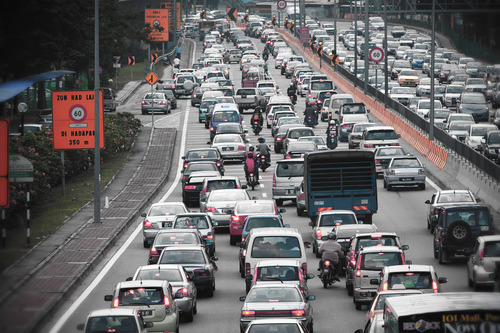
    But here’s where it gets interesting: they found that transportation costs dropped faster than housing costs increased as metro areas became more compact. Meaning if you consider both housing costs and transportation costs in aggregate, it’s actually cheaper to live in more compact areas. From what I can tell, they’re also only considering direct transportation costs and not indirect costs such as the time people waste sitting in traffic. 

    Either way, it’s something to consider the next time you’re thinking about where to live and how much you should be willing to spend on housing. That cheaper suburban home may not be as cheap as it seems.

    Photo by Aythami Perez on 500px

  • Moving people instead of cars

    As of this week, Architect This City is now being syndicated on MobilityLab. Here’s the first post. MobilityLab is a US-based think tank focused on “transportation demand management”, which is just a fancy way of saying that their focus is on optimizing for the movement of people, instead of cars.

    Not every post from ATC will get syndicated on MobilityLab, but hopefully many of the ones focused on mobility will be. But really this post this just to tell you that if you’re interested in transportation, mobility and sustainability, you should check out MobilityLab

    To get you started, here are their top 10 stories from 2013.