Daily insights for city builders, delivered every morning at 6 AM ET. I’m Brandon Donnelly — a Toronto-based real estate developer and founder of Globizen. I’ve been writing here since 2013.

Tag: tragedy

  • Seoul crush

    We have spoken a lot over the years about the benefits of narrow and pedestrian-focused streets. Most recently, I even ran around Europe with a laser distance measuring device to collect a few field samples. Here’s an example from Marseille and here’s an example from Sicily.

    But given all this, I think it is important to recognize that what happened in Seoul over the weekend — a deadly crowd crush that killed over 150 people — is both a horrible tragedy and a result of too many people in a narrow and pedestrian-focused street. So clearly there can be a flip side to what we talk about here. At the time of writing this post, investigations were still ongoing.

    I am not a crowd-control expert, but I have spent time in dense Asian cities during major events and holidays, and never have I felt so claustrophobic. I have lined up for hours to get into subway stations and I have lined up to get into entire city districts — presumably because they were trying to avoid things like what happened this past weekend.

    My heart goes out to all of the people and families that were impacted by this horrific incident.

    🇰🇷 🇨🇦

  • Thoughts on California’s wildfires

    What is happening in California right now is both sad and scary. I woke up to these photos in the New York Times. So I spent the morning reading up on wildfires and what causes them. 

    I am sure many of you are thinking: Is climate change doing this?

    It’s important to note that California is designed to burn. The characteristics that make the state a highly desirable place to live – mild winters and hot and dry summers – also make it a highly flammable place.

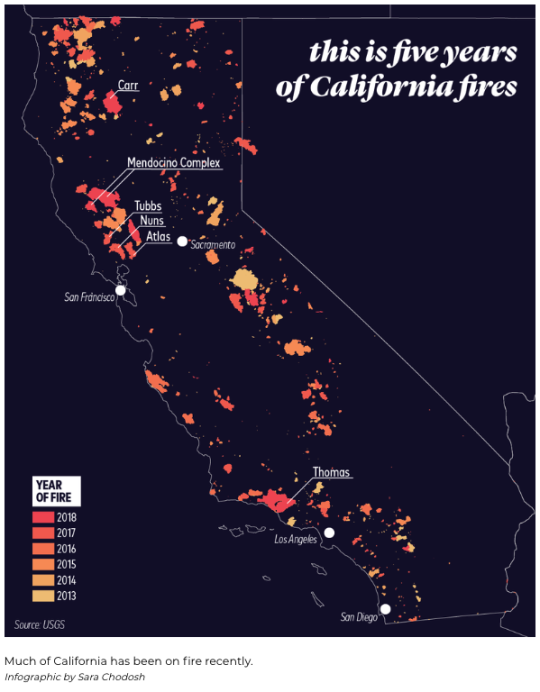
    Below is a map from Popular Science showing how much of California has burned over the last 5 years. Most of California’s hottest fires (13 of the top 20) have occurred since 2000.

    image

    But these naturally occurring fires are actually important for the regeneration of its forests. So one argument is that the current policy of “total fire suppression” is actually partially responsible for this increase in severe wildfires.

    Low-intensity forests aren’t burning like they used to and it is creating more densely packed forests for even larger wildfires. In other words, through our actions we could be exchanging smaller and more frequent fires for bigger and more severe ones.

    The other concern is development. 

    California had a population of about 24 million people in 1980. Today it is closer to 40 million. And much of that growth has occurred outside of existing urban areas (too hard to build). This has meant more people living in suburban and rural areas – adjacent to wildlands.

    Ed Glaeser has repeatedly argued that the best way to respect nature is to actually stay as far away from it as possible. Humans are a destructive species. Living in a dense city is good for the planet.

    Now let’s address the climate change issue.

    Daniel Swain, who is a climate scientist and author of the Weather West blog, published this popular thread on Twitter about a day ago. At the time of writing this post, it had been retweeted and liked over 10,000 times.

    From his perspective as a climate scientist, this is not all about climate change. That’s the wrong question to ask. It’s more complicated and nuanced than that. But climate does indeed act as a “threat multiplier” to the other factors we’ve already discussed.

    Fire season typically begins and ends with rain. When the fall rainy season starts, the fire season ends. One of the biggest risk factors is a dry fall, particularly after a hot and dry summer (or after multiple hot and dry summers, as has been the case in California). 

    Because according to Swain, fall means the start of “offshore wind” season, which can help to stoke these wildfires. 

    Unfortunately, one of the projected outcomes of climate change for California is more precipitation concentrated in the “winter” months, at the expense of precipitation in the shoulder seasons (spring and fall). So that means a longer fire season.

    Swain believes that if Northern California had received close to its typical amount of rain this fall, it is almost certain that this tragedy would have been avoided. 

    That, however, makes me wonder about the relative importance of all the factors we have discussed today.

    For Daniel Swain’s full thread, click here.

  • The tragedy of the commons

    https://500px.com/embed.js

    In 1968, Garrett Hardin wrote an article where he coined the term: the tragedy of the commons. Hardin was an American ecologist who was obsessed and concerned with the prospect of human overpopulation.

    In his article, the term tragedy of the commons was used to describe a situation where individuals – all acting independently and in their own self-interest – actually end up behaving in a way that is detrimental to the larger group and that negatively impacts some sort of common resource.

    Just in case, here’s another definition via Investopedia:

    An economic problem in which every individual tries to reap the greatest benefit from a given resource. As the demand for the resource overwhelms the supply, every individual who consumes an additional unit directly harms others who can no longer enjoy the benefits. Generally, the resource of interest is easily available to all individuals.

    So what would be an example of a tragedy of the commons?

    You may not have thought of it in these terms, but I bet you that everybody reading this blog has experienced one.

    I will give you two examples.

    1. The first is that of electricity consumption. 

    In most condominiums, there are two types of ways that electricity gets billed and paid. Either the whole building gets one bill (master metering) or each individual resident gets a bill (submetering). 

    In the case of master mastering, each resident’s consumption isn’t tracked and so nobody knows who is consuming what. But in the case of submetering, each individual resident only pays for the electricity that they use.

    Not surprisingly, the data shows that submetering can cut electricity consumption by 10 to 30%. That’s because it creates a 1:1 relationship between usage and cost. There’s now a strong incentive to conserve.

    With master metering, there isn’t a 1:1 relationship between usage and cost. The additional burden/cost of consumption actually gets shared by everyone else in the building. And since each individual is looking to maximize their own benefit, they lose the incentive to conserve. As a whole, this makes the entire group worse off.

    2. The second example is that of congestion on public, un-tolled roads.

    In most cities, public roads are a resource that is “easily available to all individuals” (to use Investopedia’s terminology). They are basically free. The marginal cost of driving another kilometer to work on a road is basically nothing (other than a bit of gas and some time).

    What this does is create a situation where individuals – in their pursuit of maximum individual benefit – start to overload the road. Everybody just wants to get where they need to go and there’s no incentive to conserve the resource (i.e. the road). Once again, the result is that the entire group becomes worse off.

    That’s why building more road rarely/never works. You’re simply increasing a resource that is easily available to all individuals. What we should instead be doing is looking at submetering our roads (i.e. pricing our roads). It’s been proven time and time again to reduce road congestion basically overnight.

    I had never heard of the term tragedy of the commons before today, but I like it a lot. So the next time you’re stuck somewhere in traffic, you can now scream to yourself: What a tragedy of the commons!