Daily insights for city builders, delivered every morning at 6 AM ET. I’m Brandon Donnelly — a Toronto-based real estate developer and founder of Globizen. I’ve been writing here since 2013.
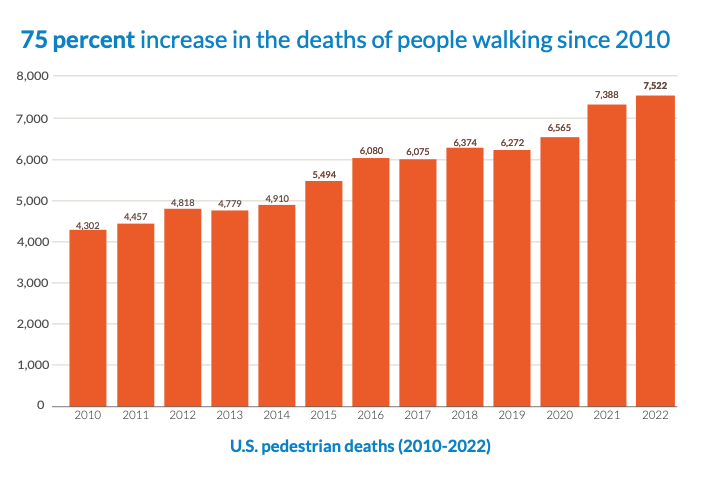
This is a shocking report from Smart Growth America on traffic fatalities in the US. Since 2010, the number of pedestrians struck and killed has increased by almost 75%. As of 2022, this number sat at just over 7,500 fatalities per year:
Here are also the top 20 most deadly metro areas:
Not surprisingly, these hot spots tend to be in the south, as opposed to in older northern cities. And that’s because these tend to be car-oriented places. As the name of the report suggests, they are “dangerous by design.” If you optimize for cars, it means you’re making trade-offs in other places.
The US Department of Transportation has just finalized a new vehicle safety standard that will require all light-duty vehicles to be equipped with a more advanced form of automatic emergency braking (AEB) by 2029. (Light-duty vehicle = pretty much all passenger vehicles, including SUVs and trucks.)
Now, most light-duty vehicles on the road today already have some form of emergency braking. What’s noteworthy about this ruling is that it requires a more robust version. Some might say one that works. Specifically, it will need to work at much higher speeds and at night.
Most of the AEB systems in operation today don’t really work at night — basically at all — and many have shown to be ineffective when it comes to stopping for humans.
This new standard will require vehicles to automatically brake at up to 90 mph when a possible collision with a car is detected and up to 45 mph when a possible collision with a pedestrian is detected.
This seems like a very good thing, especially given the persistent problem we are having with cars killing too many people. But how do we do it?
From what I have read, this new standard will be pretty challenging to meet without the use of long-range LiDAR, especially since night vision is a requirement. I find this interesting because, even though autonomy is taking a lot longer to arrive than most people anticipated, there’s still meaningful progress being made.
Here’s some recent data, via CityLab, suggesting that Americans are walking less and driving less, but killing more people when they do drive around. (The report is based on data from 2019 to 2022.)
My first reaction to these high-level findings is that they seem to make sense. This time period was the pandemic. And people were locked away at home (though I used to take some seriously long walks around downtown during this dark time).
So I don’t know, I’m not sure we can conclude that walking less is truly a structural phenomenon. Similarly, I’m not sure that we can immediately conclude that cars are becoming increasingly more dangerous.
According to Wikipedia, deaths per capita, deaths per billion vehicle miles traveled, and total deaths, have all been generally declining in the US since the 1960s.
However, I do wonder if there’s some sort of correlation between people walking less and car-related fatalities. The most dangerous streets, in my mind, are often the ones that don’t have a lot of pedestrians.
That’s why, broadly speaking, it feels safer walking around Manhattan than it does Los Angeles. So maybe less people walking is enough to trigger an increase in pedestrian fatalities.
We’ve talked about this before. If you live in New York City, you’re probably about a third as likely to die from a transportation-related accident as compared to the average American. And if you live in Paris, you’re probably about a third as likely to die from a transportation-related accident as compared to the average New Yorker.
These stats might feel a bit intuitive to you. Both New York and Paris are big and dense metros with high public transit ridership. And that usually translates into less car accidents. As for the divide between these two cities, Paris is in Europe. It’s old. Most of its streets were built before the car had been invented. And all of these things are generally good for pedestrians. Makes sense.
But David Zipper asked a good question today: So what’s going on with Canada? Canada is not in Europe (though some might argue that it sits culturally somewhere between the US and Europe). It’s not that old. And it generally has a car-oriented landscape just like the US. So why is it that in 2020, Americans were 2.5x more likely than Canadians to die in a car crash? The trend lines are also diverging between these two countries. Between 2010 to 2020, US road deaths increased 19% on a per capita basis, whereas Canada’s rate declined by about the same rate, according to David.
Ultimately, we are probably going to need Malcolm Gladwell to write a book about this so that we can really figure out what’s going on. But in the interim, David does propose a few possible explanations ranging from Canadians buying slightly smaller vehicles to Canadians being slightly more law-abiding than Americans and so less likely to run people over. But one of the most persuasive explanations for me is that maybe our urban landscapes aren’t actually the same.
More than a third of Canadians live in our three biggest cities: Toronto, Montreal, and Vancouver. And this number would be even higher if you looked at the full urban catchment areas of each. Either way, this is a significantly higher concentration than in the US, where about 13% of Americans live in the metro areas of New York City, Los Angeles, and Chicago.
Part of this difference is because the US has almost 9x more people and has many more big cities to choose from. But it doesn’t change the fact that, despite our reputed love for things like forests and beavers, Canadians are actually quite urban. And as we have discovered, that’s a good thing for pedestrians.
In the first decade of the 20th century there were no stop signs, warning signs, traffic lights, traffic cops, driver’s education, lane lines, street lighting, brake lights, driver’s licenses or posted speed limits. Our current method of making a left turn was not known, and drinking-and-driving was not considered a serious crime.
There was little understanding of speed. A driver training bulletin called “Sportsmanlike Driving” had to explain velocity and centrifugal force and why when drivers took corners at high speed their cars skidded or sometimes “turned turtle” (flipped over).
The transition from horses and buggies to horseless carriages, as they were first called, was one of the most impactful things to ever happen to our cities. Cars were more dangerous. Some, or perhaps many, were opposed to them initially (and didn’t see the need to move away from horse-drawn wagons). And we had to invent a myriad of traffic systems in order to try and make them remotely safe for people.
One could easily argue that we are still grappling with these same safety problems. See yesterday’s post about traffic-related fatalities. But is the answer to have never invented horseless carriages or is the answer that we need to be much better about managing and controlling them within our built environments and around humans? I would say it’s the latter.
And I would also argue that there are parallels here with how some people feel about electric scooters today. What is clear is that both urban clutter and safety are valid concerns. When electric scooters first started becoming popular, they were being left all over the place. But I think that has been largely solved through geofencing and by forcing people to take a photo of their parked scooter at the end of their rides.
Progress is also happening around safety. E-scooter company Superpedestrian, for example, has designed larger and more stable scooters, and also has something called Pedestrian Defence, which uses fancy AI to block people from riding on sidewalks, from going the wrong way on a one-way street, and from generally doing dumb and unsafe things.
Does this solve all of our problems? I don’t know. But I think innovation in the e-scooter space is a positive thing and I hope that cities like Toronto will one day become more openminded around these sorts of micro-mobility solutions. It’s not like our horseless carriages have an immaculate safety record.