
Daily insights for city builders, delivered every morning at 6 AM ET. I’m Brandon Donnelly — a Toronto-based real estate developer and founder of Globizen. I’ve been writing here since 2013.

Tag: toyota

  • More drivers, more supply

    This week, Lyft announced that it is going to be selling its autonomous vehicle division to Toyota for some $550 million. (Apparently $200 million of this will be paid upfront, with the remaining $350 million paid out over a five year period.) This is notable because Uber did the exact same thing last year when it sold its autonomous vehicle business to Aurora (which happens to be working with Toyota), and because the reasons for selling seem clear: getting to full autonomy is going to cost a bunch more money and both Uber and Lyft are determined to reach profitability sooner rather than later.

    The other thing that you might be able to glean from these announcements is that neither company seemingly feels like they need to fully own/control the autonomous piece. Presumably the thinking is that someone else can spend the money on developing full autonomy and they’ll just stick to building out their ride-hailing network. Once we have autonomous taxis, they’ll need a network to run on anyway, right? I guess. But wouldn’t this dramatically undermine the network effects of Uber and Lyft?

    If you go back to Uber’s S-1, there was a diagram that explained Uber’s “liquidity network effect.” See above. It starts with more drivers and more supply (1), because more cars driving around means that wait times and fares are lower (2) and so more people are likely to use Uber (3). Network size matters. But if you no longer have drivers — only autonomous vehicles — isn’t it relatively easy to add more supply to any network? I suppose this partially depends on how the ownership structure will end up working for these autonomous taxis. Still, I wonder about the barriers to entry under this scenario.
  • The world’s first programmable city — Woven City

    Last week was CES in Las Vegas. Some or many of you were probably there. One of the things that was announced at the show was a project by Bjarke Ingels Group for Toyota called the Woven City. Situated at the base of Mount Fuji in Japan, the development sits on a 70 hectare site and will eventually house some 2,000 people.

    The objective is for it to act as a living laboratory for a number of new city building initiatives, ranging from autonomy and mobility as a service to multi-generational living and hydrogen-powered infrastructure. Woven City is intended to house not only residents, but also researchers who can test out and learn from these new ideas.

    Below is a short video from Dezeen. It’s entirely visual. No words. There’s also an official website, but not much is up there yet. Hopefully there will be more soon. Construction is set to start next year (2021) and it’ll be BIG’s first project in Japan.

  • What cars can tell you about a neighborhood

    This is an interesting study from a team of AI researchers at Stanford. What they did was use car images taken directly from Google Street View (so images of cars parked on-street) to predict income levels, racial makeup, educational attainment, and voting patterns at the zip code and precinct level.

    Admittedly, it’s not a perfect survey, but when they compared their findings to actual or previously collected data (such as from the American Community Survey), it turns out that their study was actually remarkably accurate. Google Street View allowed them to survey 22 million cars, or about 8% of all cars in the US.

    Here are some of the things they found:

    –  Toyota and Honda vehicles are strongly associated with Asian neighborhoods.

    – Buick, Oldsmobile, and Chrysler vehicles are strongly associated with black neighborhoods.

    – Pickup trucks, Volkswagens and Aston Martins are strongly associated with white neighborhoods.

    Interestingly enough, the ratio of pickup trucks to sedans, alone, is a pretty reliable indicator of voting patterns. If a neighborhood has more pickup trucks than sedans, there’s an 82% chance it voted Republican in the last election.

    Perhaps this isn’t all that surprising given that car purchases are highly symbolic. But given that the American Community Survey costs $250 million a year to administer, this study is a good preview of what cheaper and more realtime data collection might look like.

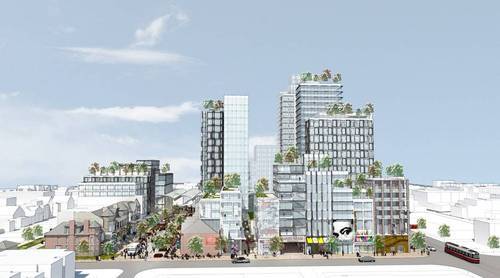
  • Westbank unveils #BloorAndBathurst before filing development application

    image

    Last night Westbank went public with their first design for the southwest corner of Bloor and Bathurst in Toronto (the Honest Ed’s site).

    There’s no name for the project yet and they haven’t even submitted a development application to the city, but I can tell you that there was a lot of excitement in the room last night. Over 500 people showed up at the Park Hyatt. And I think it only partially had to do with the fact that they were offering up free grilled cheese sandwiches.

    If you’d like to get a feel for last night’s open house, check out #BloorAndBathurst on Twitter. And if you’d like to learn more about the project, check out Alex Bozikovic’s piece in the Globe and Mail. It’s pretty exciting stuff. I’m not going to repeat all of the project details here because Alex has already eloquently done that. All of the developer’s information boards can also be found online, here.

    What I instead want to talk about is Westbank’s community engagement process. In Toronto, it’s quite rare to see this level of public consultation pre-application. And that’s because the city only requires it once a development application has been formally made.

    But I’m of the opinion that the status quo isn’t actually the optimal strategy for city building. In fact, I’ve argued before that public consultation is broken.

    And the reason I think that is because the typical process doesn’t allow for a critical mass of community feedback, both early on and throughout the process (think lean startup methodologies). In-person public meetings are too much friction for a lot people and getting feedback only once an application has been submitted means that a lot of work has already been done, which is the opposite of lean.

    In the case of #BloorAndBathurst, last night was part of an engagement process that began last year.

    Now, part of the reason that many developers don’t adopt this model is because of fear. There’s a belief that many communities just don’t like change, period. But is that really the public opinion? Or do we simply not have enough data and enough feedback loops built into the city building process?

    Time will tell how this approach works out for Westbank, but I have a pretty good feeling that they’ll do just fine.

    Image (Sketchup model + watercolor): Westbank via Globe and Mail

  • New urban planning buzzword: Lean Urbanism

    The term “lean” is well known in technology and startup circles. Thanks to people like Eric Ries and Steve Blank, it’s become all about starting up lean and not investing a lot of time and money before you’ve really tested your business assumptions in the marketplace.

    But keeping it lean isn’t unique to just tech companies. Its origins are actually in manufacturing—mostly from Toyota’s celebrated production system. Lately though, it has been starting to make its way into cities with a new buzzword called “Lean Urbanism.”

    Championed by New Urbanist Andres Duany—who is actually in the midst of writing a book on the topic—the methodology seems to be gaining awareness in cities spanning from Detroit to San Diego. Here’s an article that a friend of mine (currently working in San Diego) sent me yesterday on the topic.

    At first, the article gave me the impression that the movement was all about building as-of-right. That is, build what’s allowed and stop asking for special discretionary permissions, which is often how real estate development works.

    But then I started to do a bit more research.

    And it turns out that Lean Urbanism is about something much deeper. It’s about empowering incremental urban growth:

    “Lean Urbanism…focuses on revitalizing cities by finding ways for people to participate in community-building — specifically, by enabling everyday people to get things done.”

    What Lean Urbanism hopes to do is create tools and techniques that will help local communities avoid and workaround overly onerous regulations. It’s about removing the barriers to entry—whether that be a business permit or a building permit—so that more people can participate in shaping their own community.

    What I like about it is that it’s building upon the renewal cycle that has traditionally always powered cities. It hopes to empower the proverbial artist that moves into a neighborhood like New York’s Soho and magically makes it cool—then spurring an onslaught of investment.

    And so while the buzzword might be new, it’s a renewal cycle we’ve seen before. But, if it works, maybe not with so much frequency.