Daily insights for city builders, delivered every morning at 6 AM ET. I’m Brandon Donnelly — a Toronto-based real estate developer and founder of Globizen. I’ve been writing here since 2013.

Tag: toronto

  • Project Profile: Cabin at 45 Dovercourt

    image

    Last month,
    Curated Properties submitted a
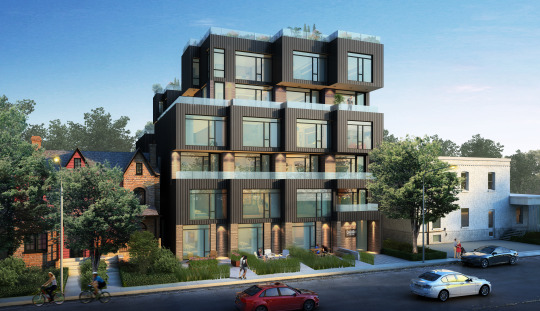
    rezoning and site plan application for a 6-storey, 25-unit building at 45
    Dovercourt Road in Toronto. The project is known to the market as Cabin and you
    can register for it now.

    The project
    immediately caught my attention (because of its design, because of its
    branding, and because I like the work of Curated), so I decided to dig in
    further and get a copy of their architectural drawings. Development
    applications and their supporting documents are all public. Anyone can request
    a copy. But the city isn’t great at making this known.

    Since I’m excited
    to see more of these small scale urban infill projects in the city, today I
    thought I would highlight some of its key features and some of the things that
    are being proposed in order to make a project like this work.

    The Homes

    First of
    all, 100% of the suites are 2-storey. 76% of the suites are also 2 bedroom or
    larger.

    The result
    is that the project is essentially a series of townhomes stacked on top of each
    other. I suspect that this will appeal to more end-users as opposed to
    investors. Hopefully, it will also attract more families to the area.

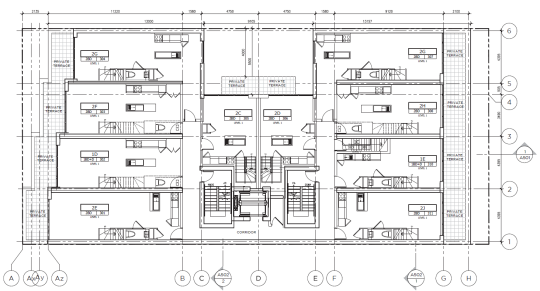
    Here’s the
    third floor plan:
    image

    You
    probably can’t see it, but all of the suites are marked as “Level 1”, obviously
    indicating that there’s more than one level.

    Also worth
    mentioning is the notch or cut out on the north side of the building. This is
    what makes the 2 suites in the middle of the floor plate possible. In order for
    them to have windows, they need to be setback from the (north) property line.
    It also means those suites get terraces.

    The Parking

    Turning to
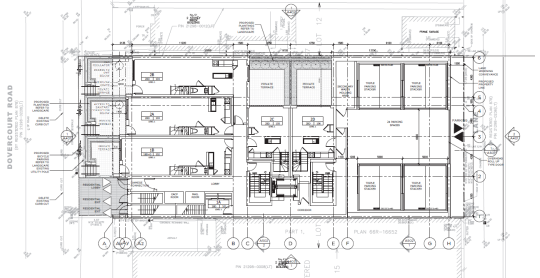
    the ground floor plan, it’s interesting to see that they are proposing 8 triple
    car stackers that will be accessible off the rear laneway (right side on the plan below). That equates to 24 parking spaces in the building (8 bays x 3
    cars per stacker).
    image

    On small
    urban sites like this one, it can be very difficult to accommodate parking. So
    it’s inevitable that we will see more parking stackers in the city and a continual
    reduction in parking minimums.

    The Construction

    Finally, I
    have been told that this project is expected to be framed in wood, as opposed
    to reinforced concrete, which is more typical of condominiums in Toronto.

    As of the
    beginning of this year (2015), the
    Ontario Building Code was modified to allow wood-frame buildings up to 6
    storeys
    . Before this change, the highest you could go was 4 storeys.

    This change
    was done with the intent of reducing construction costs so that it becomes more
    feasible to develop smaller infill sites such as this one. So expect to see
    more of this.

    I know that
    a lot of people would like to remain in the city even when they start having
    children. But it’s becoming increasingly difficult to find affordable low-rise
    homes. And not everyone wants to live in a high-rise tower. 

    That’s why I think
    we will see more, not less, low-rise and mid-rise infill projects like Cabin.
    If you’re interested in this topic, also check out a post I wrote called 3
    stages of intensification
    .

    The rendering at the top of this post is from Curated Properties and the
    drawings are by RAW Design.

  • The taxi cartel

    https://500px.com/embed.js

    Early this morning Peter Cheney of the Globe and Mail published an article called: How Uber is ending the dirty dealings behind Toronto’s cab business.

    And I highly recommend you read it. He’s been investigating this industry for decades.

    Though the article is specific to Toronto, I know that there are middle people and archaic policies governing the taxi industries in many other cities around the world.

    Here it revolves around taxi licenses issued by the city (known as “plates”), which are expensive and almost impossible to get. Last year the average price of a plate was $118,235 (2014).

    The way it works is that people – typically non-drivers – buy/inherit/get these plates and then charge rent on them to drivers who want to use them. The result is a taxi cartel:

    In fact, Toronto’s taxi plate system is anything but free enterprise. Instead, it is based on the artificial restriction of a natural market, and the granting of licences to a fixed number of participants. Even those who paid top dollar for a plate used to enjoy an annual return of more than 12 per cent. And for those who inherited plates, the return was manna from heaven.

    So it shouldn’t come as a surprise that the taxi industry is grouchy about companies like Uber. But the cost structure of the incumbents is going to need to change if they want to stay in business.

    Jeff Bezos of Amazon is famous for saying, “Your margin is my opportunity.” And that’s exactly what is happening here. A bloated legacy cost structure is being quickly supplanted by better/cheaper.

  • Saturday morning bike ride to the Bluffs

    This morning I got up at 7:30am and met a good friend of mine at the St. Lawrence Market for breakfast.

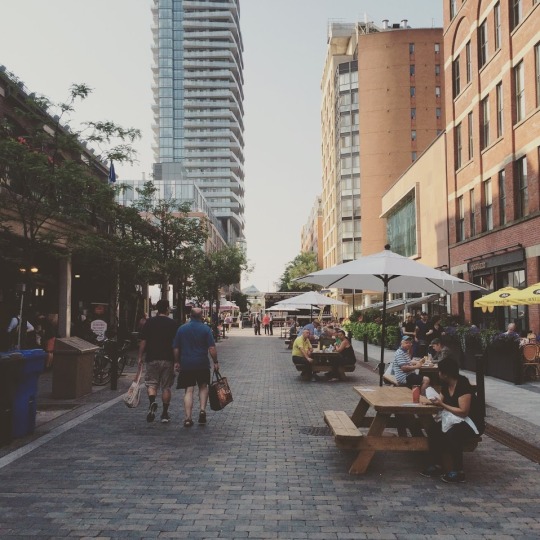
    Market Street is closed to cars today so it’s pedestrian-only. It should be this way all the time. They had a pig roasting on a spit when I walked by and a big stage set up. 

    Below is a photo of what it looks like. Keep in mind that this photo was taken just after 8:00am, which is why it’s not all that busy, yet.

    image

    When Market Street was redone a few years ago, the original vision for the street was for it to be pedestrian-only. But somebody told me that the city didn’t want that. Too bad. It strikes me as a perfect candidate for that.

    After breakfast, we then biked out to the Scarborough Bluffs in the east end of the city. If you click here, you can see the path we took via Strava. It’s only about 15km from downtown. The ride through the Beaches was by far the best stretch. The water was on my right hand side. The pavement was smooth and continuous. And I had George FitzGerald on my headphones for pacing.

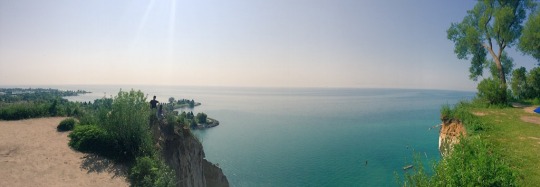
    When we got there, this was the view we were presented with:

    image

    It honestly doesn’t feel like Toronto. The water is turquoise and there’s a beautiful beach at the bottom of the cliffs. It felt like paradise.

    If you’ve never been to the Scarborough Bluffs, do yourself a favor and get out there on a beautiful summer day. It’s the dog days of summer and Toronto is a magical place right now.

  • 10 reasons to visit Toronto right now

    https://500px.com/embed.js

    Next weekend a good friend of mine from architecture school will be visiting Toronto from Philadelphia. And I’m really excited to show him the city. (Next month it’s my turn to go to Philadelphia.)

    He’s a fellow city geek. He hasn’t been to Toronto in a number of years. And I haven’t seen him since our trip to Detroit 2 years ago.

    For those of us living and working in Toronto, there’s a lot to celebrate. Sure the Gardiner Expressway East decision didn’t go as I – as well as many other urbanists, including our Chief City Planner – had hoped. But there’s no shortage of other things to brag about.

    So here are 10 reasons to visit Toronto right now:

    1. We’ve created an entirely new business district south of Union Station called South Core. Now the region’s primary mobility hub is in the middle of the country’s most important business district, as opposed to on the edge of it. It’s a better use of infrastructure.

    2. We now have a dedicated train (the Union Pearson Express) that takes you from the country’s busiest airport directly to downtown in 25 minutes. You’ll find local retailers at the stations and a brand created by the brain behind Monocle Magazine. You can even use a smart card to ride it and our local transit system.

    3. We didn’t shut down Uber. Instead our mayor wants to create new policy that will allow these services to coexist with conventional taxi services. We don’t yet know how this will turn out, but I believe it’s a step in the right direction. It’s Toronto taking a leadership approach to innovation as opposed to trying to stomp it out.

    4. We are about to host the largest sporting event in Canadian history. The 17th Pan American Games will have double the number of athletes competing as the 2010 Winter Olympics in Vancouver.

    5. We created an entire neighborhood from scratch in order to house all of these athletes (Canary District). And I think it’s destined to become one of Toronto’s great neighborhoods. I’m saving my first visit for next weekend, so expect a follow-up post on this.

    6. We are dramatically rethinking this city’s public realm. From the plaza out front of Union Station to the new Queens Quay Boulevard along the waterfront, we are prioritizing people and creating more complete streets. It has given Toronto an entirely new urban feel.

    7. We are slowly starting to embrace our forgotten laneways and alleys through the help of organizations like The Laneway Project. And this is going to eventually lead to a further rethink of our pubic spaces and urban fabric.

    8. We continue to be one of the fastest growing cities in the world (certainly in the developed world). As a result, we are building some really exciting buildings by some of the top architects in the world. This includes everyone from Norman Foster to Frank Gehry.

    9. According to a recent report coming out of the Martin Prosperity Institute, Canada is one of the most creative and globally competitive countries in the world, as well as the most open to “ethnic and religious minorities and gay and lesbian people.”

    10. The ATC community is in the process of identifying a new, quintessentially Toronto food dish. But since we have every type of imaginable cuisine here, we’re struggling to pick just one. When you visit, you can help us identify the best and most Toronto dish.

    So there’s a lot to be excited about. I for one can’t wait for us to host the Pan Am Games, starting tomorrow. It’s a chance to show off this great city. 

    So if you’re also in town next weekend and want to geek out about cities, drop me a line.

  • Vancouver isn’t immune to the urban-suburban divide

    https://500px.com/embed.js

    In the comment section of my post about Vancouver’s transit referendum, a reader suggested I take a look at an article by Peter McMartin called, The real Vancouver emerges (from the ruins of the plebiscite). 

    McMartin’s argument is basically that Vancouverism – the name given to the city’s progressive architecture and planning approach – isn’t as widespread as it might seem. The reality is that Vancouver, much like Toronto and other cities, is divided.

    “Vancouverism might be a reality for two or three neighbourhoods huddling in the downtown, and that greener, more progressive ethos might hold sway in one or two more.

    But Vancouver — and I speak of it in the metro sense — is the sum of its parts, and most of its parts are suburban in their sensibilities, and that includes not just all of the suburbs but most of the neighbourhoods in the City of Vancouver proper.

    They’re resistant to change. They abhor densification. They’re conventional in their sensibilities and they’re highly dependent on the automobile. More importantly, they’re not just dependent on the automobile, they prefer it.”

    Here in Toronto, we know our city is divided. And many people see it as evidence that amalgamating the city in 1998 was a big mistake. The inner suburbs are holding back old Toronto and elitist old Toronto just doesn’t understand the priorities of the inner suburbs.

    But I’m not convinced that amalgamation is to blame.

    Most cities have long histories of amalgamating adjacent towns, villages, and cities, and I suspect that there was opposition all along the way. At what point is amalgamation acceptable and and what point is it problematic?

    The anti-amalgamation camp here in Toronto seems to believe that it would have allowed old Toronto to continue doing what it wants to do and allowed the inner suburbs to do what they want to do.

    But this to me feels parochial.

    Our cities need to think bigger than that. We need to think as cohesive urban regions. And as Vancouver demonstrated this past week, that’s not always easy. But I don’t think the answer is to just think smaller and ignore the people whose views don’t match our own.

    Interestingly enough, what a lot of this comes down to, I think, is built form. 

    Because different kinds of built form will encourage and often mandate different kinds of transportation choices. And how you get around a city will inform a big part of what you value and what you vote for.

    Over time though, I believe that we will see built form start to level out across our city regions through continued intensification. Many people won’t be happy about this change. But it is likely that it will end up creating more cohesive cities. 

    Built form is no small thing.

  • What food is your city famous for?

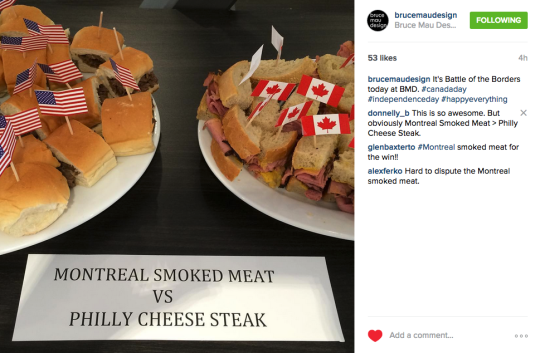
    Yesterday I came across the above Instagram post by Bruce Mau Design, which pitted the Philadelphia Cheese Steak sandwich against the Montreal Smoked Meat sandwich in a “battle of borders.” It was to celebrate both Canada Day and American Independence Day.

    I thought this was an awesome idea, so I tweeted out the photo. Then Daniel Kay Hertz – who is a Senior Fellow at City Observatory and from Chicago – asked me: “Is there a Toronto equivalent?”

    And that got me thinking. 

    Montreal has smoked meat, bagels, and poutine. Philly has the cheese steak. Chicago has deep dish pizza. Quebec City has maple sugar and tourtiere (a kind of meat pie). New Orleans has po’boy sandwiches. Boston has clam chowder. Austin has tacos. Seattle has crab. And the list goes on.

    But what is the quintessentially Toronto dish? Asian fusion food? Peameal bacon sandwiches from the St. Lawrence Market? I really don’t know. So I think we should decide on one right now. Think of it as an exercise in city branding.

    Leave your suggestion in the comments below and we’ll have a vote.

  • Teaming up to fix Toronto’s traffic troubles

    image

    “This will be a game changer and will establish Toronto as a leader in running a truly smart city.”
    – John Tory, Mayor of the City of Toronto

    Yesterday I registered for a hackathon called TrafficJam that’s taking place this October 2 – 4, 2015 here in Toronto. It’s being organized by Evergreen CityWorks and the City of Toronto, with the goal of fixing Toronto’s traffic troubles.

    Tickets are free, but going fast. If you’re interested in this sort of thing, I would encourage you to sign up today. And if you do register or are already registered, drop me on a line so we can connect. I’m excited to see what kind of solutions we’re all able to come up with over the course of a weekend.

    But as I was registering and reading through the website, I couldn’t help but think about some of the traffic problems that we won’t be solving over the hackathon weekend, namely the politicization of transportation planning in this city.

    As an example of that check out a post by transit blogger Steve Munro called, The Vanishing Relevance of SmartTrack. 

    SmartTrack is the transit platform that Mayor John Tory ran on last year. And this post explains why it is unlikely to achieve its pitch promises.

  • Fun Friday: Your ancestry

    People often ask me about “my background”. When I’m feeling cheeky, I usually just say that I’m Canadian or that I was born in Toronto (because that’s what I culturally self-identify with). But that’s not what most people want to hear.

    The short answer I usually give is Eurasian (European + Asian) or Chirish (Chinese + Irish). Although I recently learned that Chirish means something else to people from Chicago.

    But now, thanks to 23andMe’s DNA test, I can give a much more specific answer. Here’s the full chart:

    Now I can say that I’m 50.6% East Asian & Native American and 49.2% European. 

    More specifically, I can say that I’m 43.7% Chinese, 2.0% Broadly East Asian, 2.1% Southeast Asian, 1.5% Native American, 1.4% Broadly East Asian and Native American, 16.5% British & Irish, 6.0% French & German, 11.5% Broadly Northern European, 1.7% Iberian, 1.7% Italian, 6.9% Broadly Southern European, 1.5% Eastern European, and 3.4% Broadly European.

    But the interesting thing is that I don’t really feel any cultural affinity towards any of the regions or countries listed above (except for maybe France since I grew up going to a French school based off the French schooling system). For me, I identify as being Canadian. That’s more than enough for me.

    Now it’s your turn. 

    What’s your “background” and how do you self-identify? I think this is an interesting discussion given that we are now an incredibly mobile world. What your DNA says and how you feel about yourself, could be two totally different things.

  • Toronto is at the center of an emerging megalopolis

    https://500px.com/embed.js

    With the recent talk around downtown Cleveland’s resurgence, I am reminded that for those of us living near the Great Lakes, we are living in one of the most important urban agglomerations in the world: The Great Lakes Megalopolis.

    In 1962, French geographer Jean Gottmann wrote a seminal book called, Megalopolis: The Urbanized Northeastern Seaboard of the United States. And in it, he described the remarkable clustering of cities in the northeast, running from Boston in the north to Washington D.C. in the south. He called this the Northeast Megalopolis.

    The term megalopolis simply refers to a clustering or chain of generally adjacent metropolitan areas.

    Then in the 1960s and 1970s, architect and planner Constantinos Doxiadis started writing about the emergence of what he called the Great Lakes Megalopolis. In his mind, a contiguous urban region was forming that stretched all the way from Chicago in the west to Quebec City in the north east. And at its economic center was the city of Detroit.

    More recently, Richard Florida, as well as others, have been referring to these urban clusters as mega-regions. And in the case of the Great Lakes, Florida broke the area down into two distinct regions: Chi-Pitts in the west and Tor-Buff-Chester in the east. (I think you can guess how the names were derived.)

    According to his research, these two mega-regions have a combined population of almost 60 million people and an economic output equivalent to almost $3 trillion. That places it in line with the Northeast Megalopolis. But according to the Brookings Institution, the output coming from the Great Lakes could be closer to $4.5 trillion.

    Whatever the case may be and whatever you want to call it, the Great Lakes Megalopolis is unquestionably an economic and cultural powerhouse. But this has me wondering whether or not we’re doing enough to unleash its full potential.

    When I attended Joe Berridge’s talk last week on Toronto as a global city, I asked him how he thought we should be organizing our cities and regions. Do city-states make sense? Should we be rethinking the relationship between provinces/states and cities?

    His response was that we should be creating agencies and entities with regional authority (as opposed to fighting to make any constitutional changes). For example, the Toronto region should not have an array of competing transit agencies (as it does today). It should have one regional transit authority that blankets the region. People, ideas, and capital don’t follow borders.

    So with that in mind, what opportunities are there for us to unite the metropolitan areas within the Great Lakes Megalopolis?

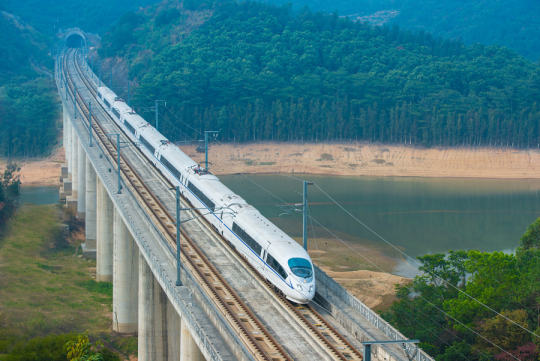
    The first idea that comes to my mind is a high speed rail network that seamlessly connects to each city’s local transit network. Imagine a Great Lakes bullet train that could zip you across the region. It would completely reorganize the spatial landscape.

    Here’s an excerpt from a recent report by the Independent Transport Commission called, Ambitions & Opportunities – Understanding the Spatial Effects of High Speed Rail:

    There has been a global shift of economic power and influence from nation states to cities and city-regions. Today’s successful cities collaborate across existing boundaries to form polycentric metropolitan regions. As a result cities function in a much less self-contained manner than they did fifty years ago. Longterm trends in the pattern of urban settlement reflect the interplay between opportunities for dispersal afforded by greater mobility, and economic and social forces promoting concentration.

    But what else could we be doing to empower the Great Lakes Megalopolis? 

    I would love to hear your thoughts in the comment section below. I think there’s a strong case to be made for thinking at the scale of the megalopolis and not just at the scale of our own backyard.

  • The Laneway Project is looking for a Fundraising Coordinator

    https://500px.com/embed.js

    As many of you know, I advise a non-profit called The Laneway Project. The goal of the organization is to change Toronto’s relationship with its laneways and help create laneway friendly policies and procedures.

    It’s something that I’m incredibly passionate about. I believe that our laneways represent a missed opportunity, both from a public space standpoint and a real estate standpoint. And I’m confident that Toronto will eventually figure that out.

    If you’re also interested in this space, now is your chance to get involved. The Laneway Project is currently looking for a Fundraising Coordinator to help develop its operational funding strategy and to help with actual fundraising.

    Since it’s still early days, this is a volunteer position (with an honorarium). But it’s a great opportunity to get involved early with a passionate group of city builders. So I hope you’ll consider applying. Click here for the full job description.