Daily insights for city builders, delivered every morning at 6 AM ET. I’m Brandon Donnelly — a Toronto-based real estate developer and founder of Globizen. I’ve been writing here since 2013.

Tag: toronto

  • Shareable cities

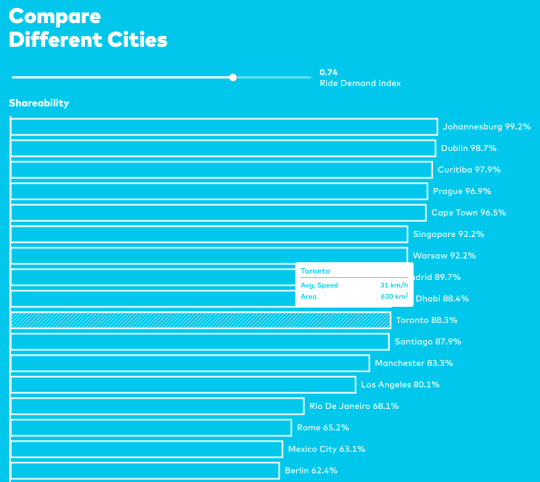
    The MIT Senseable City Lab recently looked at which cities are the most “shareable” when it comes to ride sharing services such as UberPOOL. Their goal was determine what fraction of individual trips (inefficient) could be shared or pooled (more efficient). To do this, they developed a single “shareability curve.” Full research paper, here.

    Not surprisingly, New York City does very well in this analysis. Its shareability is well above 95% for a delta of 5 minutes. That’s because the city has a large population, a small geographic area, enormous density, and lots of taxi traffic. (They used taxi data in their research.)

    But New York City also does very well when it comes to transit ridership. Highest in North America. So it strikes me that the characteristics that make a city “shareable” also apply to transit – which is effectively another form of ride sharing. Might we see the distinction between these 2 forms of mobility blur in the future? I think so.
  • Only $800,000 over asking

    Heads-up: This is going to be a Toronto-specific post.

    This week there was a lot of chatter about escalating house prices in this city (though that seems to be most weeks these days).

    Paul Johnston listed a detached house in Dufferin Grove for $1,285,000 and then turned around and sold it for just over $2.1mm, with 17 potential buyers at the table. I also saw my friend post a note this morning that the average price of a detached house in Toronto has now surpassed $1.5mm.

    What I am curious about – and this is a question for all of you who live here and/or follow the market – is what response does escalating house prices trigger for you? I asked this on Twitter (via a poll), but I would be curious to get your thoughts here in the comments.

    Do you feel rushed out of fear that you may get priced out of the market? Are you now turning your attention to out of the city? Or are you looking at other housing types, such as condos? I am sure the responses will be split.

    My response: condos.

  • Design Canada

    Canada has a rich graphic design history and that story needs to be told. Here is a Kickstarter project that’s absolutely worth checking out: Design Canada.

    https://www.kickstarter.com/projects/1002969621/design-canada/widget/video.html

    Greg Durrell (a graphic designer from Vancouver) and Jessica Edwards and Gary Hustwit (of Film First in Brooklyn) have partnered up, and they are looking for your support to produce the very first documentary about Canadian graphic design.

    As a proud Canadian, I am thrilled to see this project. Because this is obviously not just a documentary about graphic design (though in the 60′s and 70′s we were the best in the world). It’s a story about Canada, our history, and our evolving identity.

    If you can’t see the embedded video above, click here to make your way over to Kickstarter.

  • Toronto’s first condo replacement project

    image

    Last month a deal here in Toronto caught my attention because of how rare it is. 

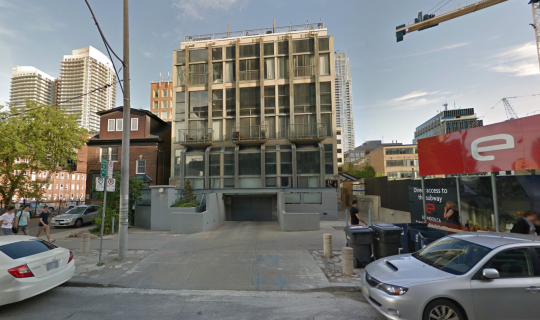
    It was the sale 39-41 Roehampton Avenue as a development site for a new (proposed) 48 storey condo tower.  What’s unique is that it’s being called the first ever “condo replacement” project in the city.

    What that means is that the existing 27 unit condo building (built in the 80′s) was bought out (along with some other adjoining lands) and it will be replaced by a new condo tower.

    In order for this to happen a minimum of 80% of the condo owners had to agree to the sale. According to Bisnow, the owners received approximately $550 per square foot, which is thought to be above market for the building (though well below market for new construction).

    I wonder how many owners voted no. If everybody had voted yes, they probably would have mentioned 100% buy-in. I also wonder if this could mark the start of a wave of “condo replacement” projects.

  • An Honest Farewell

    image

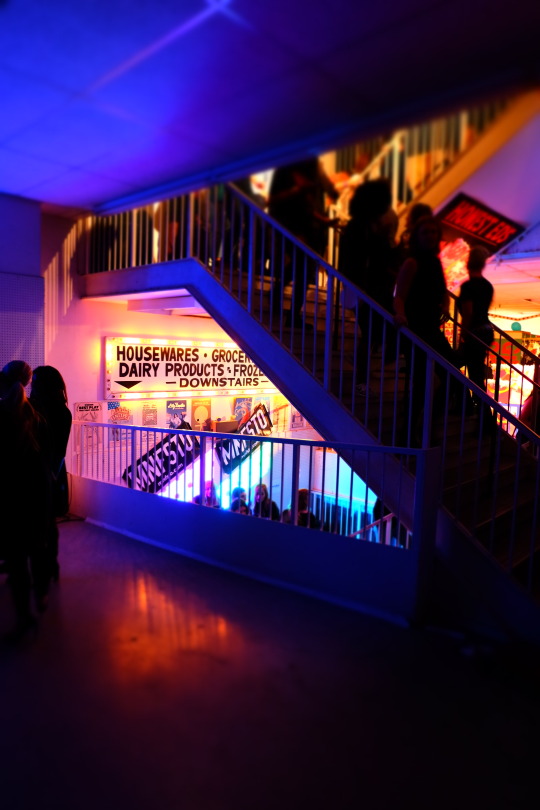
    I spent Saturday evening at Honest Ed’s for An Honest Farewell. It was a lot of fun. There were many familiar faces. And it felt very Toronto. See above photo.

    But part of me felt a bit phony pretending to celebrate the end of 68 years of operations. Truth be told, I’m not sure I ever bought anything from Honest Ed’s. Had it turned into a 3 floor super club sooner, perhaps I would have spent a bit more time there over the years.

    To me, Honest Ed’s was great big signage. 

    When I was a kid, my mom used to work on Bathurst Street just north of Bloor and I would go downtown with her early in the morning before school. It would still be dark out and I remember being so captivated by the bright lights of Honest Ed’s. That’s what the city meant to me. Lights. Flash. Excitement. It was where I wanted to be.

    A portion of the signage is being preserved and moved to Yonge and Dundas. But otherwise, this past weekend was the official end of an era. What matters now is the future of Mirvish Village. And the future is exciting.

    I’ll end with an excerpt from a recent Globe and Mail article by Alex Bozikovic:

    “The new development at Mirvish Village, after two years of conversation between developers Westbank, locals and the city, is inching closer to approval, with a new proposal submitted in January to the city. Westbank paid $72-million for the site, a big number, and yet the result is as good as private development gets in Toronto. It features meaningful preservation of heritage buildings, a serious sustainability agenda, and affordable housing – not to mention an architectural and leasing strategy geared at making the place as lively as possible, even a bit weird.”

  • The Green View Index

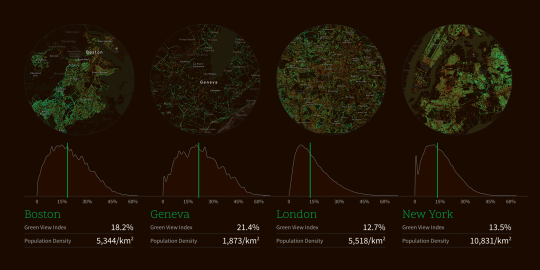
    The MIT Senseable City Lab recently developed something called the Green View Index. It is a measure of a city’s tree canopy. Below are the GVIs for Boston (18.2%), Geneva (21.4%), London (12.7%), and New York (13.5%). You may have to zoom in.

    image

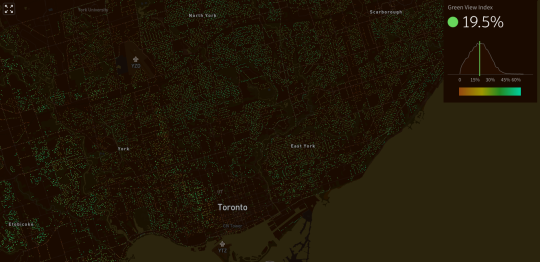
    And here is a screenshot of Toronto. We have a GVI of 19.5%.

    image

    The index was developed by methodically scanning for trees in Google Street View panoramas. The reason street view was used – as opposed to aerial photography – was so that they could capture the human experience at street level.

    All of MIT’s interactive city maps can be found here. It’s also interesting to pan around and see which neighborhoods are the greenest – particularly if you are familiar with the city.

    One thing I noticed is that large green spaces such as Central Park, High Park, and Stanley Park don’t show up as very green. And that’s because the index uses car-based street view data. I feel like these green spaces should count for something though.

  • New York, San Francisco, Toronto

    Yesterday it was announced (here, here, and here) that Toronto-based Top Hat has raised $22.5 million (USD) in Series-C funding. The round was led by New York-based Union Square Ventures.

    I am always excited to see Toronto-based startups doing well and I am particularly excited by this remark in USV’s blog announcement:

    “Also worth noting is that Toronto continues to impress us with its quality and diversity of companies. We now have five investments there, placing Toronto third as a location in the USV portfolio after New York and San Francisco.”

    Here is another quote from Fred Wilson’s blog:

    “Toronto is a great place for startups. In addition to five investments of ours that are HQ’d there, I know of at least one other USV portfolio company that has much of their engineering team in Toronto. The talent, mindset, and quality of the people in the Toronto/Waterloo tech/startup community is really top notch and we love investing there.”

    Go Toronto. 

    (Of course, Toronto really means Toronto-Waterloo. That’s the geography of the ecosystem.)

  • 3 pilot options for Toronto’s King Street corridor

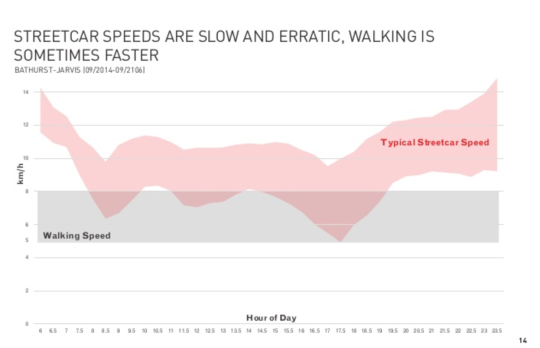
    Anyone who has ridden Toronto’s King streetcar during rush hour can tell you that the service is broken. It’s unreliable. It’s overcrowded. And during peak times it can be faster to walk. Chart below.

    Part of the problem is a misallocation of resources. Only 16% of the people who use the corridor are in cars. And yet 64% of the physical space is allocated to drivers.

    Not surprisingly, this creates a bottleneck for the ~65,000 transit riders who use the service daily. (Busiest surface route in the region.) We are not optimizing for the right variable.

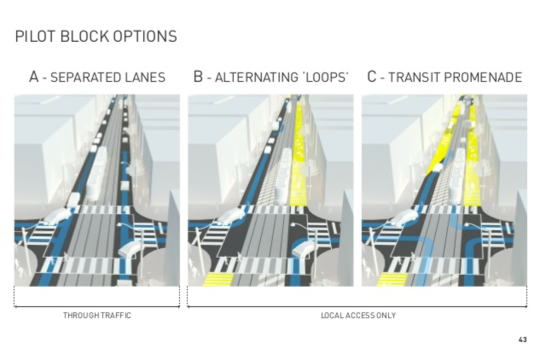
    It’s for this reason that the city is working on a rethink of the corridor. I wrote about this initiative last year, but earlier this week it got a bit more real with the release of the following 3 pilot block options.

    The plan is to launch a pilot sometime this fall (2017). This is good news. 

    If you’d like to go through the full King Street Pilot Study Public Meeting presentation, you can do that by clicking here. The above images were taken from that presentation.

  • And the award for the tallest building of the year goes to…

    The Guardian recently published an article on vanity height in skyscrapers. What this is referring to is the unoccupied portions of tall buildings which are built purely for vanity reasons – that is, to increase the face height of the building and claim some superlative title.

    Example: 

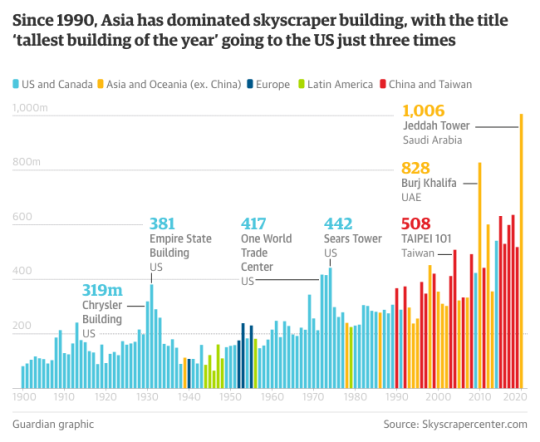
    The tallest building in the world is currently the Burj Khalifa in Dubai. It’s 828m tall. To put that into perspective, the CN Tower in Toronto is 553m. But according to the Council on Tall Buildings and Urban Habitat, 29% of the Burj Khalifa’s height is actually unoccupied or “vanity space.” In other buildings, such as the Burj al Arab (also in Dubai), the amount of unusable space is as high as 39%. 

    For the purists out there, this of course raises the question of what should should be counted when assessing building height. Should it only be spaces where humans typically inhabit? The CN Tower has a lot of unoccupied space, which is why it is frequently excluded from these sorts of ego rankings. 

    But semantics aside, this is obviously not a new phenomenon and it’s interesting to think about this race to the sky as a proxy for what’s going on in the world. Below is a chart showing which regions have been able to lay claim to the “tallest building of the year” since 1900. 

    Since 1990, it has been all about Asia and Oceania and China and Taiwan…

  • Designing for families in high-rises

    The City of Toronto Planning Division is working on an initiative called, Growing Up: Planning for Children in New Vertical Communities. 

    The objective is to better understand how new multi-unit housing can better accommodate families within the city. Supposedly as of 2011, 32% of families within Toronto lived in mid and high-rise buildings. At first I thought this number seemed high, but then I rationalized it to myself by thinking of all the post-war apartment buildings we built.

    As part of their study, the city published a number of case studies from Toronto and from around the world. These are projects that have successfully planned for families. For some of the projects they have floor plan and sections showing how the individual suites were designed and positioned within the building. One feature that they consider desirable is to cluster the family suites on the lower floors of the building.

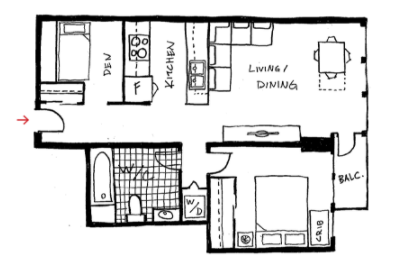
    But perhaps even more interesting is the section called CondoHacks. Here, the study team interviewed 9 families already living in vertical communities to learn about how they have “hacked” their spaces to meets their needs. It’s valuable to see how end-users actually live in specific floor plans. Lots of shared bedrooms and spaces. Here (pictured below) is an example of 2 parents and 2 children living in a 650 square foot one 1 bedroom plus den.

    image

    This a topic that I’m personally very interested in. I’m thinking a lot about how some of the projects I’m working on could better accommodate families. So it’s great to see this initiative underway. If you’d like to receive email updates from the city about this study, sign up here on the bottom right of the page. I did that this morning.