Daily insights for city builders, delivered every morning at 6 AM ET. I’m Brandon Donnelly — a Toronto-based real estate developer and founder of Globizen. I’ve been writing here since 2013.

Tag: toronto transit commission

  • Transit advertising according to the numbers

    This morning I saw this tweet about Toronto streetcar advertising. The author has a “big problem” with public transit being fully wrapped in ads and so she decided to tweet her local Councillor to see if these could be somehow limited in size.

    My first thought was: I wonder how many people would accept higher fares in exchange for fewer/no advertising. Is this something people care about? Because personally, I’ll take the lower fares in exchange for someone trying to monetize my attention. I mean, every social network I use is already selling my attention off as their product.

    But then this got me thinking about what the actual numbers look like. So let’s look at some of those for not only Toronto, but also for Hong Kong, since many people view that as the gold standard as far transit authorities go.

    For the year ending December 31, 2016, the Toronto Transit Commission (TTC) posted a total operating revenue of $1.204 billion. This represents about 41% of total revenue – the rest comes from subsidies.

    If you drill down into operating revenue, advertising makes up $28 million or about 2.33% of total operating revenue. So a pretty small number. If you tried to shift this number over to “passenger services” revenue (transit fares), it actually wouldn’t increase fares by that much. But presumably fares are already at some profit maximizing number.

    Switching to Hong Kong’s MTR Corporation, their numbers have to be unpacked a little differently because the group has a number of diverse business lines, including property development.

    For the year ending December 31, 2016, total revenue from Hong Kong Transport Operations was HK$17.655 billion (almost all fare revenue). Advertising falls within the Hong Kong Station Commercial Businesses group and that company posted revenues of HK$5.544 billion for the same time period.

    To try and create some sort of comparison, I’m ignoring all of the other segments within MTR.

    Within Station Commercial Businesses, advertising revenue alone makes up HK$1.09 billion or about 20% of that group’s total revenue. The rest comes from station retail rent (the biggest chunk), telecom, and some miscellaneous station income. 

    If you add up Transport Operations and Station Commercial Businesses, total revenue was HK$23,199 billion for the year ending 2016. Advertising comprises about 4.70% of this – so more than double that of Toronto.

    It’s also worth noting that MTR’s station retail rental revenue is about 3.4x that of its advertising revenue. In the case of Toronto, the TTC actually makes more money off advertising than it does from “Property Rental.” I’ve always thought this was a missed opportunity. Transit and land use go hand in hand.

    In any event, I’m far less fussed about advertising on transit. But what are your thoughts? Let me know in the comment section below.
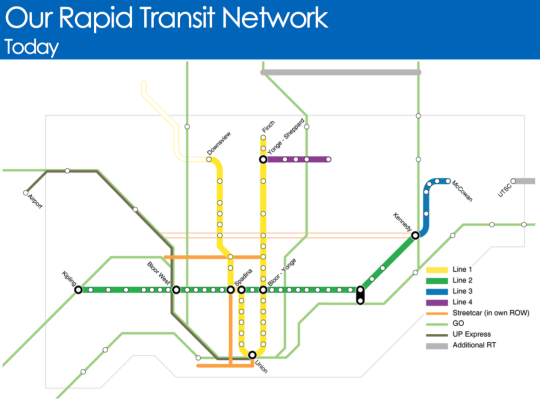
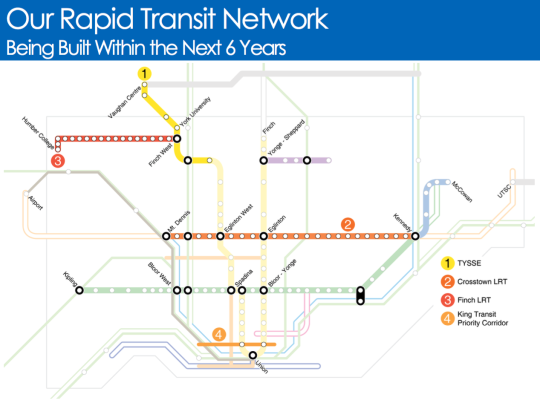
    Photo by Tomo Nogi on Unsplash

  • Towards a cashless society

    I increasingly never carry cash on me. I just never think to take out money and, when I do, I hate paying for things and getting change back. That change just ends up in a “change jar” in my apartment and then never comes out ever again. I keep telling myself that I need to buy coin rolls but that never seems to happen.

    Lucky for me, it’s pretty clear that many cities and countries are quickly headed towards a cashless society. It’s pretty easy to get by in most cities today without cash. Here in Toronto, I use Uber and my PRESTO card to get around. I can use my phone for many purchases like coffee. And I can use my credit/debit cards for everything else. I never really thought about it until recently, but I have unintentionally gone almost completely cashless.

    But of course it’s not just cash that is going to disappear; it’s also our physical wallets. Just this week Fred Wilson wrote a post on his blog about how he forgot his wallet at home and how Apple Pay came to the rescue at Whole Foods. I can’t wait until more banks roll this out in Canada. It’s also encouraging to see that under “coming soon” on the Apple Pay website, the Toronto Transit Commission is listed. I guess that means it will be integrated with PRESTO.

    However, this transition is not happening in the same way everywhere. There are many countries that still prefer cash. According to CNN (November 2015), only about 10% of people in Indonesia and the Philippines would prefer to pay with a credit card. And it’s for this reason that Uber now accepts cash in a number of countries. It’s what those customers wanted. I find this interesting though, because not having to carry cash is one of the main reasons I use Uber.

    Of course, there’s also the question of what happens to people who are currently not connected in anyway to electronic forms of money. I get asked by people on the street for change at least every day when I walk around Toronto. But there is actually no way for me to transmit the money I have to them. I don’t carry cash and I certainly don’t carry change.

    I would be curious how many of you have gone or are close to going cashless. And if you are operating cashless, did you even notice the transition happening?

  • Toronto’s rapid transit network by 2031

    Starting today and running until the end of March, the City of Toronto, the Toronto Transit Commission, and Metrolinx will be hosting several public meetings as they work towards planning out this city and region’s rapid transit network.

    Below are a few of the key maps from their presentation.

    Here is what Toronto’s rapid transit network looks like today (the hollow lines represent projects in construction):

    image

    Here is what will be built within the next 6 years:

    image

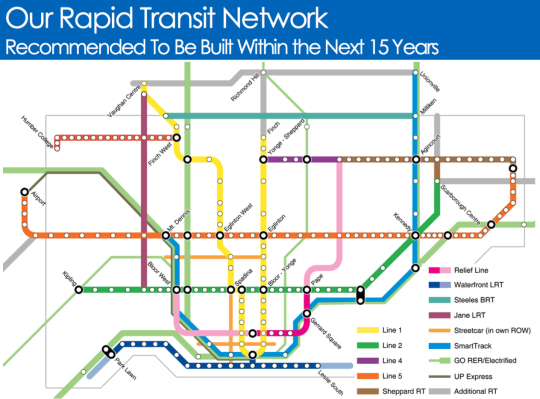
    And here is what they are recommending should be built within the next 15 years:

    image

    It’s hard not to get excited when you see maps like this. Of course, it’s a lot easier to draw lines on a map then it is to fund and execute on projects like this.

    But I think it all starts with us acknowledging that these initiatives are critical to both our economic competitiveness as a city region and our quality of life as citizens of it. Because if this is something we really want, then we can absolutely make it happen.

    Click here if you’d like to see the full presentation and also the public meeting dates/times.

  • Bringing public transit into the 21st century

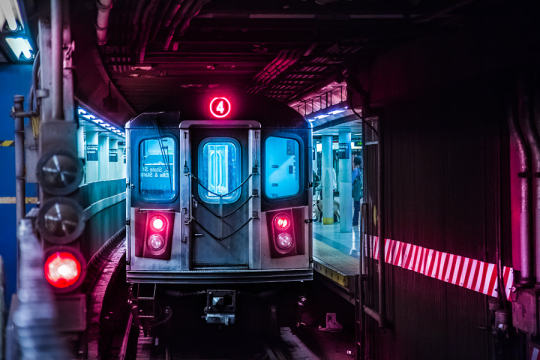
    New York Subway by Lok Yiu Cheung on 500px.com

    https://500px.com/embed.js

    I think we’ve hit peak millennial.

    Last Friday the Governor of New York, Andrew Cuomo, and the Metropolitan Transit Authority, announced that 30 subway stations will be redesigned and that “millennial-friendly amenities” would be added throughout the system

    As you might guess, this includes adding phone chargers in train cars and buses and wifi throughout all the stations (by the end 2016). They will also be replacing the MetroCard with an all digital fare system that will include mobile payments.

    But the reality is that this isn’t about being millennial-friendly. This is about joining the 21st century.

    Here in Toronto, we finally have our PRESTO card working on all streetcars and in almost 40% of the city’s subway stations. This is a huge improvement over our laughable and antiquated token system, but it’s not enough. I really hope the next rollout is a mobile app that will allow everyone to pay with just their phone.

    We also have wifi in about 30% of our subway stations, but again this is not enough. By the time you get authenticated (do you need to have Twitter now?), your train is usually arriving and then you enter a tunnel where no wifi exists. We need to be looking at the entire tunnel network. (Related topic: LinkNYC

    I say all this because I am a big supporter of public transit. Despite all the positive things I write about Uber, ridesharing, and driverless cars, I do not believe that they will eradicate the need for a strong transit backbone. This is fundamental to our city building efforts. 

    So let’s do our best to delight people when they take transit.