Last week, Joe Berridge, Partner at Urban Strategies, gave a presentation at the Institute on Municipal Finance & Governance titled, Toronto: The Accidental Metropolis. I’ve seen Joe give similar presentations to this one before, and I always thoroughly enjoy his focus on Toronto’s position as a global city.
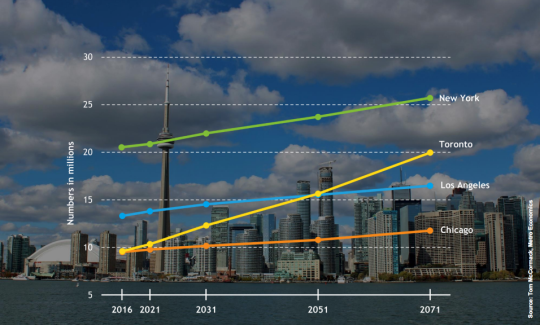
Here is a slide from the presentation that projects out Toronto’s population to 2071 and compares it to the largest cities in the US.
But the two slides that have been really making the rounds online are the following ones. The first is a rendering of what downtown Toronto looked like in 2000.
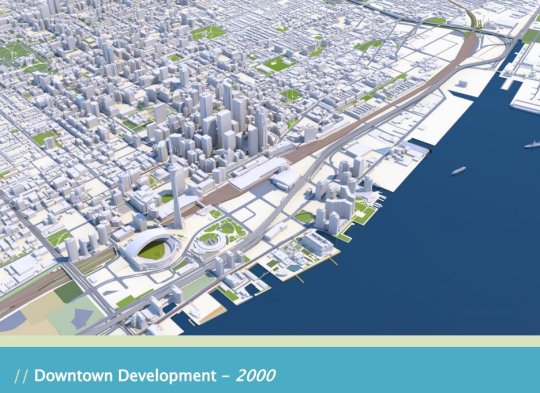
I remember this time clearly. Queen West seemed to end at Spadina. King West and Ossington weren’t things. And “Richmond and Adelaide” felt like the greatest club district in the world. (If you’re not from Toronto, these references will likely mean nothing to you. Sorry.)
The second slide is a rendering of what Toronto will look like in 2025. The transformation is just incredible.
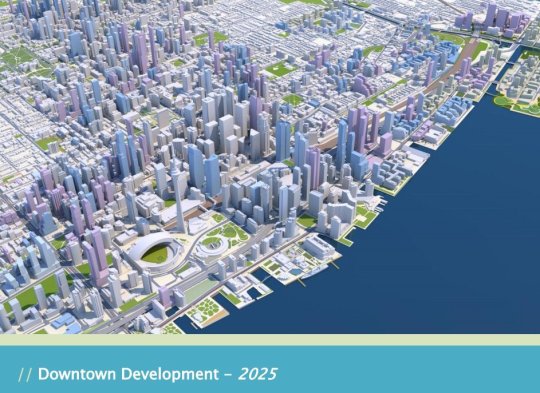
I’ve seen some people comment that the Toronto of 2000 was relatively affordable; the Toronto of 2018 is unaffordable; and the Toronto of 2025 will be even more unaffordable with all of this new development.
But I don’t understand that logic. Considering the growth rate shown in the first slide, imagine how unaffordable this city would be if we weren’t building new places for people to live and new places for people to work.
For the full slide deck, go here. And for recent aerial photos of Toronto’s downtown core, check out my Instagram page.