Daily insights for city builders, delivered every morning at 6 AM ET. I’m Brandon Donnelly — a Toronto-based real estate developer and founder of Globizen. I’ve been writing here since 2013.
I just finished watching the Raptors beat the Boston Celtics and tie up the series in double overtime, and now it’s quite possible that I may not be able to sleep for the next three days.
My favorite inbound text of the evening was this one here: “I could run 30km right now. I won’t. But you get it.” I most certainly do.
There’s something so special about seeing Lowry do things like this:
The frenetic run-up to Christmas has come to an end, and I’m looking forward to relaxing and taking it easy with family and friends. I hope that all of you are able to do the same, however you spend the holidays. This is the one time of the year when the email firehose completely shuts off and it’s a lot easier to do exactly that. I think that’s important for all of us.
This past year I found it particularly difficult to disconnect. And 2020 is on deck to be an even bigger year. But I wouldn’t have it any other way. I am, however, going to take this time to slow down, read, write, travel, and likely drink a bunch of wine. As always, you’ll find me here on the blog every morning. Merry Christmas, everyone.
This recent NY Times article about crowd estimates for Hong Kong’s annual pro-democracy protest is a good follow-up to my post about the number of people who, allegedly, showed up to last month’s NBA Championship parade here in Toronto.
For years, Hong Kong has been seeing divergent estimates for its annual protest. Organizers typically overstate. And the police typically understate. This year, organizers claimed 550,000 people in attendance, whereas the police claimed only 190,000.
The difference this year is that a local tech company has started using AI software (loaded up onto iPads) to help supplement the standard practice manual counts. This year they concluded — perhaps more definitively — that 265,000 people protested in the streets of Hong Kong.
Today was a historic day for Toronto, for Canada, and for the game of basketball in this country. The Toronto Raptors are world champions for the first time since their founding in 1995. Soak it in. Here is a photo that I took of the parade coming through the Financial District at around 2:30pm:
Some of the estimates going around are that 1 to 2 million people attended today’s championship parade. But 2 million seems like a lot, even though today was frenetic (see above photo, again). I mean, that’s 1/3 of the population of the Greater Toronto Area.
The fact that some of the “official” estimates also have a 1 million person spread tells me that, as of right now, we actually have no idea how many people were at today’s parade.
So that got me thinking: How do people count crowds? And are we using drones to do it, yet? Subway and rail ridership for the day — which surely spiked — will give us some indication. But definitely not the full picture.
It turns out that the typical approach to counting crowds is known as Jacobs’ Method. It was invented in the 1960s by a professor at UC, Berkeley, named Herbert Jacobs. He came up with the method while trying to count the number of students protesting the Vietnam War.
The concept is simple: It’s area x density. And permutations of his method usually use this same principle. What you do is take the area filled with people, break it up into a smaller grid, and then come up with a population density estimate for each square.
He had some rules of thumb for that. A light crowd was about 1 person per 10 square feet. And a dense crowd (such as a mosh pit or an NBA championship parade in Toronto) was about 1 person per 2.5 square feet.
Using this method and aerial photos of today’s parade, I would imagine that we could eventually get to a more precise estimate than 1 to 2 million people. But surely somebody has figured out how to program a drone (or other UAV) and do this even more accurately.
Crowd data is valuable information, particularly for political rallies and protests (I would imagine). If you know of a company doing this, please leave it in the comment section below. And if it doesn’t yet exist, well then, now you have a new business idea.
Kawhi Leonard doesn’t say very much, but when he does, he tends to focus the discussion less on himself and more on the achievements of the Toronto Raptors as a whole. He has said many times before in interviews that he doesn’t aspire to be the best player on the team; he aspires to win championships. It’s not about him. It’s about the team. And it’s hard not to respect that kind of humility.
One the things that I try to be aware of in business and in life is how I use first-person singular pronouns (such as “I”) and first-person plural pronouns (such as “we”). The subtleties of language are important and there’s lots of research out there on this topic. Some have even tracked Jeff Bezos’ use of “I” and “we” in Amazon’s annual shareholder letters over time.
Harvard Business Review also argued a few years ago that “we” is the language of leadership because it tells you where someone is focusing their attention. Studies suggest that when people are self-aware or insecure they naturally tend to use more first-person singular pronouns — they turn inward. Conversely, using pronouns such as “we”, “us”, or “you” suggest an outward focus or a focus on other people’s thoughts, opinions, and contributions.
Of course, when you write a personal blog like this one, you naturally end up with a lot of “I.” But when I write about broader topics, such as city building or the housing market, I do try and shift the focus. These are our cities. These are our buildings, streets, and public spaces. We’re in this together. And I aspire to get even better at “we.”
Being a sports fan is like having a bipolar disorder. The highs are high. And the lows are low. But right now — with the Toronto Raptors having clinched their first ever NBA Finals appearance — we are all on a high. Though the job is far from over, this city has waited 24 seasons for this moment. Turns out, all we were missing was one of the greatest basketball players of all time.
It’s pretty amazing to see how far we have come both as a franchise, and as a global city. When Scotiabank Arena was completed in 1999, it, and the surrounding area, looked like this. On Saturday night after the win, it looked like this, a veritable “sports alley.” I have long thought that Bremner Boulevard should be placemade into a sports alley connecting Scotiabank Arena (on the east) and the Rogers Centre (on the west).
From now until this Thursday, all is right in the world. Enjoy it Toronto, and Canada. Masai Ujiri made a bet that I think most, if not all, of us would agree has paid off. Had it not, Raptors fans across the country would be criticizing him for trading away our franchise player. But that’s par for the course in this bipolar world of sports fandom.
The Raptors had plateaued. When the Cavaliers swept them in the playoffs earlier this year we all knew there were going to be significant changes in the off-season. Many people who know more about basketball than I do also seem to believe that sending our franchise player DeMar DeRozan to San Antonio in exchange for Kawhi Leonard is a win for us. The betting odds also seem to reflect this win.
But, like many people here in Toronto, the first emotion I felt this morning when I heard the news was sadness. Here is a guy who has played his entire professional career in Toronto (9 years) and has openly and continually expressed his loyalty to this city. He wanted to retire a Toronto Raptor. He declared himself to be Toronto.
Of course in the end this is a business. And the primary goal of this business to win championships. If you don’t think you’re in a position to win championships – or lose to the Golden State Warriors in the finals, which is probably the most that teams can hope for right now – then it behooves you to make the necessary changes, however painful they may be.
I have no idea how this all went down, but the Instagram story that DeRozan posted this morning makes it abundantly clear that he feels betrayed. He feels he was told one thing, and that one thing isn’t what ended up happening. That’s the truly sad part for me. But I’m not going to speculate. Instead, I would like to thank DeMar DeRozan for his dedication and loyalty to this city. He was one of Toronto’s finest city builders.
We may not all agree on things like bike lanes and transit, but if there’s one thing that can generally unite a city it’s playoff sports.
I love the solidarity that it creates. You may have nothing else in common with the person sitting next to you at the bar, but suddenly you’re best friends because your team is winning.
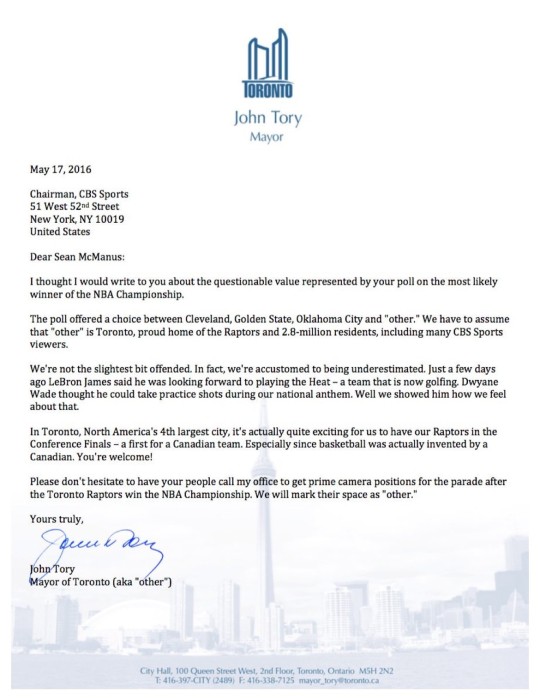
As I write this post, #WeTheOther is currently breaking the internet after CBS Sports ran a cheeky online poll asking: Who will win the NBA title? The four options were:
Warriors
Thunder
Cavaliers
Other
For those of you who don’t follow basketball, there are only 4 teams left in the NBA playoffs right now! So in what was likely a deliberate snub to the Toronto Raptors, CBS conveniently obfuscated them in their poll.
It’s currently raining here in Toronto, but the sun is supposed to come out this afternoon. The Raptors won game 7 of the first round of the playoffs last night and now go on to face the Miami Heat in the conference semi-finals. The last time they made it this far in the playoffs was in 2001! And at 33, I am pumped with where I am in my life right now. I get to do what I love every day.
It is good practice to live a life based on appreciation, rather than expectation. So I am trying to do that this morning as one more birthday passes.
Recently, a good friend of mine (Chris) explained to me two theories for why life seems to speed up as you get older.
The first is that as you get older your life becomes less punctuated with significant milestones. When you’re younger, you have: going to high school, driving for the first time, voting for the first time, going to University, as well as a series of other life events that help create temporal awareness. But as you get older, many of us fall into more consistent routines – which isn’t all bad. Consistency can be boring, but you have to put in the time.
The second theory is that as you get older each year represents an increasingly smaller portion of your overall life. For instance, when you’re 5 years old, 1 year is 1/5th of your life. But when you’re 50, 1 year is only 1/50th of your life. So with each passing year, a year feels increasingly shorter.
Whatever the case may be, time seems to be speeding up and birthdays certainly feel a little less significant. But they’re still a great excuse to spend more time with family and friends. And that’s exactly what I did this past weekend.
Based on the above, birthdays are also a great reminder to try and punctuate one’s life with as many significant milestones as possible and to be grateful for them when they happen. I’ve been told that I tend to live in the future, as opposed to appreciating the now. (Probably has something to do with what I do for a living.) Perhaps I’ll get better at that with age.