
Edward Burtynsky is a Canadian photographer who is known for his images of industrial landscapes. In 2018, he released a documentary film called Anthropocene: The Human Epoch. It was the third in a trilogy of films that he directed alongside Jennifer Baichwal and Nicholas de Pencier. In this one, the group tries to draw attention to the way in which us humans have (negatively) reengineered the planet and created a new geological epoch known as the Anthropocene. I think many of you will find it interesting and eye-opening. Here’s a trailer (it debuted at the Toronto International Film Festival in 2018):
Tag: toronto international film festival
-
My Piece of the City
A friend of mine just sent out a group city builder email about My Piece of the City, which is a new documentary that is screening all weekend here in Toronto at the TIFF Bell Lightbox.
The film is a critique on the revitalization of Regent Park, told through local residents and their efforts to stage a community musical (which happened in real life).
The Daniels Corporation, in partnership with Toronto Community Housing, is the developer and builder for the entire 69 acre community. The Daniels Foundation also funded the musical and this documentary.
But, despite this backing, the Globe and Mail has said that it remains a “healthy critique” of this entire process. And the trailer certainly gives you that impression.
I am sure that this documentary will be of interest to many of you, so if you would like to grab tickets for this weekend, you can do that here.
-
TIFF: Getting ready for guests on King Street
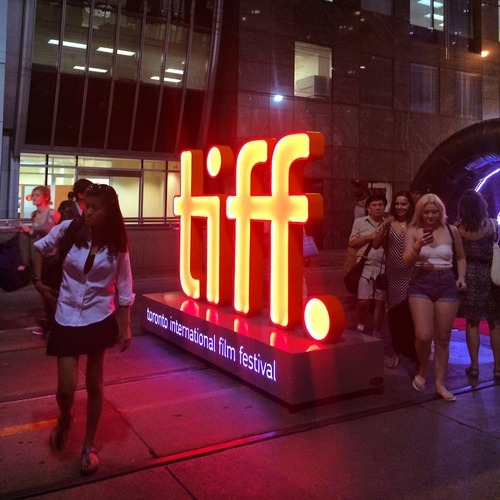
Right now the Toronto International Film Festival is going on in the city. It’s actually one of my favorite times in Toronto. There’s so much going on and the city generally does things that it doesn’t normally allow, but that it should do all throughout the year, such as extending last call at bars and closing down streets to cars.
This year, King Street between University Avenue and Peter Street has been made pedestrian-only. It encompasses an area known as the Entertainment District and includes the Bell Lightbox, which is the TIFF HQ. The street was closed last Thursday and will reopen this Monday. So it’s a 4 day thing, that TIFF is calling “Festival Street.”
Some people – like me – are really excited about this. Here’s s picture I tweeted out on Thursday night. Given the engagement (retweets/favorites), I think there are others who feel the same way I do:
Pedestrian only King Street for #TIFF. Look at this magic! #athiscity pic.twitter.com/KVR7t2Irvs
— Brandon G. Donnelly (@donnelly_b)//platform.twitter.com/widgets.js
But there are others who are furious that their commute was disrupted last week and that we’re inconveniencing locals for the sake of hosting one of the top film festivals in the world. (King Street typically moves about 60,000 people per day on the streetcar and 20,000 vehicles.)
But when I walked the entire 650 meter stretch on Thursday night, it was completely full of people. There were people playing large-scale chess. There were people eating at picnic benches. And there were lots of people just enjoying a wonderful summer stroll in the city.
And all I could think about is that this is an unmet need in the city. King Street is a wonderful place to be right now and we don’t have an equivalent during the other 361 days of the year here in Toronto. So rather than be upset that we’ve closed down 6 blocks of downtown, I’m only upset that we don’t do more of this and make it permanent during the rest of the year.
I’m not necessarily saying that King Street is the best place to do this. Yonge Street initially strikes me as being a better place to start. But I am saying that if we have to reconfigure things to make our city more awesome for when guests come over, that maybe we should think about how to make it more awesome all the time.
-
Telling Toronto’s story
If you’re a regular reader of ATC, you’ll know that I often talk about cities in the same way that many people talk about products and services. (See: The business of cities.) And I do that because cities are our new economic unit and so I find it helpful to think of them as businesses fighting to attract and retain the best talent and win over customers (i.e. residents and businesses).
Which is why I’m intrigued by Jason Logan’s pitch to invent the position of Creative Director at the City of Toronto. Here’s his pitch:
“This is an open challenge to the all the mayoral candidates. In the past 10 years, Toronto has undergone a cultural, artistic, and technological renaissance: The ROM, the AGO, and OCAD U all underwent architectural makeovers; TIFF rose to prominence as one of the most prestigious film festivals in the world; Nuit Blanche was unleashed in 2006, and Luminato in 2007, both to huge acclaim; the high-tech industry has created 30,000 new jobs; and The New York Times admitted that Toronto’s culinary scene is more ethnically diverse than the five boroughs. But here’s the thing: The story we tell ourselves and the world about our remarkable city needs an overhaul. Toronto Needs a Creative Director is a campaign committed to building a better story by better mobilizing the arts, culture, and technology sectors to enhance civic engagement. The CDTO (the office of Creative Direction for the City of Toronto) would function as a lab for incubating ideas where art, culture, politics, science, and technology intersect.”
Truthfully, I’m not yet sure if a Creative Director is the ideal approach. I haven’t had a chance to give it enough thought. But I am certain that Toronto would benefit from a bunch of smart people who were focused on telling our story to the world, crafting our brand and identity, and honing the experience of living or visiting this great city.
-
TIFF + TORONTO
During TIFF is an awesome time to be in Toronto. The city is buzzing, the bars are open until 4am (that should be standard), and everybody is talking about films. I used to go to a lot more movies when I was younger, but that’s sort of fallen off in recent years. Thankfully, my good friend Meg was kind enough to invite me out last night. We saw Blood Ties, which I really enjoyed. It’s about a good cop and a bad brother.
Before the movie started we started talking about the history of TIFF and it’s impact on Toronto’s economy. Curious, I looked it up today and the estimated annual contribution in 2011 was approximately $170M (which appears to be comparable to Cannes). That’s pretty impressive given that, even though there’s technically programming all throughout the year, it’s really only an 11 day festival.
I was also reminded of Roger Martin’s book the Opposable Mind, where he talks about the founding of the festival and the dichotomy the founders were faced with. He argues that, at the time (1970s), there were 2 predominate film festival models in place: the elitist jury driven Cannes model and the sort of grassroots model. The problem with the former was that it didn’t feel inclusive for festival goers and the problem with the latter was that it didn’t attract the buzz of say a Cannes.

The solution was to do both – basically make the audience the jury. The solution was a People’s Choice Award. This made festival goers feel like they had a say and were a part of the process, and it served as an effective buzz machine. There were also a bunch of other benefits, including the fact that the industry could now get a clear sense of a movie’s commercial appeal prior to going to market. More insular festivals couldn’t do this as well.
Here’s how Roger Martin put it:
“The People’s Choice Award put the Toronto International Film Festival on the map. By 1999, Roger Ebert, America’s most influential film critic, was telling one reporter that “although Cannes is still larger, Toronto is more useful and more important.” By 2005, TIFF had booked the largest volume of sales in film festival history, and film critic Liam Lacey named it “the most important film festival in the world – the largest, the most influential, the most inclusive.””
This is an incredible achievement and we’re lucky to have it in our city. Now let’s get out and create some more of the world’s best.