Daily insights for city builders, delivered every morning at 6 AM ET. I’m Brandon Donnelly — a Toronto-based real estate developer and founder of Globizen. I’ve been writing here since 2013.
A lot of that has to do with how design and technology seem to permeate the culture. But it also has to do with how dichotomous the culture feels to me. On the one hand they’re at the forefront of design and technology, and on the other hand they are very much steeped in tradition. It has always felt like a unique and special place to me.
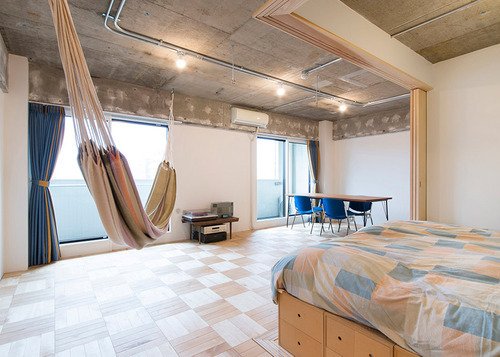
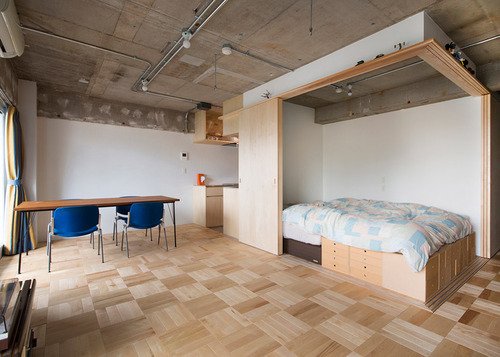
So today on ATC I thought I would share a piece of Japanese architecture that I found on Dezeen. It’s a 47.55 square meter (512 square foot) apartment in Tokyo that was recently renovated by Yuichi Yoshida & Associates.
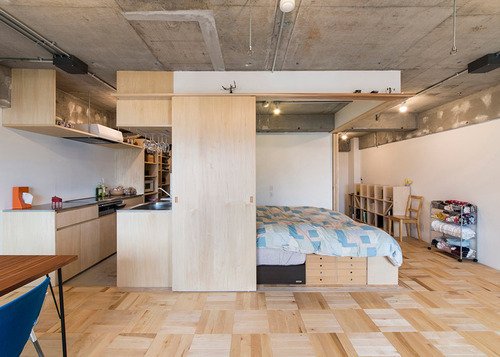
Here are three views of the main living area:
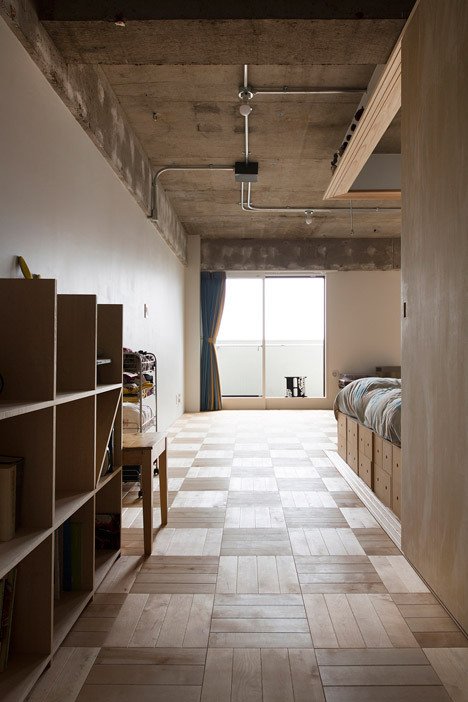
Here’s the view from the main entrance:
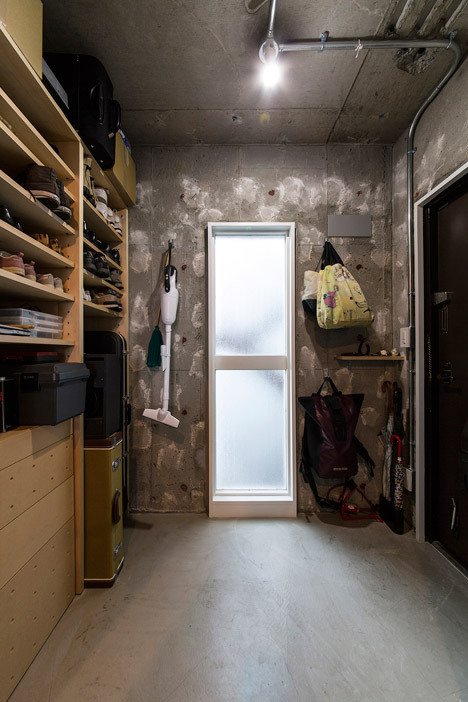
Here’s the walk-in-closet/storage area (notice how the exposed concrete walls have been dabbed with plaster):
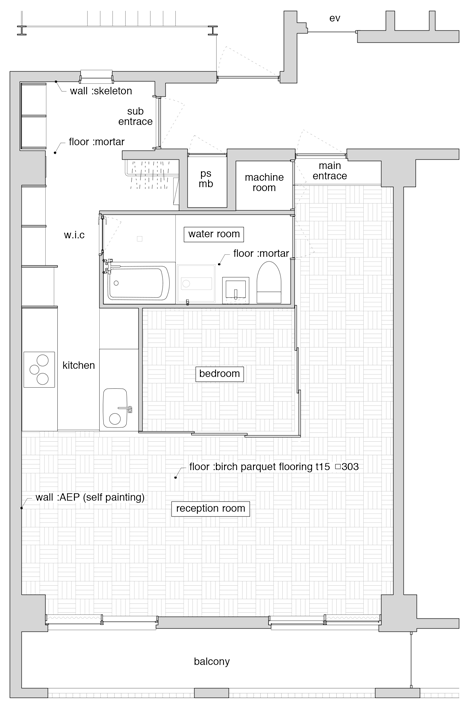
And here’s the floor plan (I’m guessing sub entrance means secondary entrance):
The first thing that struck me was the lack of a traditional bedroom. It’s basically a nook with a bed and sliding doors. But that was obviously done to give more space to the remainder of the apartment and the main living area, which they label as the “reception area.” The idea was that this space could be used for both living and working, and so they wanted a large open space.
The other thing that stood out for me was the amount of storage and shelving throughout the apartment. There’s a bookshelf as you walk in. There are drawers under the bed. There’s a walk-in-closet with floor to ceiling shelving. And if you look closely at the upper track for the sliding bedroom doors, you’ll see a small ledge that was purposefully created for storage and display.
It all seems very Japanese to me.
It’s a small space and yet there’s no absolutely zero clutter. I love how organized everything seems. For many of you, this space may be a bit too sparse (even with that hammock!). But there’s something really nice about the simplicity of it all. It’s peaceful.
One of the reasons I’m so fascinated by cities is that it’s becoming increasingly more important to get them right. From about 1831 to 1925, London was the largest city in the world. Its population went from somewhere around 1.5 to 2 million people to nearly 7.5 million. London surpassed Beijing as the largest city and was then surpassed by New York.
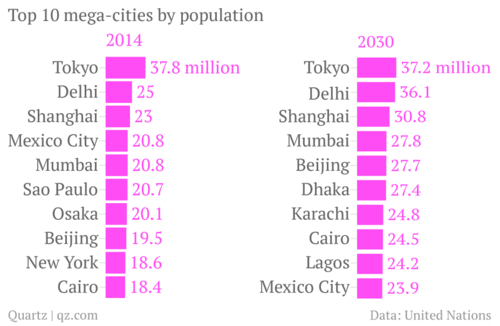
Today our largest cities are significantly bigger. Tokyo has almost 40 million people and London doesn’t even make the top 10. But there’s also a broader shift taking place. According to a new report by the United Nations, most of the world’s largest cities will be in Africa and Asia by 2030. Here’s a chart from Quartz:
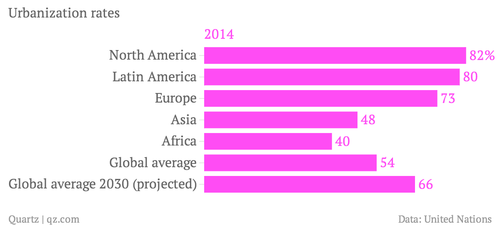
And the reason for this shift is because Asia and Africa are newly urbanizing, whereas the rest of the world has already urbanized. In North America, over 80% of people already live in cities.
But even though Asia and Africa are following a trend that has already taken place in the rest of the world, it doesn’t mean we should assume we know what we’re doing. Having spent time in cities like Dhaka, I can attest to the many challenges that these mega-cities are facing and will continue to face as people flood in from the rural areas looking for economic opportunities.
So while it’s important that we talk about strategies for reviving cities like Detroit – which has a population somewhere around 700,000 – 800,000 people – we should also keep in mind that we have some significant challenges ahead of us in terms of creating a sustainable urban planning agenda for the world.
Each year Monocle publishes a ranking of the top 25 cities around the world in terms of quality of life. Different than most city rankings, the survey goes beyond the more typical metrics around crime, education and so on, and also looks at some of the softer aspects of quality of life. Metrics such as: Can I get a good glass of wine at 1am? What they’re after is a more truthful ranking of the cities that people actually want to live in.
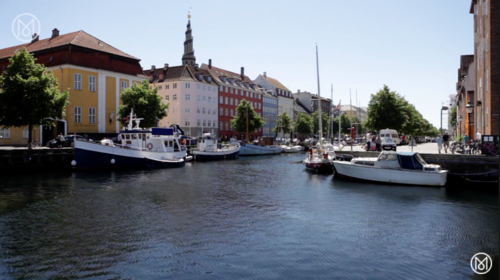
This year Copenhagen took the number one spot. Vancouver took first in North America. And Tokyo took first in Asia. All 3 cities have scored well since they began the survey. Monocle also released a short video that looks at these 3 cities and explains a bit about their ranking methodology. Click here to watch the video. It’s only about 7 minutes long, but it’ll probably make you want to visit all 3 cities. I’ve never been to Copenhagen, but it’s certainly on my list.
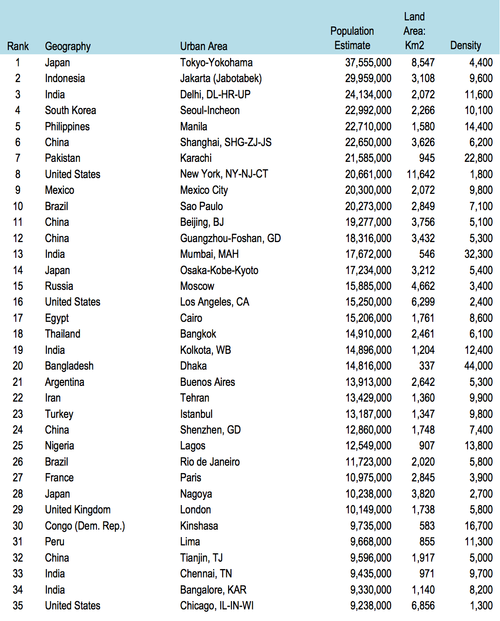
Without a question, we are living in an urban era. More people now live in cities than anywhere else on the planet and I’ve repeatedly argued that cities are our most important economic engine. As a result of these demographic and economic shifts, we’re seeing megacities at a scale the world has never seen before. Below is a list of the top 35 largest urban areas in the world.
The top urban area is Tokyo-Yokohama, with a population of roughly 37.5 million people. That’s almost the same as the state of California and is more than the entire population of Canada, which sits at just over 35 million people. London, which, during the 2nd half of the 19th century, would have been the largest urban area in the world is now the 29th largest.
But at the same time, London arguably remains the most important global city–a title that can only really be rivalled by New York. Which raises an important distinction. One that Aaron Renn clearly identifies in this recent article for New Geography: Just because a city is a megacity, doesn’t mean it is or will ever be a global city. In fact, Renn argues that many of the world’s largest megacities will never “turn the corner” and become leaders of the global economy.
For that to happen, he believes that the city needs to belong to a country on the rise:
Moscow was the capital of the Soviet Empire. New York and Los Angeles came of age when America was the rising, and ultimately dominant, economic colossus. It’s the same for Paris and London, two borderline megacities, which rose as imperial capitals.
But how much of this is driven by the country and how much of it can be driven by the city itself, upwards? Could it be the city that ultimately empowers the country to rise? I ask these questions because Renn frames his argument as if “national hyper growth” is the only prerequisite that will allow the struggling and underdeveloped megacities to pull themselves up and into the developed world.
But the problem is that there’s no clear path to prosperous maturity for these megacities. They are so huge, and their problems so immense that they are difficult to even conceptualize, much less do something about. The amount of needed infrastructure provision alone – water, sanitation, drainage, transport, telecom, electricity, parks, schools, etc. – is staggering. And that doesn’t even touch arguably more difficult problems like corruption and good governance. Absent national hyper growth – a la Japan or Korea – of a level that creates a plausible claim to being the world’s rising economic power, or the proceeds of empire, it seems unlikely any of these cities will ever succeed. By contrast, smaller cities have a much more addressable problem space.
Now, I don’t disagree that the problems in these cities seem almost insurmountable. I’ve been to places like Dhaka, Bangladesh. I’ve witnessed first hand the challenges facing megacities in the developing world.
But to assume that these cities are lost causes without the nation itself lifting it up, seems almost self defeating and overly pessimistic. It also strikes me as a bit of a chicken and egg scenario. Because if cities are our economic engine, then “national hyper growth” seems difficult without also getting our cities right.
What comes first?
Yes, there are and will be reforms that need to happen at the federal level but, at the same time, I think there’s a lot that can and should happen from the ground up. Perhaps that’s part of the reason Singapore has been so successful. As a city-state, its reforms were both top down and bottom up.
I want to believe that with the right reforms, policies, and leadership, any country can create a framework in which its cities are able to thrive. And that it’s not just the result of imperial rule or some other circumstance. From good and transparent governance to developed financial markets, there are many things that cities need to truly prosper. But when you get it right, the results can be remarkable.
I fundamentally believe that it needs to be the backbone of any well functioning and thriving metropolis. As the global economy continues to become an increasingly more urban one, we are seeing the rise of cities at a scale the world has never seen before.
Tokyo is over 37 million people. Jakarta is almost 27 million. Seoul is almost 23 million. And the list goes on. With cities of this size, do we really think it’s reasonable for everybody to be driving around in cars? It ain’t going to work.
Here’s an image from the Guardian, with the title, “Imagine if Paris had as many new cars as Mumbai”:
Now, by global standards, Toronto is a relatively small city, at just over 6 million people in the region.
But that doesn’t mean we don’t have challenges. In my view, the single biggest threat facing Toronto’s long term economic competitiveness is our severe infrastructure deficit. It’s impacting productivity levels, social cohesion, the environment, our global brand and many other things.
Because of this belief, I’ve become interested in the work of CivicAction. It’s a group of non-partisan civic leaders who care about the future of our city. They have 3 areas of focus:
Accelerating regional transportation
Enhancing the region’s economic performance
Fostering inclusion and resilience
They’ve just launched a pledge that allows Torontonians to make their voice heard to elected officials. I just pledged to support new ways to raise funds for a better transportation network, and I would encourage you to do the same if you care about the future of our city. I know I certainly do.
At the time of writing this post, 2,821 members of the general public and 126 elected officials had pledged.