
Daily insights for city builders, delivered every morning at 6 AM ET. I’m Brandon Donnelly — a Toronto-based real estate developer and founder of Globizen. I’ve been writing here since 2013.

Tag: tod

  • 25 years of transit-oriented development

    When we build next to transit, we often call this transit-oriented development. 

    What’s interesting about this moniker is that it implies we’re doing something a little special — something out of the ordinary. And I guess that makes sense because, in many cities, it is often out of the ordinary. 

    That’s why you don’t hear people at real estate conferences saying, “check out this new cutting edge car-oriented development that our firm is developing.” That doesn’t need to be specified.

    But at the end of the day, I’m not sure how special transit-oriented development really is; it’s basically just urban development. Meaning, you put density on top of and next to transit stations and then more people take transit. That’s how this works.

    On that note, here is an interesting study from the School of Cities that looked at Toronto’s transit network and how the populations around each station have changed (or not changed) between 1996 and 2021 (census data). 

    If you look at the various transit lines, you’ll see that, in some cases, like downtown, we have added a lot of new transit-oriented development. This is good. Populations increased. 

    But in many/most other cases, populations remained flat; or worse, they declined. This is a serious problem, and it shows how land use restrictions are forcing us to underutilize our existing transit assets.

    Maybe what we need to do is stop thinking about transit-oriented development as something special, and instead remind ourselves that this is standard operating procedure. It’s just what you do next to transit.

    Thanks to Sam Kulendran for sharing the above study with me.
  • Urbanizing the suburbs

    Commuter rail has typically functioned as a way to bring people from the suburbs into downtown for employment, and sometimes recreation. That has typically translated into good inbound service in the mornings, good outbound service in the evenings, and mediocre service the rest of the time. It has also historically meant lots of subsidized surface parking. Free parking was (and still is) often thought of as the key to putting bums in seats and increasing ridership.

    Here in the Toronto region, this service is provided by GO Transit, which, since 2009, has been owned by Metrolinx. But as one of the fastest growing regions in North America, this kind of service and thinking has become increasingly antiquated. That’s why Metrolinx and the Government of Ontario are working to profoundly change the economic geography of this region by both electrifying the lines and implementing 15 min, all-day two-way service. 

    This may seem like an incremental improvement, but it is not. It is a significant change that will transform the service from commuter rail to regional express rail. Of course, this now means that it is time to rethink the land use policies and built form that surround these key transit nodes. One of the places where this is happening today is at the Clarkson GO Station. The City of Mississauga is in the midst of a planning study that will ultimately guide future development around the station. 

    I think this one of the most important shifts taking place right now in this region and elsewhere. It is the maturation of our suburbs and it is going to result in more walkable and vibrant urban places across our cities. So if you have a few minutes, I would encourage you to complete this survey that the City of Mississauga recently put out. The results will help to guide their Clarkson Transit Station Area Study. 

    I also think think it is worth completing the survey even if you aren’t local to the area. How to urbanize the suburbs is a universal problem.

  • Microsoft Canada moving to CIBC Square

    image

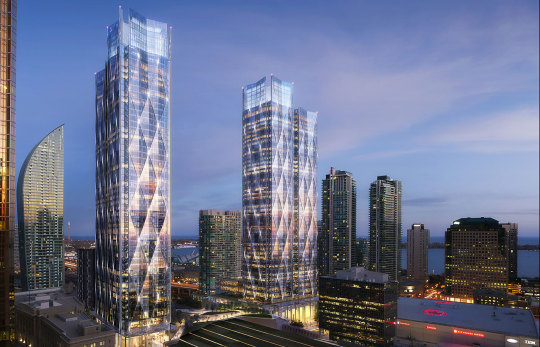
    Today, Microsoft announced that it will be moving its Canadian headquarters from Mississauga to the new CIBC Square development that is currently under construction in downtown Toronto (and rendered above). 

    According to RENX, Microsoft will occupy 132,000 square feet across 4 floors in the first tower. Occupancy is scheduled for September 2020.

    I love this project. The design architect is WilkinsonEyre. And there’s going to be an elevated one-acre park spanning the rail corridor between the project’s two towers.

    But it’s also noteworthy because it is an example of a major suburban tenant deciding to relocate to a transit-oriented urban environment. (I have a post on this somewhere.) 

    Image: WilkinsonEyre

  • 8 standards for transit oriented development

    Recently in the comment section of ATC, Lloyd Alter of Treehugger shared a great article talking about the 8 principles of Transit Oriented Development (TOD). “TOD” is one of those buzzwords (or buzz acronyms?) that gets thrown around a lot in city building and real estate circles. But I suspect that most people don’t exactly know what it takes to design and build successful TOD projects and neighborhoods.

    Which is why the Institute for Transportation and Development Policy came up with these 8 standards:

    1. WALK: Develop neighborhoods that promote walking
    2. CYCLE: Prioritize non-motorized transport networks
    3. CONNECT: Create dense networks of streets and paths
    4. TRANSIT: Locate development near high-quality public transport
    5. MIX: Plan for mixed use
    6. DENSIFY: Optimize density and transit capacity
    7. COMPACT: Create regions with short commutes
    8. SHIFT: Increase mobility by regulating parking and road use

    What should be apparent from this list is that the standards are quite clearly stacked against cars. Number 2 is about prioritizing non-motorized transport networks. And number 8 is about regulating parking use and road use. It’s about making a decision who you are planning for and acknowledging that when you do all of the above, you largely eliminate the need for driving.

    If you’re a “war on the car” kind of person, this might offend you. But if you look at the data I shared about a week ago (forgive me, I know the chart is a pain to read), you’ll see that it’s seemingly pretty difficult to design a city that’s equally great for both cars and for people. The cities where people love to walk, cycle, and take transit are precisely the ones where few people drive.

    Image: Flickr

  • Moving people instead of cars

    As of this week, Architect This City is now being syndicated on MobilityLab. Here’s the first post. MobilityLab is a US-based think tank focused on “transportation demand management”, which is just a fancy way of saying that their focus is on optimizing for the movement of people, instead of cars.

    Not every post from ATC will get syndicated on MobilityLab, but hopefully many of the ones focused on mobility will be. But really this post this just to tell you that if you’re interested in transportation, mobility and sustainability, you should check out MobilityLab

    To get you started, here are their top 10 stories from 2013.