Daily insights for city builders, delivered every morning at 6 AM ET. I’m Brandon Donnelly — a Toronto-based real estate developer and founder of Globizen. I’ve been writing here since 2013.

Tag: the guardian

  • An interactive map of industrial space in southern California

    Here is an interactive map, created by the Robert Redford Conservancy for Southern California Sustainability, showing the approximately 1,573,777,062 square feet of industrial space that can be found in Los Angeles, Riverside, and San Bernardino.

    The map allows you to zoom in on specific parcels to see things like site area, warehouse size, and year built. You can also play around with different map radii to create a rollup of warehouse space within a specific area, which includes an estimate of daily truck traffic and CO2 produced.

    The Guardian also used this data to create the following chart, which is helpful in showing the dominance of certain cities, as well as how much of this industrial space has been built since 2010:

    The point of this interactive map, this data, and the accompanying articles is to highlight just how disruptive all of this new industrial space is to these southern California communities and to the environment in general. But I think it is also an important reminder that, whether we like it or not, our online activities have real-world physical implications.

    Online shopping requires warehouses and logistics. Online food delivery requires (ghost) kitchens. And online activity, in general, requires the storage of unprecedented amounts of data. All of these “back-end spaces” take up room, even if they’re mostly easy to ignore when we’re just looking at our phones.

    This is our new “phygital” world and, yes, it is changing the landscape of our cities. Now our task is to figure out how to do this in a way that respects communities and respects the environment.
  • A tale of two different kinds of Brutalism

    This article from the Guardian about two Brutalist housing estates in London is now more than five years old. But the story is perhaps just as interesting. The article is about two “New Brutalism” estates that were designed and built in the 1960s and 1970s.

    The first is the Barbican Estate (which appeared recently on the blog over here) and the second is Robin Hood Gardens (pictured above, partially). Both were designed by notable architects and both have been equally divisive when it comes to their aesthetic appeal. We’re talking about Brutalism. So it’s likely that you either love them or hate them.

    One of the big differences between these two housing complexes is that one is a private estate and the other is (or was) social housing. And perhaps because of this, the Barbican has remained desirable and Robin Hood Gardens was ultimately demolished starting in 2017. This is despite numerous outcries from the architecture and design community that it should be both preserved and listed.

    We could get into questions of funding and maintenance, as well as the design differences between the two complexes (I don’t have any of these details), but even without all of this, I find these two divergent outcomes pretty interesting. Architecture, it would seem, isn’t everything.

  • The world’s biggest fishing port

    Here is an excerpt from a Guardian article that was published last year (by Tim Burrows) about Grimsby, England:

    In Grimsby’s 1930s heyday, fishermen used to head to Freeman Street as soon as they were off the trawler, straight to the Lincoln or the Corporation Arms to spend their bountiful earnings. A century previously, Grimsby had been a fairly sleepy fishing village, but by the 1890s it was on the way to becoming the biggest fishing port in the world. In the mid 20th-century, trawlers were bringing in 500 tonnes of fish a day.

    Today, Grimsby still has a thriving indoor market (paid for by the EU and the Enrolled Freemen of Grimsby, an organisation that dates back to the 13th century), but the further north towards the docks you walk, the emptier and more dilapidated things get. A local businessman says sex workers wait around at night for lorries to take them to the deserted docks. “It’s a legacy of the old fishing days.”

    There is scant legacy to be found elsewhere. After a long decline, the fishing industry died in the mid 1980s, its owners selling their trawlers to companies in Aberdeen or Japan. Unlike Hull across the river, currently basking in its year as Capital of Culture, Grimsby is the Humber city that never was.

    More than 70% of people in Grimsby, England voted to leave the European Union in the 2016 “Brexit” referendum. It was one of the highest shares in the country. But with one of the highest unemployment rates in the country, that outcome is not all that surprising.

    Supposedly, at its peak, there were eight onshore jobs for every one at sea in Grimsby. And like all thriving cities, there were economies of agglomeration, which resulted in things like the largest ice factory in the world. The fishing fleets needed crushed ice — and lots of it.

    The Grimsby story is, of course, not a unique one. You just have to replace fishing with some other industry. Many cities have managed to diversify their economies either out of necessity or because they saw the writing on the wall. But for others it has been a real struggle.

    It’s one of those things that is perhaps simple, but far from easy.

  • The next 15 megacities

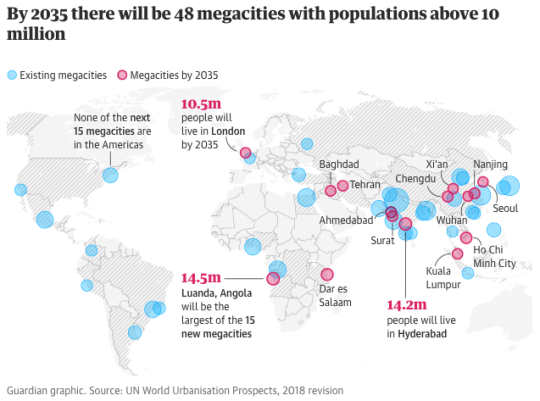
    The Guardian is running a series right now called: The next 15 megacities. A megacity is typically (but loosely) defined as a city (or metropolitan area) with a population of at least 10 million people. 

    By 2035, another 15 cities are expected to become megacities according to the United Nations. Hence the above series. None of these new entrants will be in the Americas. And only one – London – is anticipated to be in the West.

    The first city in their series is Baghdad. The second is Dar es Salaam. And the third, and latest, is Tehran. They are such interesting reads.

    I have said this before on the blog, but the pace of growth in many of these cities is astounding. Dar es Salaam – one of the fastest growing cities in the world – is adding about half a million people ever year.

    For the full megacities series, click here.

  • Thoughts on California’s wildfires

    What is happening in California right now is both sad and scary. I woke up to these photos in the New York Times. So I spent the morning reading up on wildfires and what causes them. 

    I am sure many of you are thinking: Is climate change doing this?

    It’s important to note that California is designed to burn. The characteristics that make the state a highly desirable place to live – mild winters and hot and dry summers – also make it a highly flammable place.

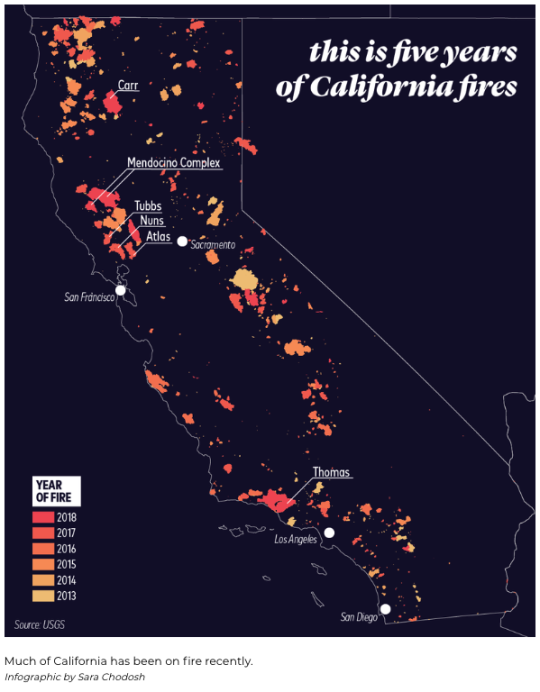
    Below is a map from Popular Science showing how much of California has burned over the last 5 years. Most of California’s hottest fires (13 of the top 20) have occurred since 2000.

    image

    But these naturally occurring fires are actually important for the regeneration of its forests. So one argument is that the current policy of “total fire suppression” is actually partially responsible for this increase in severe wildfires.

    Low-intensity forests aren’t burning like they used to and it is creating more densely packed forests for even larger wildfires. In other words, through our actions we could be exchanging smaller and more frequent fires for bigger and more severe ones.

    The other concern is development. 

    California had a population of about 24 million people in 1980. Today it is closer to 40 million. And much of that growth has occurred outside of existing urban areas (too hard to build). This has meant more people living in suburban and rural areas – adjacent to wildlands.

    Ed Glaeser has repeatedly argued that the best way to respect nature is to actually stay as far away from it as possible. Humans are a destructive species. Living in a dense city is good for the planet.

    Now let’s address the climate change issue.

    Daniel Swain, who is a climate scientist and author of the Weather West blog, published this popular thread on Twitter about a day ago. At the time of writing this post, it had been retweeted and liked over 10,000 times.

    From his perspective as a climate scientist, this is not all about climate change. That’s the wrong question to ask. It’s more complicated and nuanced than that. But climate does indeed act as a “threat multiplier” to the other factors we’ve already discussed.

    Fire season typically begins and ends with rain. When the fall rainy season starts, the fire season ends. One of the biggest risk factors is a dry fall, particularly after a hot and dry summer (or after multiple hot and dry summers, as has been the case in California). 

    Because according to Swain, fall means the start of “offshore wind” season, which can help to stoke these wildfires. 

    Unfortunately, one of the projected outcomes of climate change for California is more precipitation concentrated in the “winter” months, at the expense of precipitation in the shoulder seasons (spring and fall). So that means a longer fire season.

    Swain believes that if Northern California had received close to its typical amount of rain this fall, it is almost certain that this tragedy would have been avoided. 

    That, however, makes me wonder about the relative importance of all the factors we have discussed today.

    For Daniel Swain’s full thread, click here.

  • Long live the neon

    image

    I like this article and photo essay in the Guardian talking about “Hong Kong’s fight to save its neon shimmer.” Neon lights have been a ubiquitous feature of the Hong Kong nightscape since about the middle of the 20th century. They were an outcropping of increasing economic prosperity. And in many ways they really represent the culture of the city – a frenetic free market where entrepreneurs have no choice but to compete for attention. 

    But thanks to more restrictive sign ordinances and new technologies (though LED can be made to look pretty similar to neon), there’s growing concern that a fundamental part of Hong Kong’s urban landscape may be disappearing. The article mentions a newish (2017) advocacy group called the Hong Kong Neon Heritage Group, which is trying to raise awareness about the city’s remaining lights.

    Love live the neon.

    Photo by Sean Foley on Unsplash

  • Cities with perfect climates

    Last year Nolan Gray mapped out “the cities of the world where you don’t need AC or heat.” And just recently he updated his data with the help of Guardian Cities for their “sweltering cities” series. As part of the study, they projected out average temperatures, in both the summer and winter, to 2059, showing which cities may become more dependent on air conditioning. The answer looks to be many.

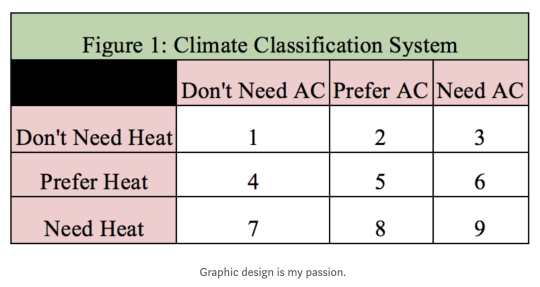
    In his original study, Gray had 9 climatic categories, all of which were based on average high and low temperatures throughout the year. Category 1 was you definitely don’t need AC or heat. These cities are essentially perfect year round. And category 9 was you definitely need heat and AC. These cities are basically the worst places on earth to occupy from a climate perspective.

    Here is that climate classification system in lovely chart form (note his caption):

    The climatic utopias ended up being places like Bogotá, Guatemala City, Lima, Mexico City, San Diego, São Paulo, and Sydney. The worst places were the southeastern United States, Central Asia, and northern East Asia.

    But one factor that is not included in the study is humidity, which Gray rightly points out has a meaningful impact on comfort. Toronto, for example, is classified in his system as category 7. Heat needed. But AC definitely not needed. Personally, I would bump us up to category 8: AC preferred, but not needed.

    Still, this is an interesting study. There are relatively few cities with so-called perfect climates. And I have always found these sorts of climates fascinating because they empower a very different kind of relationship to outside spaces.

  • The 100 million city

    The Guardian recently published this reminder that the real population growth in the world today is happening in Asia and Africa. The article is called, “The 100 million city: is 21st century urbanisation out of control?” Much of the data is from this 2016 paper by Daniel Hoornweg and Kevin Pope, which projected the populations of the world’s biggest cities by 2100.

    The standout example is that of Lagos, Nigeria, which went from under 200,000 people in the 1960s to an estimated 20 million people today. Though, I would imagine that the ubiquity of informal settlements makes it difficult to come up with an accurate number.

    Still, it is one of the world’s top 10 largest cities and, by 2100, it may be the largest city in the world. The Guardian described the population as young, fertile, and increasingly urban. The median age in Nigeria is 18 and the fertility rate for the content is 4.4 births per woman.

    I am mentioning all of this today because I think it grants some perspective. This is an immense city building challenge, not only because of the unprecedented growth rate, but also because it remains largely poor. Lagos, a city, may add more than 2.2x the population of Canada, a country, during the balance of this century.

  • Big bad developer

    I just stumbled upon an older (2014) article by Oliver Wainwright in the Guardian called, The truth about property developers: how they are exploiting authorities and ruining our cities. In case the title didn’t give it away, it’s a scathing article about the current state of real estate development and city building.

    Here’s an excerpt:

    “Across the country – and especially in superheated London, where stratospheric land values beget accordingly bloated developments – authorities are allowing planning policies to be continually flouted, affordable housing quotas to be waived, height limits breached, the interests of residents endlessly trampled. Places are becoming ever meaner and more divided, as public assets are relentlessly sold off, entire council estates flattened to make room for silos of luxury safe-deposit boxes in the sky. We are replacing homes with investment units, to be sold overseas and never inhabited, substituting community for vacancy. The more we build, the more our cities are emptied, producing dead swathes of zombie town where the lights might never even be switched on.”

    Now, I’m not that familiar with the London market, so I can’t really comment on the dead swathes of zombie town. But I did enjoy the insights into the UK entitlement process.

    At the same time, my overarching thought as I read through the article was that I don’t believe that making money and doing what’s right need to be mutually exclusively. You can do both in development and in business. Making money as a developer does not mean you have to build shitty buildings.

    Part of the development game is managing an endless number of competing tensions. And profitability and responsible city building is just one of them. Of course, you have to want to do the right thing in the first place.

  • And the award for the tallest building of the year goes to…

    The Guardian recently published an article on vanity height in skyscrapers. What this is referring to is the unoccupied portions of tall buildings which are built purely for vanity reasons – that is, to increase the face height of the building and claim some superlative title.

    Example: 

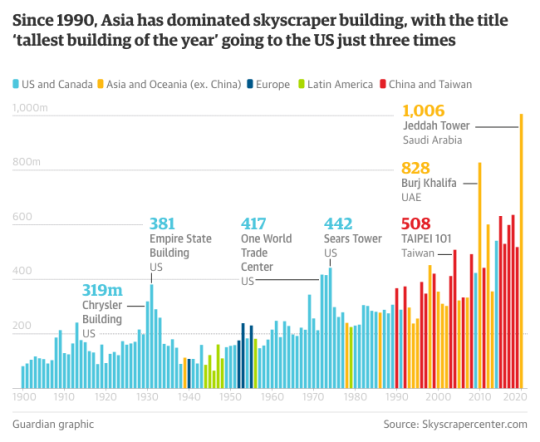
    The tallest building in the world is currently the Burj Khalifa in Dubai. It’s 828m tall. To put that into perspective, the CN Tower in Toronto is 553m. But according to the Council on Tall Buildings and Urban Habitat, 29% of the Burj Khalifa’s height is actually unoccupied or “vanity space.” In other buildings, such as the Burj al Arab (also in Dubai), the amount of unusable space is as high as 39%. 

    For the purists out there, this of course raises the question of what should should be counted when assessing building height. Should it only be spaces where humans typically inhabit? The CN Tower has a lot of unoccupied space, which is why it is frequently excluded from these sorts of ego rankings. 

    But semantics aside, this is obviously not a new phenomenon and it’s interesting to think about this race to the sky as a proxy for what’s going on in the world. Below is a chart showing which regions have been able to lay claim to the “tallest building of the year” since 1900. 

    Since 1990, it has been all about Asia and Oceania and China and Taiwan…