Daily insights for city builders, delivered every morning at 6 AM ET. I’m Brandon Donnelly — a Toronto-based real estate developer and founder of Globizen. I’ve been writing here since 2013.

Tag: the globe and mail

  • What’s next for Canada’s housing market?

    Rachelle Younglai’s recent piece in the Globe and Mail does a great job summarizing Canada’s COVID-19 housing boom. The title of the article is, “How Canada’s real estate market defied expectations in the COVID-19 pandemic.”

    Non-mortgage debt is down. Mortgage debt is up. Money is cheap. And people are clamoring for drivable vacation homes. Average home prices in places like Prince Edward County and the Kawartha Lakes (both outside of Toronto) are up ~30% from Jan 2020 to Jan 2021.

    But after I sent this article around this morning, I was reminded that this is a good summary of what has just happened. It, for the most part, does not speak to what might happen going forward.

    None of us can travel anywhere. We’re stuck at home. And immigration volumes last year were down some 48% in Toronto, 43% in Vancouver, 40% in Montreal, and 46% in Calgary. The Toronto region went from about 120,000 new permanent residents in 2019 to about half that last year.

    The behaviors and market outcomes that we have seen over the last 12 months, therefore, make intuitive sense. But how about the next 12 months or the next 5 years? I would prefer to use this latter time period for decision making right now.

    Chart: The Globe and Mail

  • Metrolinx to further optimize the Union Pearson Express train

    It was announced this week that Metrolinx will be making changes to the popular UPX train service that connects Union Station to Toronto’s Pearson International Airport. This is an interesting transit story. And as someone who will be moving to the Junction (adjacent to one of the stops along the way), I have a vested interest in this announcement.

    The UPX started out as a high-priced boutique train service to the airport. A one-way fare was $27.50 per person (without a PRESTO card). This was too much and I argued that here on the blog. If you looked at the math and compared it to the alternatives, such as taking an UberX, most people were not going to take this train.

    The fares were ultimately dropped — by a lot — and the service then took off not only as a link to Pearson but as an inner-city commuter service. I now sometimes call it the Union-Junction Express, because the actual train ride from Union to Bloor St (at Dundas West) is about 7 minutes once you’re on the train.

    The announcement this week merely solidifies the train’s evolution from high-priced boutique service (which didn’t work) to airport/commuter service (which is really working). The trains are expected to run more frequently now, some of which will continue to make the same stops as today and some of which will stop in new locations along the line.

    As transit-advocate Cameron MacLeod said in the Globe and Mail yesterday, “there’s both good and bad news here.” The good news is more frequent service. Even quicker trips in some instances. And better integration with the broader GO train network. The bad news is the award-winning UPX station at Union will no longer be needed. The service is expected to move to a new platform.

    Photo by Sean Thoman on Unsplash

  • An example of city building doublethink

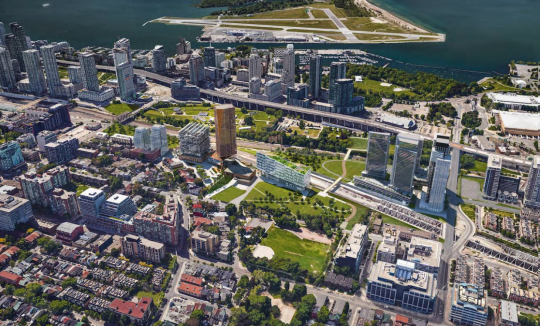
    Earlier this month, Shane Dingman wrote a piece in the Globe and Mail talking about TAS’ proposed development for 2 Tecumseth Avenue here in Toronto – the former home of Quality Meat Packers, a slaughterhouse. In the article there’s a quote from Mazyar Mortazavi, which I posted to my Instagram (as a story), but that I have been meaning to also post to the blog. So here it is: 

    “It’s not a conversation about towers good, towers bad: Mid-rise is the most expensive construction typology and it delivers effectively luxury housing, so it doesn’t respond to the needs of affordability,” he said. “We didn’t buy Tecumseth to build a bunch of condos and move on. We bought it because we wanted to pursue a vision around city building. You need density … the question is how do we actually deliver density that’s relevant today and relevant 50 years from now?”

    He’s of course right about mid-rise construction costs. There are diseconomies of scale and other construction inefficiencies that we have talked about many times before on this blog. The result is one of the Catch-22s of city building. Mid-rise and small scale infill is often seen as desirable, but we also say that we need more affordable housing.

    It’s doublethink.

    Image: 2 Tecumseth by KPMB Architects for TAS

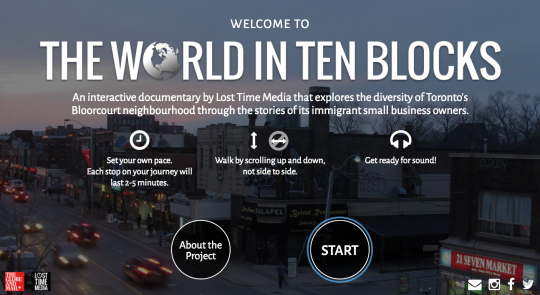
  • The World in Ten Blocks

    “Toronto is probably the world’s most diverse city.”

    That is how a new interactive documentary called The World in Ten Blocks starts. Produced by Lost Time Media and hosted at theglobeandmail.com, the documentary examines a ten block stretch of Toronto’s Bloorcourt neighborhood and tells the story of a diverse set of small-business owners who have moved to this city from all around the world. People from Guyana, Mexico, Nicaragua, Saudi Arabia, as well as many other places.

    It’s amazing to be reminded just how diverse ten small blocks of this city can be; especially at a time when immigration has become such a polarizing topic around the world. I sometimes take it for granted just how diverse this city is. I forget and assume that this is just how cities are. But of course that is not always the case. Toronto is an exceptional city.

    Click here for The World in Ten Blocks.