Daily insights for city builders, delivered every morning at 6 AM ET. I’m Brandon Donnelly — a Toronto-based real estate developer and founder of Globizen. I’ve been writing here since 2013.

Tag: texas

  • World’s largest 3D-printed community

    I’m not sure how I missed this before, but ground has just been broken on what is being called “the world’s largest 3D-printed community.” Co-designed by ICON and Bjarke Ingels Group and “implemented” by Lennar, the community, which is located north of Austin, Texas, will consist of 100 homes ranging from 1,500 to 2,100 square feet. There are 8 different floor plans and 24 different elevations to choose from. Each home will also come with rooftop solar panels.

    Here’s a short description on how the overall construction process is working:

    To automate the manufacturing of homes ICON is using its Vulcan robotic construction system, a large, transportable printer that can be used in tandem with Magma, a cement mixing machine. The homes are being constructed out of Lavacrete, a durable-concrete polymer added in layers to form the structure’s facade and foundation by Vulcan. Their design blends Texas ranch vernacular with sustainable technology, providing a model for the future of large-scale 3D construction. The residences will adhere to a common design, featuring metal roofs, concrete floors, and distinct curvilinear and rib-textured concrete walls, which are the product of 3D printing.

    It is quite a different looking construction site:

    Now, there is certainly a conversation to be had about what these machines are building as a housing typology: This is still suburban sprawl, regardless of how the homes are being made and if there are solar panels on the roof. But if you ignore all of this for a minute, there is obviously something pretty incredible about 3D printing being able to now deliver stuff at the scale of a suburban housing project. It represents a fundamental change in how we build, in an industry that has a long history of changing very little.

  • US migration patterns according to one-way U-Haul truck transactions

    One of the ways to try and keep tabs on where people are moving is to look at the number of permanent address changes. Another way is to look at the number of one-way U-Haul trucks that enter versus leave a particular state. And it turns out that if you’re U-Haul, you do care to track where all of your trucks are going. Each year in the United States there are about 2 million one-way truck transactions.

    Looking at the data from 2020, the top inbound destinations — that is, the states that had the largest net gain of one-way U-Haul trucks — were (1) Tennessee, (2) Texas, and (3) Florida. This is a big jump for Tennessee as it was 12th in 2019. Texas and Florida, on the other hand, were similarly in the top three last year. In last place on this list is California, meaning that it had the largest net loss of one-way U-Haul trucks leaving the state.

    Overall, this data continues to reinforce a shift that is taking place toward more affordable housing markets, such as those in the southern United States.

    For the full U-Haul article, click here.

    Photo by Tanner Boriack on Unsplash

  • Where Americans moved over the last year

    According some recent data from the US Census Bureau and USPS (via this CityLab article), the number of Americans who registered (between March 2020 and February 2021) that they were making a permanent move somewhere else, only increased by about 3%. And the vast majority of people that did move tended to simply spread out and move within the same metro area — about 84%. About 7.5% moved within the same state. And about 6% moved to some other top 50 metro area in the US.

    Some are of the opinion that these moves to the outskirts of cities would have happened regardless. The pandemic simply sped things up. Perhaps. But whatever the case may be, CityLab and others have argued that an “urban exodus” is likely the wrong way to describe what is happening. Despite reports that everybody seems to be moving to Texas and Florida (yes, Miami saw a spike), most people are simply spreading out in geographies where they already happened to live.

    The notable exceptions are the Bay Area and New York. San Francisco and San Jose — both of which usually register as being two of the most expensive housing markets in the US — saw permanent moves increase by 23% and 17%, respectively. Compared to other metro areas in the US, these figures stand out. (I assume this data is collected after somebody goes to the post office and says that they want to change their address forever.)

    But we are already seeing net outflows from San Jose and San Francisco start to taper off (see above). It’s also important to keep in mind that these cities were losing people well before the pandemic started. They are expensive places. And the fastest growing cities tend to be ones that sprawl, have a more elastic housing supply, and are consequently more affordable. That said, I suspect we’ll see this tapering off continue. The “urban exodus” isn’t going to be what it’s cracked up to be.

    Images: CityLab

  • Crossing the chasm in Austin

    I can’t open Twitter these days without seeing someone in the tech industry talking about moving or talking about someone who just moved to either Austin or Miami. “What’s the best neighborhood in Miami for startups? My friend just moved to Edgewater. Where did so-and-so move?”

    Here’s a recent article from the WSJ talking about how accelerated tech-fueled growth is straining Austin. And below is a set of charts (from the article) comparing home prices in Austin and San Francisco. (Reminder, the California-to-Texas migratory pattern recorded the highest number of “net movers” last year.)

    But in reading through the article, I am reminded that the challenges facing Austin are not entirely unique. Growing cities all around the world are being put in a position where they need to decide whether they want to remain car-oriented and relatively low-density, or if they want to make the shift toward more transit-oriented urbanism.

    It’s admittedly not easy, both politically and practically speaking. It’s hard to rewrite deeply entrenched built form. But Austin is naturally looking at what happened in San Francisco, where restrictions on new development are thought to be partially (largely?) responsible for the city’s unaffordable housing.

    According to the same WSJ article, voters in Austin turned down two previous transit proposals. One was in 2000 and the other was in 2014. There was concern over too much urbanization. There was concern it would induce more people to move to the city. And there was concern that it would threaten the city’s low-rise single-family homes.

    But this year a transit plan was approved that includes three new rail lines, one of which will tunnel through downtown. Provided that Austin can effectively pair this with more housing, more uses, and more density — which is generally what you need to make transit work — then it may be well on its way to crossing, if you will, the chasm of urbanity.

    Charts: WSJ

  • Where people are moving in the US

    Another day, another set of announcements about large companies and rich people moving to lower cost US states. Yesterday it was announced that Oracle will move its corporate headquarters from Silicon Valley to Austin, Texas. (If you remember, Elon Musk also recently announced that he had moved himself to Austin from California.) The company has said that the move puts Oracle in the best position to grow and to give its employees greater flexibility about where and how they work.

    While these sorts of moves are making headlines right now, it’s important to keep in mind that this is not necessarily a new phenomenon. In fact, depending on how you look at it, you could argue that these headlines are a lagging indicator for trends that have been underway for some time. Below is a chart from New Geography showing the top 50 state-to-state moves last year. Number one is the move from California to Texas with 45,172 net movers. And number two is the move from New York to Florida with 38,512 net movers.

    According to New Geography, California saw a net domestic migration loss of 912,000 people from 2010 to 2019. And the most popular receiving states are what you would expect: Florida (1,230,000 people) and Texas (1,146,000 people). A big part of this story obviously has to do with housing affordability and the search for an overall lower cost of living. As well, since companies are always in need of young and smart talent, it makes since for them to locate in places where young and smart people want to live.

    But urbanists like Richard Florida have also pointed out at this relocation of companies could be a leading indicator for something else: the decline of innovation in America. Here, he argues that in the nascent stages of a new invention, there tends to be a tight clustering phenomenon. Think steel in Pittsburgh, cars in Detroit, and computing in Silicon Valley. However, as the industry matures, the tendency to centralize seems to decline and companies then start moving around.

    I’m not yet convinced that this is what’s happening. Because there seems to be a pile on happening in specific cities like Austin (which, by the way, I hear is terrific). Even before this pandemic, there was a growing sense (from the outside, mind you) that the Bay Area had simply gotten too expensive, both for individuals and for companies. It would seem that when you greatly restrict the supply of new housing and make it unattainable for many, people go find housing somewhere else. Sometimes in other states.

    Photo by Tomek Baginski on Unsplash

  • Zoning in Silicon Valley, New Haven, and Austin

    Robert C. Ellickson’s recent paper, titled Zoning and the Cost of Housing: Evidence from Silicon Valley, Greater New Haven, and Greater Austin, really holds back when it comes to the shortcomings of zoning ordinances. Here’s an excerpt:

    Zoning, as practiced in much of the nation, gravely misallocates resources. Some distortions are micro, such as the mediocre siting of Anton Menlo housing [a project by Facebook], and the lack of walkable neighborhoods in New Haven suburbs. Others are macro. If Silicon Valley were more populous, it would be a world tech center even more attractive to IT workers. The misuse of zoning squanders land, adds to the nation’s carbon footprint, warps interstate migrants’ choices about where to reside, and helps price poor households out of wealthier neighborhoods that would offer better life prospects for their children.

    The paper focuses on three metropolitan areas: Austin, Silicon Valley, and New Haven. Of these three, Austin is the most permissive in terms of allowing new and denser housing. Silicon Valley and New Haven, by contrast, have done a great deal to limit intensification by adopting exclusionary policies.

    In 1970, home prices in Silicon Valley were only slightly above the national average. Today, they are by far the highest in the United States, which is, of course, partially a result of high demand (tech salaries) and low supply (zoning ordinances). Ellickson’s paper examines the effects of the latter.

    If you’d like to download a copy, click here.

    Photo by Carlos Delgado on Unsplash

  • Algorithmic home buying — what’s the end game?

    Bloomberg recently published a good summary of Zillow’s business and their move into algorithm home buying and flipping. (They are trying to avoid the “flipping” moniker because of the negative connotations associated with it.)

    Zillow started buying homes directly from owners last spring. They charge the seller between 6-9%, so more than using a typical agent, but inline with their competitors. There’s clearly a segment of the market willing to pay a premium for the added convenience.

    The thinking used to be that discount brokerages were the way to disrupt the housing market. This is the opposite strategy.

    Interestingly enough, Zillow felt that they needed to make this pivot with their business model. It used to be about selling ads. They were definitive in that they were not a disruptor of real estate agents.

    But now:

    If getting an offer from an iBuyer became a crucial step in the selling process, they worried, Zillow could lose its audience and its advertising base. What’s more, market researchers kept finding that consumers said they’d pay a modest premium to get a cash offer. “People expect to press a button and have magic happen,” says Rascoff, a 43-year-old former Expedia executive who’d earlier started the travel search engine Hotwire, which he sold to Expedia for $700 million. Getting into the business of buying homes directly, Rascoff says, was “the only way to remain in a leadership position.”

    Here is a map of the companies in this particular space and the cities in which they operate:

    Some investors aren’t sold on this strategy and have begun short selling Zillow (according to the Bloomberg article). I keep getting the sense that there’s a greater end game in the cards here. It is about building up A (algorithmic home buying and flipping) in order to unlock B.

    But what’s B — a new end-to-end transactional model for the housing market?

  • Houston, the global city

    Houston doesn’t often get a lot of love in urbanist circles.

    Though since Ed Glaeser published Triumph of the City and declared Houston’s unfettered sprawl the secret sauce for housing affordability, it is now frequently held up as the shining example of why housing supply matters.

    But this is a hotly debated topic. 

    Ed Glaeser would argue that increased supply is the key to housing affordability. But Richard Florida would likely be quick to point out that Houston is also one of the most unequal and segregated cities in America. It is not the model we should be following.

    But let’s be positive today on the blog.

    At the bottom of this post is a great talk by Stephen Klineberg called: Houston, The Global City. Klineberg is a Professor of Sociology at Rice University and the founder of the Kinder Institute for Urban Research.

    In this hour long talk, he outlines, among other things, the remarkable transformation of Houston from a one-industry town (oil) comprised predominantly of white people to a mixed economy where every major ethnicity is now a minority.

    He also argues that Houston is at the forefront of the demographic shifts happening all across the country and that, without this inflow of immigrants over the past couple of decades, Houston today would probably look a lot like a decaying rustbelt city.

    It’s a good watch.

    If you can’t see the video below, click here.

    [youtube https://www.youtube.com/watch?v=SJdWYXIr_qE?rel=0&w=560&h=315]

  • Is sprawl to blame (at least partially) for the flooding in Houston?

    What’s happening in Houston right now is devastating. Ian Bogost of The Atlantic is calling the flood a “disaster of biblical proportions.” Harvey has unloaded 9 trillion gallons of water.

    It is once again reminding us of the importance of resiliency when it comes to our cities.

    One emerging argument is that this is an almost inevitable outcome for Houston, brought on by the multiplicative effects of climate change, unfettered urban sprawl, and poor design decisions.

    The barriers to development are famously low in Houston, which allows the city to quickly add housing and people. There are many benefits to this. 

    But it also means that there has been, among other things, a dramatic increase in the amount of impervious surface.

    This matters because impervious surface creates runoff.

    According to The Texas Tribune, impervious surface in Harris County (third most populous county in the U.S.) increased by 25% between 1996 and 2011. 

    And it replaced things like the below prairie grass (switchgrass), which are highly absorbent as a result of their deep root system. 

    But much like climate change, not everyone believes this is to be blamed. 

    For more on this, check out The Texas Tribune’s full interactive piece. It’s called “Boomtown, Flood Town” and it’s worth a read.

    Image from The Texas Tribune

  • Follow the sun and sprawl

    image

    The U.S. Census Bureau recently released it’s 2016 city and town population estimates. The press release can be found here.

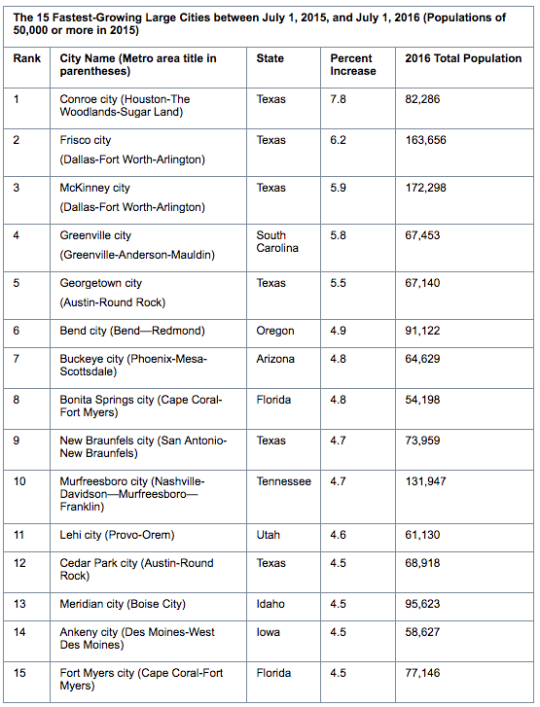
    The headline isn’t a new one. Southern cities continue to grow quickly. This is not a new trend. Humans seem to like warm weather and the housing supply in southern cities tends to be more elastic. This keeps home prices relatively in check and allows the cities to more easily accommodate growth.

    From July 2015 to July 2016, 10 of the 15 fastest growing large U.S. cities were in the south (based on % growth). 4 of the top 5 were in Texas. 

    From 2010 to 2016, the population in large southern cities grew an average of 9.4%. Cities in the west clocked in at 7.3%. And cities in the northeast and midwest were at 1.8% and 3.0%, respectively.

    Two outliers near the top are Seattle and Denver. Since 2010, the population of these two cities grew 15.39% and 14.87%, respectively. I’m going to say it’s because of the skiing and snowboarding. Half-joking. For the top 25 large cities ranked by 2010-2016 growth rate, click here.

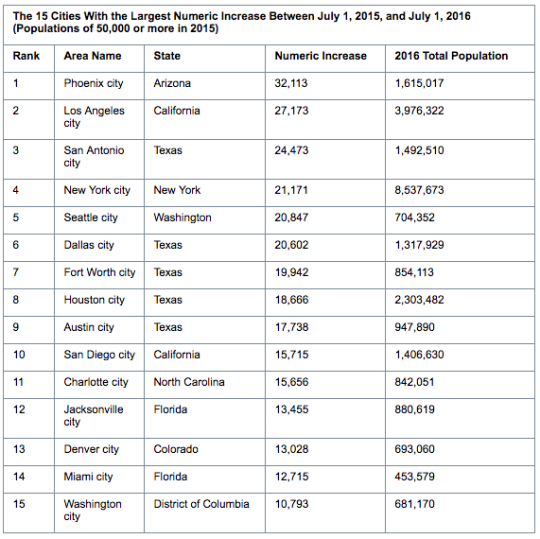
    In terms of absolute humans, Phoenix had the largest numeric increase between 2015 and 2016: 32,113 or about 88 people per day. After Phoenix it’s Los Angeles (27,173), San Antonio (24,473), New York (21,171), and Seattle (20,847). These are all city proper figures.

    It’s also worth noting which large cities aren’t growing. From 2015 to 2016, Chicago fell -0.32% and Detroit fell -0.52%. Philadelphia was only slightly positive at 0.19%. Going back to 2010, Chicago is still flat at 0.27% and Detroit is even more negative at -5.39%. Philadelphia is 2.5%.

    Follow the sun and the sprawl.

    The below charts are from the United States Census Bureau.

    imageimage