Daily insights for city builders, delivered every morning at 6 AM ET. I’m Brandon Donnelly — a Toronto-based real estate developer and founder of Globizen. I’ve been writing here since 2013.

Tag: technology

  • Apple and Google are building a voluntary contact-tracing network for COVID-19

    Venture capitalist Albert Wenger wrote on his blog today that the road back from COVID-19 could start — as early as May — provided we’re able to get our act together around three essential things: masks, tests, and tracing for everyone. We have all been talking about the importance of these things over the last few weeks, but I think it’s worth mentioning just how quickly some of this is starting to happen.

    Both Apple and Google have announced that they are building a voluntary contact-tracing network. By May, they hope to release a set of APIs that other software developers will be able to build on top of. Bluetooth will be what is used to detect when humans are in close proximity to each other. Eventually, both companies plan to integrate contact tracing right into their operating systems.

    Here’s how it might work:

    Of course, we are also seeing new startups emerge, like this one here called Coronatrace.

    Similar to what Apple and Google have in mind, the app will be a voluntary contact-tracing network. By using it, your phone will begin to log how you move about, something that is already happening today with many of the apps we already use. Should someone test positive for COVID-19 (they would need to update their health status within the app), it would then immediately notify the network and anyone who might have crossed paths with them.

    Obviously it would be far better to simply have a vaccine. But the experts are saying that will take some time — 12 to 18 months? And in the interim, we’re going to need to get the global economy back up and running. Seeing solutions like these being developed makes me hopeful we’ll be able to do that sooner rather than later.

  • The future of clothing

    Today’s post is going to be a bit of a departure from our regularly scheduled programming. But it’s so cool that I had to share it. It’s a company called Vollebak, and they use science and technology to make highly technical clothing (or, as they call it, the future of clothing). It was founded by two brothers.

    Every month they launch a new clothing concept. (Sign up here if you want to get on their list.) But each new piece they develop could take anywhere from one to five years to actually produce. Usually we’re talking about new production methods and materials that have never before been used for clothing.

    Examples include an indestructible puffer jacket designed to help us withstand up to -40 degrees; a solar charged jacket; a “black squid jacket” that reflects visible light to go from black to bionic; and a plant/algae t-shirt that is grown and can later be composted.

    But the piece I’m really eyeing is this blue morpho ski/snowboard jacket. It uses two billion microscopic glass spheres to try and replicate the wings of a blue morpho butterfly. During the day the jacket is matt blue. But as soon as you shine light onto it, it looks like the above photo.

    This would be useful if you were, say, caught in an avalanche and a helicopter searchlight was trying to find you. Hopefully that’s a use case that none of us have to experience. But it could also be invaluable if you were out walking or cycling at night and you wanted to make sure that cars could see you.

    (Please note how I somehow managed to make this post mildly relevant to cities.)

    Image: Vollebak

  • Standing on the shoulders of giants

    “Every failed idea from the dotcom bubble would work now.”

    Marc Andreessen

    Every year, Benedict Evans publishes a “big presentation” on the current trends in tech. They are always excellent and they help to put a lot of things into perspective. This year he covers everything from TV subscriptions to online mattress companies (there were 175 of them as of last year), and asks: What’s next in tech?

    New technologies have typically come in S-Curves (see above). They start out slow, see rapid growth, and then taper off. To use Benedict’s wording, they go from stupid to exciting and then to boring. Smartphones are currently in the boring phase. Each new year sees only incremental change. So, what’s next? That is still TBD.

    To download a full copy of the presentation, click here.

    Slide Image: Benedict Evans

  • Non-load-bearing curtain wall

    image

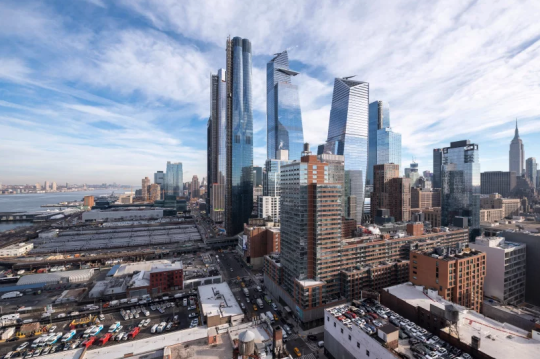
    Liz Diller of Diller Scofidio + Renfro was recently asked by designboom about how her firm approached the design of Fifteen Hudson Yards (the first residential tower in New York’s Hudson Yards).

    The firm had never designed a high-rise before. So while their typical approach would be to analyze program, here they were heavily informed by the views – both in and out from the site – as you move up the tower.

    The 88 storey tower transitions between two footprints. The base matches the street grid of the city, but as you move up the tower it transforms into a cloverleaf – allowing panoramic views of the city.

    It is a somewhat similar approach to what has been proposed by Studio Gang for One Delisle. Except for the transformation here is to a multifaceted cylindrical shape (a hexadecagon is what has been drawn).

    From the late 19th century when Chicago began to pioneer the modern skyscraper, architects and engineers have been thinking about how you treat a tall building as you move from top to bottom.

    Chicago architect Louis Sullivan responded to this challenge with his tripartite approach to design. He believed that tall buildings should be characterized by three main divisions: a base (bottom), a shaft (middle), and a cap (top).

    The technological innovation that allowed this thinking to flourish was the non-load-bearing curtain wall. Once the exterior walls of a tower no longer supported the actual building, architects then had the freedom to really experiment.

    This remains true to this day, but we no longer need to confine ourselves to only three parts. New technologies now allow for more.

    Today we have parametric modeling and other design tools that allow us to create new geometries and transitions; forms that would have been pretty complex to draw up in the past. 

    In the case of Fifteen Hudson Yards, every floor plate from 20 something and up is slightly different. I wonder what Louis would think of this.

    Image: Timothy Schenck via designboom

  • The rise of proptech

    A friend of mine flipped me this New York Times article today talking about the rapidly growing interest in proptech and about Opendoor – a topic and a company that I have written about many times before on the blog.

    Here’s a snippet about proptech:

    The hauls are part of a race by investors to pour money into technology for real estate, or what Silicon Valley now calls proptech. Having watched tech start-ups upend old-line industries like taxis and hotels, venture capitalists are casting about for the next area to be infused with software and data. Many have homed in on real estate as a big opportunity because parts of the industry — like pricing, mortgages and building management — have been slow to adopt software that could make business more efficient.

    On the Opendoor front, which is the largest/most valuable company in the proptech category, they have now raised over $1 billion. By the end of this year they plan to be in 22 cities across the United States.

    Interestingly enough, they have started experimenting with other business models, beyond just buying and flipping homes. They now circumvent agents and sell some homes directly to customers.

    But Eric Wu, the CEO of Opendoor, believes that you can’t automate proper advice and so that will remain. The role of agents is simply about to shift from “administration” to that of “advisory”.

    I have been arguing for years that the home buying and selling process is ripe for change. And what we are seeing today is really the start of that.

    According to the NY Times, real estate tech startups raised $3.4 billion in funding last year. Some firms, such as Fifth Wall Ventures, are entirely dedicated to the space.

    This is money betting on change.

    Photo by Grant Lemons on Unsplash

  • Autonomy, sometimes

    Benedict Evans raises a number of good points and asks a bunch of good questions about the “steps to autonomy” in his recent blog post.

    Right now we’re all talking about autonomous vehicles in terms of their level of autonomy – namely 1 through 5. L1 is some degree of autonomy, but in almost all situations, you still need a human driver. L5 is no human driver needed, ever.

    But as Evans points out, the level of autonomy depends on the place, and it is unlikely – at least initially – that L4 or L5 will mean L4 or L5 in all environments. Here is an excerpt from his post:

    It naturally follows that we will have vehicles that will reliably reach a given level of autonomous capability in some (‘easy’) places before they can do it everywhere. These will have huge safety and economic benefits, so we’ll deploy them – we won’t wait and do nothing at all until we have a perfect L5 car that can drive itself around anywhere from Kathmandu to South Boston. And so, if we call a car even L4, we have to say, well, where are we talking about? We might mean ‘most of this country’. But more probably, it will be L4 in one neighborhood, L3 in another and only L2 in a third – and a car might encounter all three of those on one journey. Put your route into the map and it will tell you if today is an L5 day or not.

    Thinking about the Gartner Hype Cycle, there’s often (always?) a “peak of inflated expectations”, as well as a chasm that new technologies need to cross as they are being adopted.

    Benedict’s article reminded me that we’re probably coming off that peak with autonomous vehicles and about to enter the so-called “trough of disillusionment.” 

    Autonomous vehicles represent a monumental shift in mobility, which will in turn impact our cities. That’s going to seem like an insurmountable challenge – until it doesn’t.

  • What’s the realtor jiu-jitsu move?

    Today’s post is a set of related questions for all of you.

    Fred Wilson has a post up on his blog today called, The Jiu-Jitsu Move. It’s about how people often dismiss new technologies, market entrants, and/or consumer behaviours as silly; whereas the real power move is to embrace and leverage them. That’s what he is calling the jiu-jitsu move.

    He gives a few examples, but for obvious reasons this one stood out to me:

    I spent the day yesterday at a real estate industry event and talked to a lot of agents about the fact that their clients are often more informed than they are these days. I encouraged them to embrace that fact and use it to their advantage and not fear it. It is hard when you have grown up in an industry when your advantage was information and you no longer have that working for you.

    For all the agents (and real estate consumers) who read this blog, I am curious if you agree with the above. Are consumers increasingly more informed than agents? I am sure that many of you will disagree. But if things are really changing, what should the jiu-jitsu move be?

  • Experiences over fashion — or is that really the case?

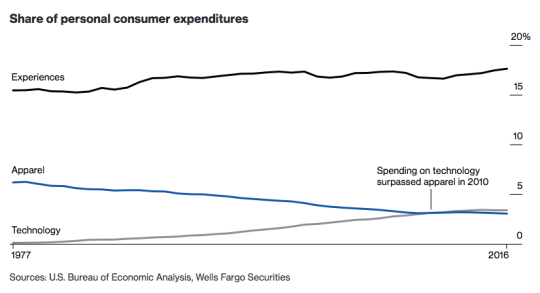
    Bloomberg recently published this interesting piece talking about the death of clothing. The reasons are as follows: we’re spending more on experiences, as well as technology (tech spending surpassed apparel spending in 2010); casual dress in the workplace has become more widely accepted; fast fashion companies like H&M and Zara are putting downward pressure on prices; and social media influencers – instead of big companies – are now the ones showing us what to buy and wear.

    Here is a graph from the article comparing experiences, apparel, and technology expenditures: 

    image

    The first thing I noticed is that experiences, while still increasing, haven’t really spiked since 1977, even though everybody seems to be talking about how social media-fueled Millennials are all about experiences. I was also surprised to see that the share of US employers that allow casual dress every day seems to be closing in on 50%. (Informal survey for the comments and for Twitter: Do you wear casual clothes to work? I’m a no.)

    But perhaps the biggest contributors to this decline are fast fashion and low-cost manufacturing. Stanley Pignal – South Asia business and finance correspondent for the Economist – pointed out on Twitter that since 1982 inflation in US apparel was only 123% compared to 248% for overall CPI. So maybe a lot of the above reasoning is just a distraction.

  • In defense of Instagrammable moments

    Surface Magazine – and more specifically the CEO of Surface Magazine – recently published this article criticizing the “trend” toward designing for Instagrammable moments.

    Here is an excerpt:

    We—and yes, this includes architects, too—have succumbed to the pressures of gaining followers, likes, and comments. High-priced, difficult-to-attain architecture degrees are now, incomprehensibly, being used to create “Instagrammable” installations for things like impromptu selfie fashion shoots and hotel lobby photo booths. The whole thing is, I must say, sad. It’s embarrassing enough that our team at Surface has received press releases from architects promoting their latest project with “Instagram-friendly interiors.” They can’t be serious.

    And here are his final words:

    If retail is dead, then its rebirth will depend on creating memorable atmospheres that don’t call for #✌💙👯🙋📷.

    I certainly appreciate the push for lasting and memorable spaces, but, at the same time, I can’t say I’m nearly as fussed about lobby selfies and the alleged timelessness of Instagram. 

    In fact, I think it would be an interesting exercise to study how social media may be impacting the way we design physical spaces.

    Maybe it is simply a fad being promulgated by “knucklehead junior marketers” or maybe 100 years from now nerdy architectural historians will look back on that quaint period of time when we designed spaces to service rudimentary 2D images shared amongst friends.

    Whatever the case may be, I think that architecture, like all art, should embody the milieu in which it was designed. 

    But often we have biases telling us that what is new is not as good as what’s existing and already accepted.

  • The scale of Apple’s iOS economy

    This is an interesting post on the size of “the iOS economy.” 

    About 70% of customer spending on Apple’s App Store goes to developers. The remaining ~30% is kept by Apple. 

    In 2017, iOS developers earned $26.5 billion. This is up about 33% from the year prior and is higher than McDonald’s revenue in 2016. Cumulatively, Apple has paid out about $86.5 billion to developers.

    And this past new year’s day, a new record was set with $300 million in App Store purchases. According to Horace Dediu, this year should average closer to $100 million per day.

    Also, this year’s App Store revenue is expected to surpass the film industry in terms of global box office sales. And we’re only talking about Apple. This does not include Android revenues.

    Click here to check out the full post.

    Photo by Ben Kolde on Unsplash