Daily insights for city builders, delivered every morning at 6 AM ET. I’m Brandon Donnelly — a Toronto-based real estate developer and founder of Globizen. I’ve been writing here since 2013.

Tag: tech

  • The taxi cartel

    https://500px.com/embed.js

    Early this morning Peter Cheney of the Globe and Mail published an article called: How Uber is ending the dirty dealings behind Toronto’s cab business.

    And I highly recommend you read it. He’s been investigating this industry for decades.

    Though the article is specific to Toronto, I know that there are middle people and archaic policies governing the taxi industries in many other cities around the world.

    Here it revolves around taxi licenses issued by the city (known as “plates”), which are expensive and almost impossible to get. Last year the average price of a plate was $118,235 (2014).

    The way it works is that people – typically non-drivers – buy/inherit/get these plates and then charge rent on them to drivers who want to use them. The result is a taxi cartel:

    In fact, Toronto’s taxi plate system is anything but free enterprise. Instead, it is based on the artificial restriction of a natural market, and the granting of licences to a fixed number of participants. Even those who paid top dollar for a plate used to enjoy an annual return of more than 12 per cent. And for those who inherited plates, the return was manna from heaven.

    So it shouldn’t come as a surprise that the taxi industry is grouchy about companies like Uber. But the cost structure of the incumbents is going to need to change if they want to stay in business.

    Jeff Bezos of Amazon is famous for saying, “Your margin is my opportunity.” And that’s exactly what is happening here. A bloated legacy cost structure is being quickly supplanted by better/cheaper.

  • The evolving gig economy

    This morning venture capitalist Fred Wilson wrote a post on his blog talking about the gig economy and Hillary Clinton’s economic speech last night. 

    Here’s a snippet from Clinton’s talk:

    Meanwhile, many Americans are making extra money renting out a small room, designing websites, selling products they design themselves at home, or even driving their own car. This on-demand, or so-called gig economy is creating exciting economies and unleashing innovation.

    But it is also raising hard questions about work-place protections and what a good job will look like in the future.

    So, all of these trends are real and none, none is going away. But they do not determine our destiny. The choices we make as a nation matter. And the choices we make in the years ahead will set the stage for what American life in the middle class and our economy will be like in this century.

    The headlines this morning are making it seem like Hillary Clinton is taking direct aim at companies like Uber. But the transcript suggests that she’s being far more balanced than that: these new companies are creating exciting opportunities, and they are not going away, but there are still things to figure out.

    That’s basically how I feel.

    Take, for example, Airbnb. I think Airbnb is a great idea and company. A lot of my friends use it both as consumers and as suppliers of space.

    But for many (most?) condos in Toronto, owners are strictly prohibited from renting out their units on leases that are less than six months. It’s a direct ban on short-term leasing and it’s written into the Condo Corporation’s Declaration.

    And there’s good reason for that. Who wants to buy a condo only to find out that next door is being operated as a nightly hotel? Most people would even prefer that their neighbor is an owner rather than a renter.

    That doesn’t mean I believe Airbnb should not exist. I think we’ll likely end up getting more transparent about how buildings (and portion of buildings) are operating, as opposed to it being a shadow economy. And that could help.

    If you have any ideas for how companies like Airbnb might be better integrated into urban life, I would love to hear from you in the comment section below.

  • Are there enough nerds in Miami?

    image

    I was browsing through my online reading list this morning (as I do every morning), and I stumbled upon this Dezeen article talking about a big new 6.5 million square foot development being proposed in Miami’s Park West neighborhood. 

    The goal of the project is to transform Miami into “Florida’s Silicon Valley.”

    This sort of thing is happening all around the world. From Buffalo to Lisbon, cities everywhere are betting on tech, startups, and entrepreneurship to grow their economy in the 21st century. And I personally think that’s really exciting.

    But as I was reading the article, I couldn’t help but think of an old essay that Paul Graham wrote back in 2006 called, How to be Silicon Valley. (Paul Graham is a famous Silicon Valley entrepreneur/investor).

    In his essay Graham argues that to be or to replicate the model of Silicon Valley in your city, you basically need two types of people: rich people and nerds. The idea, of course, being that the nerds work on the cool new ideas and the rich people then fund them.

    Using this logic, he specifically calls out Miami as a city where few startups happen and as a city not likely to become another Silicon Valley. Though there’s lots of money and rich people in Miami, there simply aren’t enough nerds. In Graham’s words: “It’s not the kind of place nerds like.”

    But that was back in 2006. 

    The iPhone didn’t even exist yet. Things have since changed. Now there are successful tech companies like Snapchat (valuation north of $15 billion) that are based out of cities like Los Angeles. And I think you could argue that Los Angeles and Miami do share some similarities.

    So while it may have seemed far fetched in 2006 for Miami to become a startup hub, is that really the case today?

    Image: Dezeen

  • How Bitcoin could transform home buying

    Earlier today a friend of mine sent me this Fast Company article talking about bitcoin and the future of home buying. I’m really glad he did. Both because I wasn’t yet sure what I was going to write about today and because this is a topic that I’m deeply interested in.

    I recently heard Brad Burnham (venture capitalist at Union Square Ventures) say in a talk that if you’re thinking about Bitcoin just as a currency, then you’re thinking about it in the wrong way. If you take nothing else away from today’s post, I think you should remember that. Bitcoin, and the underlying block chain architecture, have the potential to be very transformative.

    The Fast Company article was written by Matt Weiss of IDEO (the powerhouse design and innovation firm). Here’s an introductory snippet:

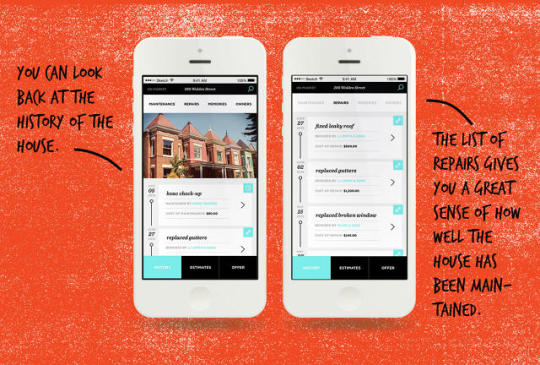
    Insert block chains: a relatively new and promising technology that could transform the way we digitally exchange value, similarly to how Internet protocols, like TCP/IP, transformed the way we exchanged information. For example, to transfer ownership of a home today, there are countless check of authenticity and intermediaries involved to insure the transfer is legitimate. By using a distributed database (a.k.a. “a block chain,” the same technology behind Bitcoin) to prove authenticity, we could legitimately transfer ownership immediately without the need of a middleman. In fact, when we think about block-chain technology and the industries it could disrupt, real estate tops the list. While Trulia, Redfin, Angie’s List and others have brought some transparency to the opaque world of home buying and home ownership, most of our experiences in this industry are fraught with incomplete, inaccurate, and asymmetric information.

    Following this, he goes on to talk about what it might be like – each step of the way – to buy a house using the block chain technology. There are even mockups of what the app could look like. I highly recommend you give it a read if you’re interested or involved in this space.

    The real estate industry hasn’t seen a lot of innovation. It remains an opaque market with lots of information asymmetries. I have no doubt that will one day change; it’s just a question of when. Perhaps it’ll be the block chain that makes that happen.

    Image: IDEO via Fast Company

  • Lisbon is the new Berlin

    Photograph Tramway à Lisbonne by yannick le goff on 500px

    Tramway à Lisbonne by yannick le goff on 500px

    This morning I stumbled upon a blog post by a Berlin-based venture capitalist (Ciarán O’Leary) talking about how Lisbon feels like the next Berlin. In other words, it feels like the next great European startup hub.

    Here’s his reasoning:

    • The tech scene is organic – it happened on its own, came out of nowhere. That is much more fun and sustainable than any kind of political or targeted economic strategy.
    • There are a ton of constraints (funding, local talent base, etc.) so entrepreneurs need to hustle to make things happen. Hustle is good.
    • Berlin was an economic void, Portugal had a massive economic crisis and Lisbon sure isn’t letting that crisis go to waste.
    • Entrepreneurship has the real chance to be a center stage act, not a side gig. It’s everywhere.
    • The city is very, very cool. You just want to be here.
    • You can have a great life on a startup salary.
    • Everyone speaks english; everyone is welcoming and open. That matters a lot when you want to attract international talent and funding.

    Of course, he’s not the only one calling Lisbon the next Berlin. The EU also named Lisbon “the most entrepreneurial region in Europe in 2015.” Isn’t it interesting what can grow out of economic crisis? See PIGS.

    I also don’t think it’s a coincidence that Monocle held its first ever Quality of Life Conference in Lisbon. It’s a testament to O’Leary’s point above that, “You just want to be here.”

    And while being “very, very cool” may not seem immediately relevant to creating a robust startup environment, it really is. It may be the most important point. It makes the city a magnet for talent. 

    Just the other day I was trying to explain Berlin to someone and I used a similar lexicon. I said: “It’s an unbelievably cool city. It bleeds hipness. You will love it.”

    If you’re a city, that’s a great thing to be.

  • Imagining the way things could be

    Photograph Old in new by Andrew Johnston on 500px

    Old in new by Andrew Johnston on 500px

    I was out for lunch with a colleague of mine yesterday afternoon and he said to me: “Brandon, I’m really surprised that you’re so interested in technology. It just seems so different compared to real estate and architecture.”

    And I’ve certainly heard that exact same comment from a number of people before. But I don’t see it that way and here are a few reasons why.

    The common thread for me between architecture, real estate development, and technology is that in all of these cases it is about imagining the way things could be in the future and then creating it. It’s about change. It’s about growth. It’s about creation. And I consider myself a builder in practically every sense of the word.

    At the same time, each of these disciplines is about creating engaging spaces for people. Architects and real estate developers do it in the physical world, but many technology products strive to do exactly the same thing in the online world.

    In fact, a couple of years ago I was fascinated to learn that Facebook has and continues to draw inspiration from many of the same books and philosophies that architects, planners, and developers rely on when it comes to creating engaging communities. The medium might be different, but it’s still about people.

    Finally, as I’ve said many times before here on Architect This City, I think that the distinction between tech and non-tech companies and industries is quickly evaporating. Is Airbnb a tech company or a hospitality company? Is Uber a tech company or a taxi company? Pretty soon we’ll be saying that about many other industries.

    Maybe it’s because I’ve always been interested in wading through the overlaps between disciplines, but this is just the way I see it.

  • Why Toronto-Waterloo needs all-day two-way urban rail service

    image

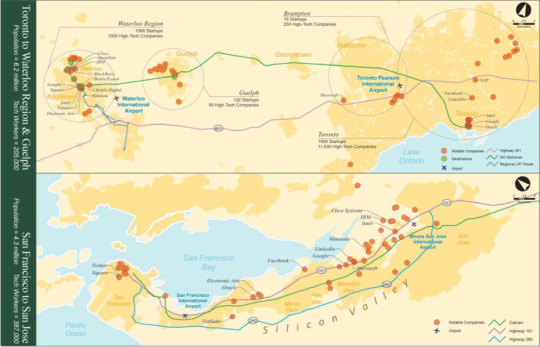
    This morning I stumbled upon an interesting Medium article talking about the need for an all-day two-way urban rail service between Toronto and Waterloo. 

    The argument is that along this corridor sits a technology ecosystem that is second in size only to San Francisco-Silicon Valley and that current connectivity levels represent a missed opportunity of epic proportions. Presently this rail service will feed you into Toronto during the morning rush hour and take you back out in the evening rush hour. But that’s it.

    According to this report prepared by the City of Kitchener (which is beside Waterloo), efficient train service would stitch together an ecosystem of approximately 12,800 technology companies, 2,800 startups, and 205,000 technology employees. It would also connect 6 universities and 4 colleges, many of which are ranked top in the world.

    There’s an argument here that this is exactly the sort of thing that governments should be doing to encourage innovation and entrepreneurship. Rather than trying to be heavily involved in actual startups, they should be creating an environment that maximizes output and then getting out of the way. 

    I think this makes a lot of sense. Don’t you?

    Image: The Innovation Express

  • Amazon Dash — foolish joke or disruptive innovation?

    [youtube https://www.youtube.com/watch?v=NMacTuHPWFI?rel=0&w=560&h=315]

    Earlier this week on the day before April Fools’, Amazon launched two new services. The first was called Amazon Dash (see above video) and the second was called Amazon Home Services. The entire internet seemed to think that Dash was actually an April Fool’s joke, but it turns out it’s not. In fact, it’s actually an incredibly smart product.

    The way it works is simple. Each branded Dash Button is about the size of a pack of gum. You mount it in, on, and near things that you replace on a regular basis, such as laundry detergent, coffee refills, and so on. Then all you have to do is push the button and your order gets sent to Amazon. Shortly after the product arrives at your door. I say “shortly” because you can be certain that Amazon’s goal is to make that time frame as short as physically possible.

    I don’t know about you, but I could definitely see myself using this product. There are a number of essentials – such as laundry detergent and toilet paper – that I just hate shopping for. I have to create reminder appointments in my calendar just so I don’t forget. In fact, I did that today and I still forgot to pick everything up on my way home (my phone died).

    But what’s even more interesting about Dash, I think, is that it increases the threat to brick-and-mortar retailing and, more specifically, big box stores. Because if same day and same hour delivery is a big threat to big box stores, just imagine one button and same hour delivery. And, is it only a matter of time before something like this comes to Apple Watch? It seems like the right medium for it.

    Isn’t it interesting how something that most people believe is a silly joke could actually turn out to be a huge innovation? I try to always remain open minded. Sometimes it’s hard. But it’s good practice.

  • “Project Snowball” cracks down on UberX drivers in Toronto

    https://500px.com/embed.js

    This afternoon I saw on Twitter that Toronto Police are now starting to crackdown on UberX drivers in the city. The investigation is called “Project Snowball” and they have already charged at least 11 people. The fines are anywhere from $200 to $20,000.

    My response on Twitter was the following:

    I get that Uber is a highly disruptive company. I’ve written about it many times before. But at the end of the day, this is not just about Uber. This is about a larger shift in the economy.

    The buzz term is “sharing economy.” But one of the ways I like to think about it is like so: Facebook doesn’t produce any of its own content, and yet you could define it as a media company. Airbnb doesn’t own any rooms, and yet it is disrupting hotels. Uber doesn’t own any cars or plates, and yet it is disrupting the taxi industry.

    What’s happening is that the internet and mobile phones are allowing for peer-to-peer connectivity and more decentralized forms of marketplace supply.

    What does that mean?

    It means that instead of having a fleet of cars or a centralized hotel building, anyone with an extra car or an extra room (and an internet connection) can plug themselves into the market. And that represents an entirely different cost structure for businesses.

    It’s worth noting that prior to Uber, Travis Kalanick founded a peer-to-peer music sharing company called Scour (1998). Its closest equivalent would have been Napster. Remember Napster? This is not a new trend.

    That said, I still think we’re at the early stages of this shift. I predict that many other industries will see disruptors similar to Airbnb and Uber. And so when I look at it in this context, I have a hard time believing that fining UberX drivers is the most enlightened way forward.

    I believe we should instead be taking a leadership position and trying to figure out how to adapt our rules and regulations to this changing economy. Toronto is not alone in this battle. But we could certainly be the one to lead the way out.

  • Towards more publicness

    Back when the commercial internet first started to take off it was uncommon to use your real name online. Instead people relied on usernames and other pseudynoms to represent themselves. I honestly can’t remember what I used in those days, but I’m sure it was something ridiculous.

    Over time though that started to change. 

    Blogging started to take off in the late 1990s. And we started to become more comfortable sharing personal information online. Perhaps the biggest shift though, came with the introduction of Facebook in 2004 (over 10 years ago!). All of a sudden people – young college students initially – started sharing lots of personal information online, including photos of themsleves and their friends.

    But this wasn’t an overnight change. When Facebook first launched, privacy was an important component. It still is, but I would argue that it has become less central given how public a lot of other social media platforms are today. Twitter, for instance, is what it is today largely because of its publicness. 

    For my own social media accounts, I have made every single one of them completely public. From Twitter to Facebook to Instagram to Snapchat, nothing I post to social media is restricted in any way. And I do that because I believe we are headed towards a world with more – not less – openness, transparency and publicness.

    Of course, I’m not just talking about social media and tech. I’m talking about open data in general.

    Earlier this year, the Toronto Real Estate Board clamped down on real estate brokers who were publishing historical sales data online. Citing privacy concerns, TREB ordered them to stop or lose their access to the MLS system. 

    For those of you not from familiar with the Toronto real estate market, historical sales data for homes is not open and published online. You generally need to go through a realtor to get access to this data. Some think this is the right approach. And others think it is antiquated.

    But as I explained above, our conception of what should be private can, and will, evolve over time.

    Here are the details on my home:

    I purchased it in September 2012 for exactly $400,000 (Canadian). It’s a 650 square foot condo in the St. Lawrence Market neighborhood of Toronto. It has one bedroom, a 400 square foot terrace, one parking spot, and 10′ ceilings.

    Sooner or later, I believe this information will be freely available online. But since that’s not the case today, I figured I would just tell you. Sharing this information is not a big deal for me.