
Daily insights for city builders, delivered every morning at 6 AM ET. I’m Brandon Donnelly — a Toronto-based real estate developer and founder of Globizen. I’ve been writing here since 2013.

Tag: tech workers

  • The Canadian Dream

    This has become a frequently reported topic, but here’s a recent article from Wired talking about tech workers living out the American Dream — in Canada. The story is pretty simple. Immigrants are smart and work hard. Canada has a system in place that privileges newcomers who are young and smart. And this has become a boon for our largest city and for the country. Here are two excerpts from the article:

    But there’s a new global winner: Canada, and particularly Toronto. Since 2013, the tech scene there has grown faster than in any other North American city. In 2017, Toronto added more tech jobs than Seattle, the San Francisco Bay Area, and Washington, DC, combined; in 2018 (the most recent year for which numbers are available), the city was second only to the Bay Area in new tech jobs. Toronto is so crammed with immigrants that nearly 50 percent of all residents were born outside the country.

    Canada’s immigration policy is hardly warm and fuzzy. On the contrary, it’s icily calculating. The government loves educated, elite newcomers, because they help propel the economy, says immigration lawyer Peter Rekai, but it wants them young, so they won’t drain the public health care system. Their parents are much less welcome.

    In the first quarter of this year, international migration accounted for 82.3% of Canada’s population growth. And at the beginning of this year, Ottawa was planning for up to 370,000 new permanent residents. It is highly unlikely that we hit that number given our current health crisis, but I have no doubts in my mind that we will hit it in the very near term. And when we do, it will be a good thing for Toronto.
  • Maple Valley? No.

    At this time of year, I am always amazed by the number of mass emails that I receive from unknown people and companies. They have my email address, clearly, and yet I only receive one email a year from them – a happy holidays email. I am not opposed to holiday cheer. I love Christmas. But if you’re looking to build any sort of meaningful rapport with an audience, my sense is that you ought to send more than one email a year.

    In other news, the Economist published an article this past week talking about how Toronto is attracting disaffected (Indian) tech workers from the US and, more particularly, Silicon Valley. It is largely a story of immigration and diversity. But at the end of it, the Economist also reports that some people are now calling Toronto, Maple Valley. Toronto immediately reacted to this moniker – negatively.

    Nobody refers to Toronto as Maple Valley. And these sorts of names are stupid. In the 1990s, the Flatiron District in Manhattan started being called Silicon Alley (at least by some). That name was also stupid. New York is New York. And Toronto is Toronto. If you’re going to assign a nickname, it should not be derivative. And in the case of Toronto, you probably also want to avoid kitschy Canadian stereotypes.

  • What happened (in tech) in 2017

    I am still catching up on reading after being mostly offline last week, minus short windows where I would go online to upload these daily blog posts.

    Here is a post that Fred Wilson wrote on new year’s eve about “what happened in 2017.” It has become a tradition of his to write a “what happened” post on the last day of the year and a “what is going to happen” post on the first day of the new year. He then uses these posts to keep track of how well he does on his predictions for the year.

    His three headlines for 2017 were: (1) crypto; (2) the beginning of the end of white male dominance; and (3) the tech backlash (i.e. tech is the new Wall Street). It is worth a read. Crypto was an obvious one, but he has been writing about it – and investing in the space – for years. Of particular interest in this post is how he positions it as the basis for Internet 3.0 (the decentralized internet).

    What is also clear from the post is just how ingrained tech has become in our everyday lives and how much it reaches beyond simply the tech industry. I have been saying this for years, which is why I spend a lot of time writing about it on this blog.

  • How should cities manage their own awesomeness?

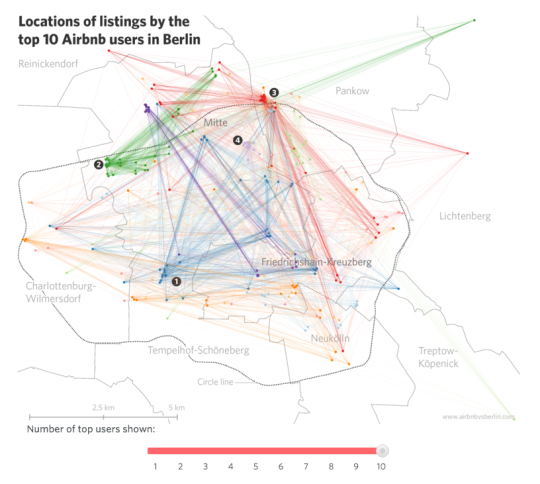
    Conor Maguire introduced me to an interesting site today called Airbnb vs. Berlin. The site does a deep dive into Berlin’s Airbnb market with the hope of answering the question: Is Airbnb contributing to a shortage in affordable housing?

    The site is very well done. It’s filled with lots of great market stats and diagrams such as this one here: 

    Of course, the impetus for a site like this is that cities all around the world, from San Francisco to Berlin, are grappling with rising home prices. If you happen to live in a successful, growing city, that’s probably what is happening.

    But when this happens, we seem to want to look for something or someone to blame. In San Francisco it’s the tech workers. They’re the ones driving up homes prices. In Vancouver, it’s the foreign Chinese buyers. And in Berlin, it’s those Airbnb users who are just out to make a profit. In all of these cases, we like to tell ourselves that if we could just get rid of “X”, everything would be much better. 

    But I think sometimes we forget that this is also the result of doing many things right.

    If Berlin wasn’t a brilliantly cool place to visit, then tourists wouldn’t come. And if tourists didn’t come, then Berlin wouldn’t have, by far, the largest Airbnb market in Germany. If Vancouver wasn’t one of the most enjoyable places in the world to live, you wouldn’t have the same attention from overseas buyers looking to snatch up properties. 

    So in a way, we should be asking ourselves: How do we, as a city, manage our own awesomeness?

    The other thing that Airbnb vs. Berlin reminded me of is the viewpoint that profits are some dirty little secret. I hear it all the time in the real estate development business. People will say: “That developer is just out to make money.” Of course she/he is! They operate a business. And like all for-profit businesses, one of the objectives – it may not be the only one – is to make money.

    I say all this not as a direct response to the website. They remained fairly neutral in their analysis. Instead, I raise it as an alternate viewpoint in the seemingly universal battle against “X.”

    In case you’re wondering about Berlin’s Airbnb market, the site estimates that there are roughly 11,701 Airbnb listings in the city out of a total of about 1.9 million flats. Of these listings, it is estimated that somewhere around 30% are by “professional users” who are only out to make a profit and are not participating in the “sharing economy” in its purest sense. That equates to about 0.18% of all Berlin flats.

    Based on this number, I’d say that Berlin’s cool factor probably has a lot more to do with the city’s rising rents than do the profit seeking Airbnb users.