Daily insights for city builders, delivered every morning at 6 AM ET. I’m Brandon Donnelly — a Toronto-based real estate developer and founder of Globizen. I’ve been writing here since 2013.
A few weeks ago the WSJ published an article about Toronto’s growing tech talent pool, arguing that its base now rivals the top US cities, but that it may not be an entirely good thing for the city’s ecosystem. I wrote about it here.
This morning venture capitalist Fred Wilson published a post on his blog talking about the necessity of scaling tech companies in lower cost locations. It’s a good follow-up to the above article/post.
Here’s an excerpt from Fred:
Last week I heard some shocking numbers about salary levels for certain kinds of engineers in the bay area. I checked them out with a few of our bay area portfolio companies and they were more or less corroborated.
The tight technical labor markets in the bay area, NYC, and a number of other regions in the US are making it hard to scale software businesses without burning massive amounts of cash.
He goes on to argue that (startup) companies now need to think about scaling in other/remote locations sooner than they ever have before — basically as soon as the company hits about 50 engineers (or 100-200 employees).
Many companies are now working with a distributed workforce. Supposedly 2/3 of the global workforce now spends at least one day of the week working remotely. I almost never work from home, but I do get how this is possible.
So what is happening is that engineering talent is spilling over into secondary markets out of necessity. There’s an economic imperative to colonize. But I would imagine that, at least initially, most of the economic benefits accrue to the colonizer.
The Wall Street Journal’s recent piece about “Silicon Valley invading Toronto” is, in my view, describing a generally positive outcome.
We are one of the largest cities in North America (the exact ranking depends on where you draw the urban boundaries).
We have more enlightened views around foreign and high-skilled workers (I was given a short window in which to leave the US after I finished my first graduate degree there).
And we have a large and highly educated pool of tech talent (the salary differential discussed in the article looks to be, at least partially, a result of the weaker Canadian dollar).
US companies are gobbling up office space in Toronto. And presumably, this is one of the reasons why 139 new flights were added between Toronto and Francisco over the last two years. (Source: WSJ)
However, I do agree with the remarks from people like Jim Balsillie (Blackberry) and Harley Finkelstein (Shopify) that a better outcome would be the creation of more massively successful Canadian tech companies.
As Finkelstein points out, there’s a big difference between 100,000 square feet of space for the HQ of a new and growing Canadian tech company and 100,000 square feet for a new branch or satellite office.
The stats we read in the papers about the number of tech jobs being created in Toronto generally don’t speak to composition. Where in the value chain do these people sit? Where is the value accruing?
The intellectual capital is here. And we should be doing everything we can to foster and finance new homegrown ideas and businesses.
Sidewalk Labs just released its draft Master Innovation and Development Plan (“MIDP”) for Toronto’s eastern waterfront. It’s called Toronto Tomorrow: A New Approach for Inclusive Growth, and it’s massive. Over 1,500 pages. It consists of an overview and 3 volumes, all of which can be downloaded here.
At a high-level, the objectives of the plan are twofold. They want to revitalize the eastern waterfront (it’s currently appalling) and they want to test new urban ideas that could benefit the broader city, as well as the rest of the world. Deploying new technologies at a larger scale is one of the ways the company intends to make money.
I am still working my way through the plan (I may never finish), but here’s a breakdown of the development program for the Quayside precinct:
If you’re looking for a quick overview of the plan, here are five things to know about the Sidewalk Toronto project and here is an overview of the public-private partnership that they are proposing. Of course, there’s also no shortage of criticism on Sidewalk’s plans for the waterfront. Some links here, here, and here (paywall).
Sidewalk Labs is trying to assuage public concerns through some of its open commitments. They have said that they will not seek special tax subsidies, control urban data, sell personal info and/or use it for ads, or develop the entire eastern waterfront themselves. But the plan remains highly controversial.
I think part of the issue is that, because so much of what they are proposing hasn’t been done before, there are a lot of unanswered questions and a great deal of uncertainty around the future. Many are interpreting this as the company hiding its true intentions. Maybe it is. Or maybe it isn’t.
But let’s not forget what Waterfront Toronto requested back in 2017 for these lands. It wanted an innovation and funding partner:
Waterfront Toronto is seeking a unique partner, one with invention ingrained in its culture, which can transform conventional business practices and help to establish a benchmark climate positive approach that will lead the world in city building practices.
There’s no question that what Sidewalk Toronto has put forward is bold. As I scanned through the plans today, I found myself hard pressed to think of any “conventional” developer that would be willing to come forward with a proposal as ambitious as this one.
As you all know, Sidewalk Labs’ parent company is called Alphabet. But I think it’s worth mentioning that “alpha” is a finance term that refers to the excess return of a strategy beyond that of a benchmark index. Put differently: How much better are you than the status quo?
The whole point of Alphabet is that they’re supposed to make “alpha bets” on ambitious projects. They are given the “resources, freedom, and focus” to try new things. Sometimes those projects will fail. But in other cases they will succeed in moving the world forward.
Every city today is trying to grow a thriving technology ecosystem. We want to be innovative. We want to transform conventional businesses practices. And we want to lead the world. Unfortunately, that rise to the top is almost never a smooth and linear one. There will be mistakes along the way.
Wired’s oral history of how the London startup scene came to be is a good reminder that, typically, a city needs some great big exits (acquisition or IPO) to really kickstart an ecosystem. In the case of Silicon Valley, you could perhaps trace things back to Fairchild Semiconductor (1950s). But a more recent example of this phenomenon would be the PayPal Mafia, whose members have gone on to found Tesla, LinkedIn, YouTube, and other companies that you may have heard of.
Put simply: success begets success. When a startup does really well and the founders and employees of that company get rich, it is likely that many will go on to found/fund other successful companies in that same city. In the case of London, that catalytic startup was arguably Skype (at least according to Wired). Microsoft acquired the company in 2011 for $8.5 billion, giving birth to the Skype Mafia. Of course, that wasn’t the only ingredient, but it sure helped (excerpt from Wired):
Since 2008, according to data compiled by Dealroom.co, the UK has created 60 unicorns (tech companies valued at $1bn or more) – 35 per cent of the 169 created across Europe and Israel. In the past three years, the UK has created more unicorns (25) than France, Germany, the Netherlands and Sweden combined (19). And London has produced 23 unicorns with a combined value of $132bn, compared with Berlin’s eight, worth $32bn.
The world has changed since Skype was founded. It’s now cool to be doing a startup. But given that every city seems to be trying to establish a thriving startup scene, I think it’s valuable to point out just how important a single big exit can be, not just for the people within the company, but for the broader city. Easier said than done, right?
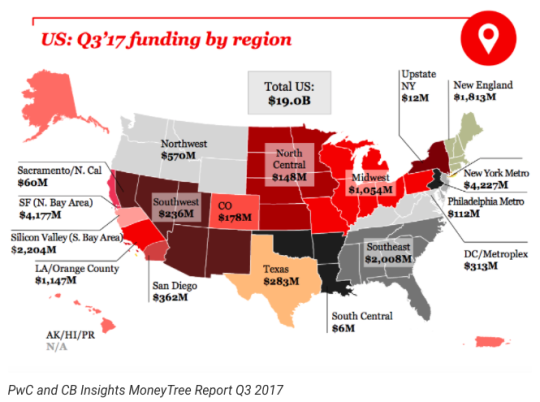
The Q3 2017 Moneytree Report from PwC and CB Insights was recently released. It tracks venture capital trends in the US and globally.
Last quarter, US venture capital-backed companies saw $19 billion in total funding across 1,207 deals. Perhaps most notably for the US, funding in the NY metro area rose 57% to $4.227 billion and inched out the San Francisco Bay Area ($4.177 billion).
But this was really because of two epic rounds to WeWork (NYC HQ) totalling around $2.5 billion. Also, Silicon Valley ($2.2 billion) is tracked separately to the San Francisco Bay Area in the report.
Still, there’s a real sense that the New York tech ecosystem is on the rise and that it is probably furthest ahead in the US in terms of being able to catch up to California.
Last week, MongoDB (NASDAQ: MDB) went public. Albert Wenger, who is an investor in the company, argued on his blog that this is an important milestone for technology companies based in New York.
It’s the first core technology company (instead of applied technology company) to go public in the city and it’s a big step forward in terms of demonstrating that “geography is no longer destiny.”
You don’t have to move to the Bay Area to win in tech.
They estimate that there are over 400,000 tech jobs in Toronto, out of a total of 2.7 million people employed. That number includes tech people working for non-tech companies, and tech and non-tech people working for tech companies. So tech jobs are thought to represent about 15% of the city’s employment.
Within this 400,000 or so jobs, an estimated 93,000 people are self-employed (23% of tech jobs). And the belief is that there are around 2,500 to 4,100 active “startups.”
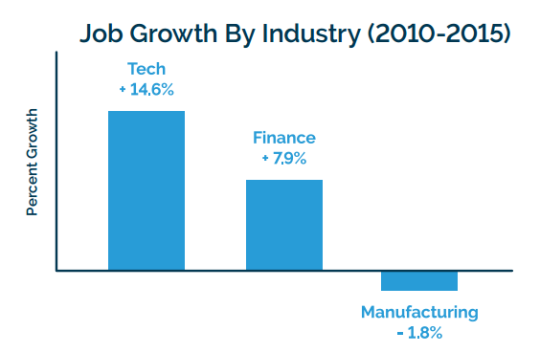
Zooming out, it is also one of the fastest growing industries in the city:
To try and put this into perspective, a similar report for New York – published in 2014 – reported 291,000 tech jobs out of 4.27 million people employed. I was a bit surprised by these numbers, but the Toronto report seems to have been modeled after the New York one. So presumably they use similar methodologies.
Of course, there’s the big question of quality over quantity. There’s a certainly a difference, in terms of impact to the economy, between a back office tech job and fast growing startup that will eventually reach the coveted $1 billion valuation number and create thousands of new jobs.
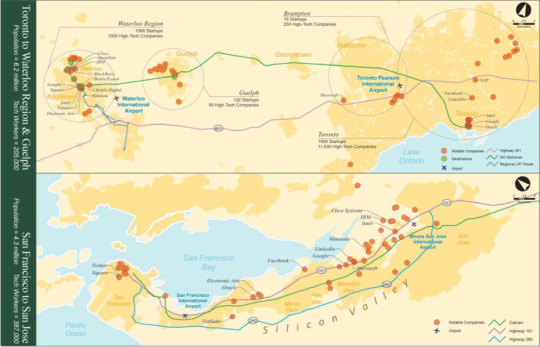
This morning I stumbled upon an interesting Medium article talking about the need for an all-day two-way urban rail service between Toronto and Waterloo.
The argument is that along this corridor sits a technology ecosystem that is second in size only to San Francisco-Silicon Valley and that current connectivity levels represent a missed opportunity of epic proportions. Presently this rail service will feed you into Toronto during the morning rush hour and take you back out in the evening rush hour. But that’s it.
According to this report prepared by the City of Kitchener (which is beside Waterloo), efficient train service would stitch together an ecosystem of approximately 12,800 technology companies, 2,800 startups, and 205,000 technology employees. It would also connect 6 universities and 4 colleges, many of which are ranked top in the world.
There’s an argument here that this is exactly the sort of thing that governments should be doing to encourage innovation and entrepreneurship. Rather than trying to be heavily involved in actual startups, they should be creating an environment that maximizes output and then getting out of the way.