
Daily insights for city builders, delivered every morning at 6 AM ET. I’m Brandon Donnelly — a Toronto-based real estate developer and founder of Globizen. I’ve been writing here since 2013.

Tag: taxi

  • The PRESTO Push

    image

    Back in 2004, I spent a summer living in Asia. And one of the things that I remember really standing out for me was Hong Kong’s Octopus card. It’s a refillable card that you just tap to get onto transit. Lots of cities have them.

    But the cool thing about the Octopus card was that you could use it so many other places besides just on transit. I don’t know know what it’s like today in Hong Kong, but I remember also using it in taxis and to buy breakfast in the morning at Pret a Manger. That was pretty incredible for 2003.

    This was also great for me because I’m one of those people that dislikes carrying around paper money/change. I almost never spend my change and so it just ends up just accumulating in a container beside my front door. Here in Toronto we also use microscopic transit tokens, so that adds another layer of inconvenience.

    But that’s all changing.

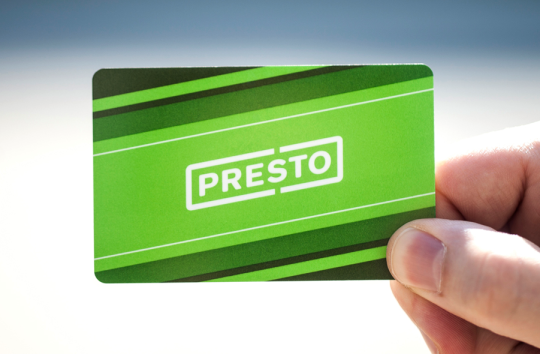
    Toronto now has its own version of the Octopus card and it’s called PRESTO. Technically it launched in 2009, but I only recently noticed the card readers appear at my home subway station (King Station). So tonight I decided to finally pull the trigger and order a card. I’ve been waiting 11 years for this moment 🙂

    And I was doing that, I noticed this message on the website:

    image

    Not surprisingly, we seem to be pushing to get PRESTO rolled out before the world comes to visit. And I think that’s a great thing.

    One of the big benefits of hosting an event like the Pan Am Games or the Olympics is that it creates a hard deadline to get things done, which is something governments often need. It’s a bit like tidying up before guests come over for dinner. You find a way to do it before people arrive.

    There’s a lot of debate about whether or not it makes sense for cities to spend the money on playing host city. But I don’t think we should ignore the fact that they can be a great catalyst for city building. Things get done. And oftentimes done is better than perfect.

    Good news: I’ve been told that the PRESTO system will be compatible with mobile phones and near field communication. Because let’s face it, cards won’t be around that much longer.
  • The Tesla Easter egg

    I was rushing to get to a real estate forum dinner last night and so instead of walking — which is normally what I would have done — I decided to grab an UberX. As some of you might be aware, I like UberX. It’s convenient to use. And the fares are cheaper than regular taxis. So why wouldn’t I use it?

    But last night I got an extra treat. A guy named Mike picked me up in his Tesla Model S:

    //platform.twitter.com/widgets.js

    According to Mike there are two of these “Easter eggs“ in the UberX Toronto fleet, which I was also told is now up to hundreds of cars. So it’s not everyday that you’ll get picked up in a Tesla.

    If you’ve never been in a Tesla, the first thing you’ll likely notice is the absolutely epic screen that sits in the dash. Most people’s laptops don’t have a screen this big. It’s gorgeous.

    But there are a bunch of small details that also standout. For example, the door handles sit flush with the door until they’re needed. Here’s a video of how they work:

    [youtube https://www.youtube.com/watch?v=UxavZ2QxuLY]

    But the real question that is probably on your mind is: Why is some guy with a Tesla driving around Toronto offering rides via UberX? That was certainly one of the first questions I asked him after I got in the car.

    And the answer is that he does it for fun.

    He actually owns a medical clinic in Markham, but comes downtown on the evenings and weekends to drive around and meet new people. In fact, he called it the “best networking tool on the planet.” Because as soon as he picks people up in his Tesla, they immediately take him seriously and want to have a conversation. That has translated into business relationships and even invites to parties. As in, he drives a group to a party and they ask him to come in — which he said he often does.

    If he really took it seriously and did it full-time, he figures he could make around $40,000 – 50,000 a year driving for UberX. And I believe that’s close to what a regular taxi driver would make. But again, that’s not why he’s doing it. Isn’t it interesting how things change?

  • Toronto seeks injunction to stop Uber

    image

    One evening this past spring I was leaving a Rotman School event at Liberty Grand on the west side of Toronto. There aren’t a lot of taxis coming through this part of the city, so I figured I was going to have to wait while I hailed one from my phone. But as luck would have it, one happened to be pulling up just as I walked out of the hall.

    As he drove up and rolled down the window, I told him that I was going to the St. Lawrence Market area and that I needed to pay by credit card (I was trying to be a nice guy and avoid the inevitable fight when he was dropping me off). He responded by saying, “My machine is broken. Can’t you pay with cash?” I told him, “No, unfortunately I don’t have any cash on me. I need to pay with credit card.” He then rolled up his window and drove up closer to the entrance of the hall.

    Faced with this scenario, I did what most people would probably do nowadays: I pulled out my phone so that I could hail either an Uber or a Hailo cab (I’m sad that Hailo has since left the North American market). I decided on Hailo (it was cheaper until UberX came along) and ordered a car.

    But within a few minutes, the same taxi with the broken credit card machine circled back around, rolled down his window, and told me that his machine was now working and he would take me to the St. Lawrence Market. Knowing exactly what had happened, I said to him, “Wooooow, that’s funny that within the span of a few minutes your machine has magically started working again.” He wasn’t happy with that response.

    Now, we all know why he didn’t want to take my credit card. He didn’t want to pay the fees and he wanted the cold hard cash. And who can really blame him for wanting to maximize his profits. But for the end user, this experience sucks. When it’s 2 in the morning and all you want to do is go home to bed, you don’t care about the few dollars he’s trying to save. You just, want, to go, home.

    And that’s one of the reasons why Uber (and previously Hailo) is having such a huge impact on the market. Even before UberX arrived (the cheaper alternative), lots of people were more than willing to pay the Uber premium. And they continue to pay their controversial surge prices. But that’s because the experience is so much better than what’s offered today.

    We all know that Uber is under a lot of fire for what they do, but Toronto mayor Tory is 100% right in saying that ridesharing and peer-to-peer taxis are here to stay. Toronto may be seeking a court injunction to stop the service in this city, but I would agree that it’s likely going to be a big waste of money. The cat is already out of the bag.

    What’s happening here is no dissimilar to what happened with Napster. A court order may have forced the company to shut down, but it didn’t maintain the status quo for the music industry. That industry went, and continues to go through, a lot of change. So a better option, would be for everyone to sit down together and figure out what the future of the taxi industry is going to look like. Because I can guarantee you that it’ll continue to change.

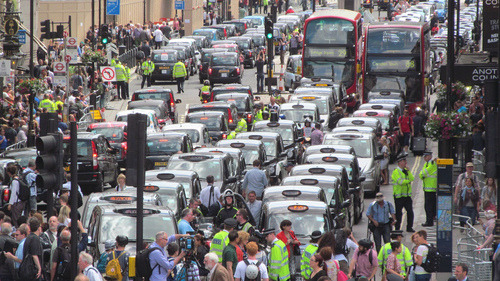
    Image: Anti-Uber protest in London (Flickr)

  • Toronto needs a consistent taxi brand

    For the sake of our global brand, Toronto taxis need to have a consistent brand – the same car, the same colour. I’ve thought about this before and written about it somewhere, but it’s worth repeating.

    I was driving around downtown on Saturday night and I started to compare the ratio of cabs to non-cabs on the road. As is typical for any weekend night, most of the cars were cabs. And yet they’re a complete hodgepodge of different car types and colours.

    The cab companies, of course, like it this way. They want to be differentiated. But from a practical standpoint, does this even matter? Sure, I might call a specific company to pick me up somewhere, but when I’m hailing a cab on the street I go for the first available car. I couldn’t care less what company it is. 

    The result of this heterogeneity though is that we’re missing out on a valuable opportunity to brand our city. New York has its yellow cabs, London has its black cabs and all of Germany has its beige Mercedes Benzes. In our psyche, those cars symbolize those cities.

    Just like companies, cities today compete with one another for talent and capital. It’s been said many times before that the vast majority of Millenials now choose where they want to live (which city) before they even start looking for a job. Toronto needs to be on the top of that last.

    Taxi branding may seem like a small detail, but it’s not. As a comparison, take for example the Shangri-La Hotel company. The first time I stayed at one of their hotels was in Vancouver. I remember asking one of the staff members about the fragrance that seemed to permeate the entire building.

    He told me that it was the “Essence of Shangri-La” and that it was actually diffused throughout the entire building, as well as around the perimeter. The purpose of this was to give global travels a familiar feeling – that feeling of being home – wherever they are in the world. Now that’s consistent branding.

    Similarly, being in Toronto should make you feel like you’re here and in no other city. Our lumbering streetcars certainly help with that, but our cabs don’t. In a time where globalization is making cities feel more and more alike, we need to be doing everything we can in order to differentiate.

    Hell, in addition to having the same car and colour, maybe we should even create an Essence of Toronto scent for our cabs.