Daily insights for city builders, delivered every morning at 6 AM ET. I’m Brandon Donnelly — a Toronto-based real estate developer and founder of Globizen. I’ve been writing here since 2013.

Tag: taxes

  • Fees on homes

    A colleague of mine sent me this Bloomberg article today and said, “Here’s an article about things you already know.” The article cites a recent report by Altus Group that compared government-related fees on new housing across Canada and the U.S. What they discovered will not surprise any of you who are in the industry: Toronto has some of the highest government-imposed charges on new homes.

    For new condo apartments, the report found that government charges can add up to as much as C$124,582 per unit. That’s about 50% higher than the average unit in the U.S. and about 30% higher than the average unit in Canada (see above chart for the list of cities). While all of us in the industry can appreciate this, I don’t think most homeowners and tenants understand this. Hopefully they’re reading this post.

    Chart: Bloomberg

  • “I hate golf”

    I am a big fan of Malcolm Gladwell, and not just because he’s Canadian and went to the University of Toronto (my alma mater), although those facts certainly don’t hurt.

    I’m late to his podcast, Revisionist History, so in case some of you are as well, I would encourage you to check it out. Every episode reexamines something from the past and questions: Did we get it right the first time? It’s very Gladwell. It’s a must listen.

    The episodes span a secret research project setup by the Pentagon in downtown Saigon during the Vietnam War to why rich people are obsessed with the game of golf. Spoiler: He hates golf.

    The golf episode will be of particular interest to many of you because it deals with real estate. Malcolm wades into something known as California Proposition 13, which is a constitutional exemption that keeps property taxes artificially low.

    It is what has allowed these “vast, gorgeous, and private” golf courses to continue to exist in expensive cities like Los Angeles. Otherwise they would have long ago drowned under the property taxes following reassessment.

    This also leads to a philosophical debate about what constitutes a change in ownership, since many clubs are member owned and Proposition 13 requires that there not be a change in more than 50% of the ownership. 

    But I’ll stop there. Give it a listen. Malcolm is just excellent.

    Photo by Rémi Müller on Unsplash

  • What tax policy could be doing to home sizes in Ontario

    Golden City (of Toronto) by Evgeny Tchebotarev on 500px.com

    https://500px.com/embed.js

    In yesterday’s post I made a remark that we have antiquated tax policies here in Ontario that encourage the building of smaller new construction condominiums. There seemed to be a lot of interest in that comment, and so I’d like to talk about that today.

    Some people thought I was referring to development charges, but I was actually thinking of the GST/HST New Housing Rebate in Ontario

    The way it typically works in Ontario is that when buy a new construction home, the price you pay is inclusive of HST (harmonized sales tax) and net of any applicable rebates, such as the rebate program mentioned above. 

    This means that the price you see on your agreement is usually the price you pay. I say usually only because there are ways that you could disqualify yourself from the New Housing Rebate program. But that’s a different post.

    So what does this mean in practice?

    Let’s say you went out and bought a new construction condo for $368,200 (there is a reason I’m picking what seems like an arbitrary number). If there was no such thing as the New Housing Rebate program, then the sales tax owing on this home would be the full 13%. And that would mean that the price paid before any taxes is actually $325,841 (x 13% = $368,200). This is an important number because it represents revenue to the developer.

    But since there is a New Housing Rebate program, the effective tax rate actually works out to be 5.20% for this particular sale price, which means that the price paid before any taxes is now $350,000 (a nice whole number). And so because of rebates and because they are now paying less HST, the developer’s revenue number has increased. It has gone from $325,841 to $350,000.

    The way this logistically works is that purchasers usually assign the New Housing Rebate benefits to the developer who then processes all the paperwork. This is what I mean when I say that the “sticker price” is inclusive of HST and net of any rebates – it already factors in the possible deductions.

    So far things are looking good. And I want to be clear that I don’t have concerns with the New Housing Rebate program in its entirety. In fact, it’s a hugely important part of the new home industry. Without it, many projects would simply not be feasible to build.

    However, as the price of the new home increases (which typically happens as the home gets bigger), the rebates start to fall off. The federal portion of the rebate maxes out at a base purchase price of $350,000 (which is why I chose that number) and the Ontario portion maxes out at a base purchase price of $400,000.

    What all this means is that as the unit sizes get bigger and more expensive, the effective tax rate is no longer at 5.20%, as was the case in the example I gave above. It increases. And if you hold prices constant for the purchaser, it means that the developer’s revenues now start to drop.

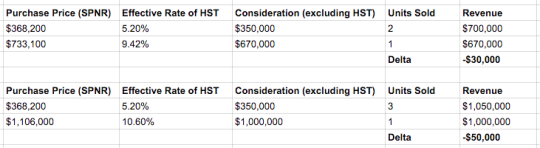
    To illustrate why this matters, consider the following chart:
    image

    In the first scenario, the developer builds and sells 2 units for a price of $368,2000. This translates into revenue of $700,000. However, if the developer instead decides to combine those 2 units and sell the larger single unit for $733,100 (roughly double the price) then the effective rate of HST goes up and revenue drops by $30,000.

    The second scenario is similar to the first one except that instead of 2 units, it’s 3 units which then get combined into one. Here revenue drops even further – by $50,000.

    Now, you could argue that there are some cost savings associated with building fewer suites, but I don’t think it would offset the differentials shown above, especially if you multiply those revenue numbers across an entire project. So what this all means is that it can be more profitable for developers to build smaller units priced below the thresholds mentioned above, as opposed to a smaller number of larger units. 

    Again, I’m not saying that HST rebates are bad. They’re critical to the industry. I love them. But I do believe we should be thinking about the possible implications that the current set up could be having on what we’re building and in particular on unit sizes.

    If you’d like to learn more about how the rebates work, check out this PDF from the Canada Revenue Agency. I tried to keep things simple in this post.

  • Thoughts on land-value taxation

    Yesterday I wrote about a new book that was just released called The Next Urban Renaissance

    The first essay in the book, written by Ingrid Gould Ellen of New York University, is centered around three ideas to help cities deal with the affordable housing problem. This is something that successful cities all around the world are grappling with.

    The first idea is land-value taxation, which is also known as a “split-rate” tax. I’ve touched on land-value taxation before on ATC, but I never really dug into it. So this was a good reminder to do that.

    The idea behind land-value taxation is to split property taxes into a land tax and an improvements tax (i.e. the building), and then shift more of the burden over to the land side. Economists tend to really like this model because taxing buildings/improvements can discourage property investment and development, whereas taxing land doesn’t impact supply. The supply of land is fixed.

    So in the context of affordable housing, land-value taxation is thought to be a way to encourage more development and to increase the supply of new housing – which is usually a good way to keep home prices in check.

    Here’s how Ingrid Gould Ellen described it:

    …a land tax would discourage speculators from hoarding
    undeveloped land and incentivize them to develop their parcels to the
    full extent allowable. Regardless of whether a parcel sits vacant, houses a
    partially occupied, one-story retail strip, or holds a 30-story apartment
    tower, the annual tax bill would be the same. By switching to a land tax,
    a city could therefore increase the supply of housing and, by doing so,
    reduce prices across the board.

    But I can’t help but wonder if this isn’t more applicable to cities or areas that are currently struggling to encourage development. For instance, would boom town Toronto really benefit (in terms of affordable housing) from a tax change that ends up encouraging more high-rise development?

    It also strikes me as being exceptionally difficult to implement, particularly in city like Toronto that is growing and changing so quickly. Is it reasonable to ask the owner of a small downtown parking lot to being paying property taxes as if a 90 storey supertall had been built on top of it? Because that is the reality in some parts of this city.

    And if we opted to phase in this new land tax, would it then become a game of arbitrage where developers look for properties with the lowest land taxes but the highest achievable densities?

    Finally, I wonder if it wouldn’t exacerbate some of the problems that already exist in rapidly growing cities, one of which is the preservation of smaller heritage buildings in centrally located neighborhoods:

    In the case of a split-rate tax,
    the losers will be owners of parcels with high land-to-building value
    ratios, or owners of small buildings on valuable, centrally located parcels,
    who will likely see an increase in their tax bills after the switch to
    a split-rate tax.

    Land-value taxation is something that I’ve been thinking about for a number of months now. But I am struggling to come up with a decisive position. If you have any thoughts on this, it would be great to hear from you in the comments.