
Daily insights for city builders, delivered every morning at 6 AM ET. I’m Brandon Donnelly — a Toronto-based real estate developer and founder of Globizen. I’ve been writing here since 2013.

Tag: talk

  • 3 real estate + tech startups

    image

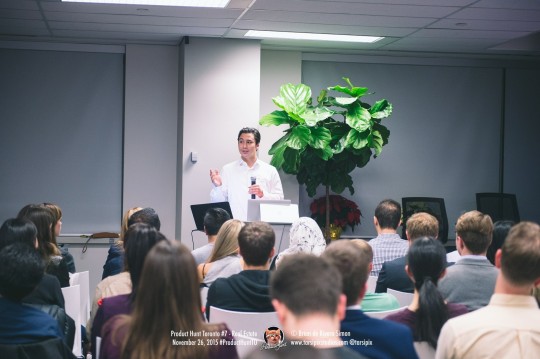
    On Thursday night I spoke at Product Hunt Toronto about the overlap between real estate and tech. My slide deck will be made available online and I’ll be sure to tweet it out and link to it in the comment section of this post.

    What was amazing to see was a room filled with 250 people coming together from almost two different worlds. I’m generalizing here, but you had the real estate people in suits and the tech people in t-shirts. But they were all mixing together to figure out how technology is going to disrupt the real estate industry. That is great to see.

    This was not the case 5+ years ago when I started obsessing about the overlap between these two spaces. I remember pitching at a Startup Weekend here in Toronto where I was pegged as the fringe outlier for wanting to work on a real estate idea. Now I can’t keep track of all the startups who are tackling this space.

    But this is a trend that is happening not only in real estate but in almost every other vertical. Here’s a quote from Fred Wilson that I used last night:

    “One of NYC’s great strengths is the diversity of its economy – finance, real estate, media & entertainment, retail, fashion, health care, education, and now tech. And the reason tech is growing so fast in NYC is that it is embedding itself in all of these other industries.”

    It’s an exciting time.

    In any event, for those of you weren’t able to attend, the 3 startups that presented were Evercondo, PiinPoint, and MappedIn.

    Evercondo is a condo communication and management tool for property managers and boards. PiinPoint is a data-driven tool that helps businesses find the best places to locate within a city. And MappedIn creates digital wayfinding solutions for (primarily) retail stores and venues.

    If you know of any other interesting startups tackling the real estate space, please share them in the comment section below. Early stage companies need all the support and exposure they can get.
  • Real estate + tech

    If you’re interested in tech and tech products, you might be familiar with a platform called Product Hunt that helps you discover new products/startups on a daily basis. They launched back in 2013 and have since become an important part of the startup ecosystem.

    Here in Toronto, the Product Hunt community has been incredibly active with organizing regular meetups. Every 2 months they host an event, which includes a keynote speaker, 3 product demos from local startups, a panel discussion, and of course the usual drinks.

    The next Product Hunt Toronto event (#7) is scheduled for Thursday, November 26th at 6pm and the focus is on digital products serving the real estate industry. Back when I became obsessed with this space, this would have been considered pretty niche. But today there’s a tremendous amount of interest in the overlap between real estate and tech. And I’m thrilled to see that.

    If you’re also interested in this space, you should grab a ticket right now. They just went on sale yesterday, but usually sell out within a few days. At the time of writing this post, there are only 82 tickets left. I’m also going to be delivering the keynote talk. So I hope to see you there 🙂

  • City building every way you can

    Tonight I attended and gave a short talk at a city building themed PechaKucha night here in Toronto. If you aren’t familiar with the PechaKucha 20×20 presentation format, click here.

    The first PechaKucha night was held in Tokyo, but it has since expanded to over 800 cities around the world. Each city has a local organizer who acts as a steward and here in Toronto it is Amy Bath. She did a fantastic job this evening.

    Tonight’s event was all about non-traditional forms of city building. It was not so much about how architects and developers are shaping the built environment – thought there was some of that. It was more about how interdisciplinary artists, graphic designers, bloggers, and others, are having an impact on cities. So in my case, I was speaking as a blogger, rather than as a real estate developer, which was a bit unique for me.

    What excited me about tonight is the amount of talent and passion that we have in this city, and how so much of it is being harnessed to make cities better.

    Jay Wall of Studio Jaywall is doing incredible work at the intersection of graphic design and city building. My friend Mackenzie Keast of Distl and NXT City Prize is organizing public space competitions and then working with the city to get them built. And my friend Justin Broadbent, who is an interdisciplinary artist, is just killing it and putting Toronto on the map. I don’t know how else to say it.

    And this is just naming a few of the people in attendance.

    I have so much respect for people who love the city they call home and actively try to make it a better place. That’s a lot harder to do than just complain about why your city isn’t (insert other allegedly better city here). But it’s also a lot more productive.

  • Blogging as city building

    This past week I received 2 separate invitations to talk at events about blogging as a form of city building.

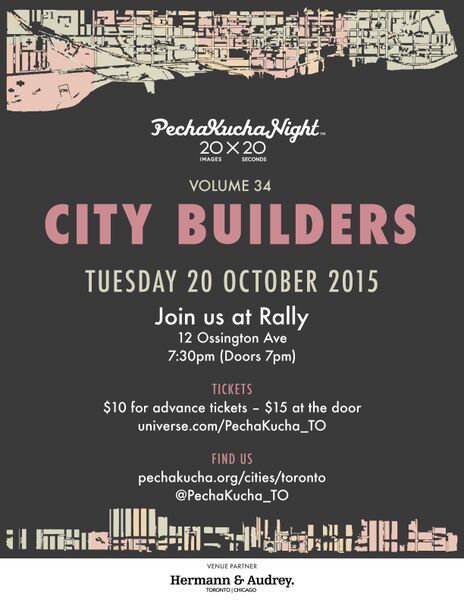
    The first is a Pecha Kucha talk being held here in Toronto on Tuesday, October 20th, 2015. If you’ve never heard of the Pecha Kucha movement, it’s basically all about rapid fire presentations. Each person gets 20 slides and 20 seconds for each one. 

    Here are the details for the upcoming Toronto event:

    image

    The second event is being held in Ottawa in the new year. I’ll write more on that closer to the date when I have more information to share.

    I haven’t yet figured out exactly what I’m going to talk about at each event, but I am starting to think about a few things.

    When I started writing this blog, it was intended simply as an outlet for my own city-related – and also personal – thoughts. Ultimately, the blog evolved into having its own mission, which is to promote the building of beautiful, sustainable, and globally competitive cities. And so clearly in my mind blogging was and is in fact a form of city building.

    But writing is vastly different than the kind of city building I do for a living. During the day I worry about things like rental rates, building setbacks, bulkhead locations, parking counts, and a bunch of other fun stuff.

    The two are certainly related, but the latter feels a lot more tangible. The result is spaces that people will occupy and buildings that will have some sort of impact on the overall built environment.

    But as you all know, city building is a lot more than just bricks-and-mortar. It is political. It is emotional. It is subjective. It is ego-driven. And it is so many other things. Because of this, words do have a role to play in shaping the cities we live in. And hopefully my words are having some kind of positive impact.

    At the same time, I see myself as simply part of a larger set of trends that are happening in both city building, as well as in many other sectors. Trends around transparency, decentralization, and the democratization of information.

    Technology today allows us to connect at zero marginal cost. And that is empowering people like me to self-publish, people to crowdfund real estate development projects, people to crowdsource community feedback for projects, and to do many other exciting things that weren’t possible before. Without this blog, most of you reading this right now would have absolutely no idea who I am.

    So I guess I kind of do know what I’m going to talk about.

  • Marginal cost = 0

    Earlier this week I wrote a post called: The pull from services to products. And in it I made mention of the fact that part of what’s driving this pull towards products is that the marginal cost of servicing additional users or customers is almost nothing in a world of internet services and products.

    Well the reality is that this phenomenon is driving a hell of a lot more. It could – and probably will – fundamentally change almost all aspects of the economy.

    I know that sounds like a pretty audacious statement, but if you watch the following 10 minute talk by Albert Wenger (Union Square Ventures) you might start to feel the same way. He outlines 5 changes being driven by the fact that in the digital world, marginal cost = 0. The impacts go well beyond tech, capturing sectors such as transportation and industrial real estate.

    [youtube https://www.youtube.com/watch?v=sVEtTzlqsoE?rel=0]

    If you can’t see the video, click here.

  • A video and conversation about laneways

    Two weeks ago I gave a brief presentation at The Laneway Project’s inaugural summit here in Toronto. I then wrote about it here on ATC.

    At the time, I wasn’t sure if the event was being filmed or not, but it turns out it was. So here is my presentation from the event. It’s just over 7 minutes. Click here if you can’t see it below.

    [youtube https://www.youtube.com/watch?v=vdMNC1BtUz8]

    If you’d like to see the other 5 presentations and the Q&A session, click here

    Following the event, I was also interviewed by a radio show out of Calgary called Space + Place. If you are really into laneways and would like to listen to that as well, go here.

    I’ve said this before, but I’ll say it again: I continue to be amazed by how much interest there is — both here in Toronto and elsewhere — in laneways. They may be overlooked today, but that’s going to change. It’s inevitable.

  • How technology could completely change the real estate development industry

    If you’re involved in the built environment in any way, shape, or form – as a developer, architect, policy maker, and so on – I would highly recommend you watch the video below. My friend Candice Luck, who I went to Rotman with, sent it to me this morning with a link starting at the 24 minute mark. I haven’t yet watched the whole thing, but given how interesting this short section was, I plan to.

    The video is a talk by Steve Jurvetson, who is a venture capitalist with DFJ. He was one of the founding investors in Hotmail and currently sits on the board of companies like SpaceX and Tesla Motors. At the 24 minute mark he talks about a startup called Flux.io that hasn’t yet launched their product, but is working towards “reimagining building design”. They’re a spin-off from Google X and plan to officially launch in early 2015.

    Rather than try and describe the video here, I will just say that it’s an incredible example of how technology and digitization could completely change the real estate development industry. If you can’t see the video below, click here. The video starts at the Flux.io section.

    [youtube https://www.youtube.com/watch?v=IPgyb6euISs]

  • True Condos Podcast: Transparency in the Real Estate Industry

    A few weeks ago I was invited by Toronto realtor Andrew la Fleur to participate in his True Condos podcast series. I had actually never met Andrew before in person, but I knew of him because of Twitter, his blog, and because he was an early user of my past startup, Dirt.

    I was initially a bit apprehensive about being on a realtor podcast, because I thought it might end up as some sort of cheesy marketing piece. But I’ve come to learn that Andrew is not that kind of guy. He’s also interviewed some really great people in his podcast series (here’s the full list), so I feel honored to have been invited. 

    I’ve embedded the podcast below, but if for whatever reason you can’t see it, click here to be redirected to Andrew’s site. We talk for about 30 minutes, with a big focus on openness and transparency in the real estate industry. Thanks again for the invite Andrew. It was great to meet you in person.

    http://www.podbean.com/media/player/audio/postId/5289048?url=http%3A%2F%2Ftruecondos.podbean.com%2Fe%2Fbrandon%2F

  • What are Generation Y condo dwellers going to do when they have kids?

    I gave a talk about condos this evening at the Ted Rogers School of Management. For regular readers of this blog, the material wouldn’t have been all that new. I talked about supply and demand in housing markets and 2 of the projects that TAS is working on. The best part though was the Q&A, which, I think, was longer than the actual talk.

    One question that I particularly liked (maybe because I’ve blogged about it before) was the question of what all these Generation Y condo dwellers are going to do when they decide they want a family. We know that people are getting married later and that more people are living alone. So there are some demographic changes at work here. But people are still going to have kids and people are still going to need more space.

    At that point, I think 2 other, interrelated, factors come into play: first, a lot of people still feel you need a house in order to raise kids; and, second, there’s a problem of affordability. Multi-family dwellings (built out of reinforced concrete) are inherently more expensive to build than wood-framed single family homes.

    To deal with these factors, a lot of young couples in Toronto (at least from my own empirical research) seem to be looking to inner city neighborhoods like Leslieville, Roncesvalles, Trinity Bellwoods, High Park, the Junction and so on. They still want to be in the city, but they want a house, for their kids. Problem is, everybody is trying to do the same and it’s creating tremendous pressure on our low-rise housing stock.

    So what’s going to happen in the longer term?

    Well if low-rise housing keeps appreciating at the rate it has been, we could reach a point, I think, where all of a sudden condos become the more cost effective solution.

    For example, let’s say a young family is looking for a 3 bedroom home. It’s not inconceivable that the 1,500 square foot, 3 bedroom condo could become the cheaper option. At $650 per square foot (I’m assuming a slightly higher number because I’m assuming this is at some point in the future), you’re looking at roughly a million dollars. No question this is a lot of money, but what if the alternative (a single family home) is $1.5 million?

    I’m sure there will always be a segment of the market that rushes towards the suburbs and/or a house when they decide they want to have kids. But I think we’ll see more and more families decide–either because of cost or because of a lifestyle preference–that having children in a condo isn’t all that bad.

    What do you think? Would you ever raise children in a condo?

  • Turning post into talk

    I’m going to be turning one of my blog posts (“Why Toronto should stop complaining about all its condos”) into a talk at Ryerson University’s Ted Rogers School of Management on March 10th, 2014 at 6:30pm. But since it’s an academic setting, they wanted me to make it more impartial and so the talk instead, asks a question, and is called: “Should Toronto stop complaining about all its condos?” 

    You can register for the event here. It’s primarily geared towards students, but I’m told it’s also open to industry and the public. I haven’t completely figured out what I’m going to talk about yet, but I plan to focus on the issues of supply and demand I raised in my blog post and then tie that into a discussion about the rise of midrise development—specifically through DUKE and Kingston&Co (both TAS projects).

    If you have any other suggestions, I’m all ears.