Daily insights for city builders, delivered every morning at 6 AM ET. I’m Brandon Donnelly — a Toronto-based real estate developer and founder of Globizen. I’ve been writing here since 2013.

Tag: sweden

  • The average wait time for a rent-controlled apartment in Sweden is now over 9 years

    I’m not all that familiar with Stockholm’s housing market, but according to this recent article, it would appear that, like most big cities, there isn’t enough affordable housing to go around. This is despite the fact that everyone in Sweden is technically entitled to it.

    As of December 2021, there were 736,560 people (in Sweden) in the queue for a rent-controlled apartment, resulting in an average wait time of about 9.2 years. So basically what you want to do is put yourself on the list as soon as you turn 18. And then hope that at some point in the future you’ll be granted an affordable apartment.

    Given this dynamic, it makes sense there would be a long waitlist. If everyone is entitled to a rent-controlled apartment, you are effectively giving people two options: pay the market price or put yourself on this list, wait for a decade, and then pay less than the market price.

    Why wouldn’t you at least try to pay less?

    The problem with this approach is that supply will almost certainly never keep pace with demand. It also appears to be fuelling a robust (and I guess illegal) secondary sublet market. Because if you have a below-market contract that is yours to keep forever and that lots of other people want, you have a valuable asset.

    Getting housing right certainly isn’t easy.

  • Super-entrepreneurs by region

    A super-entrepreneur, according to the common definition, is a rich person who has amassed a net worth of at least US$1 billion dollars by either starting a company or taking a small company and growing it into a big one. A super-entrepreneur is, by definition, not someone who inherited their wealth. Though I’m not sure what the cut off is. If you inherited $1 million and then started a massive company, does that still make you a super-entrepreneur? What about if you inherited $100 million?

    In any event, here is a chart from New Geography showing super-entrepreneurs by region:

    The USA is in the lead in this chart at about 3.1 super-entrepreneurs per one million inhabitants. But the highest rate in the world, at least according to this data set, actually belongs to Singapore at 4.7 per million. Europe, as a whole, doesn’t look all that great here. But again, if you get more specific, some European countries are actually doing quite well. Sweden, for instance, is sitting at around 2 per million, which is higher than Canada’s figure.

    Why this data is potentially interesting is that it tells you a bit about these countries. It tells you whether they have strong property rights, whether it’s easy to conduct business, and whether it’s supportive of new ideas, among, of course, many other things. There also appears to be a clear link between the presence of super-entrepreneurs and unemployment. Turns out that the more people you have starting wildly successful businesses, the lower unemployment tends to be.

    For the full New Geography article, click here. In addition to what I just wrote about, it talks about Europe’s “entrepreneurial paradox” and issues of gender equality.

  • From social housing to highly desirable in Stockholm

    Feargus O’Sullivan is back with another Bloomberg CityLab article about “the iconic home designs that define our global cities.” In this recent article he focuses on the Barnrikehus of Stockholm (and also talks about Sweden’s housing market in general). Originally built in the 1930s, the slab-like midrise buildings were largely intended to address two pressing problems: 1) the need for affordable housing and 2) Sweden’s incredibly low birthrate (supposedly the lowest in Europe at the time).

    The Barnrikehus template was deployed on the edges of Stockholm and other Swedish cities. The designs were/are fairly simple. Very little ornament (this is Scandinavia). Four or five storeys usually. And no more than about 12 meters deep. This allowed for better natural ventilation, which was important for stymying the spread of tuberculosis. The rents were also heavily subsidized and declined even further with every child in the family. In other words: the more kids you had, the less rent you had to pay.

    The suites were fairly compact, with many around the 430 square foot mark. This kind of space might have housed a family of six according to O’Sullivan. But compared to the other available housing options at the time, this was a significant improvement. Perhaps not surprisingly, these “child-rich houses” (which is how the name translates) developed the same kind of social housing stigma that was prevalent in many other countries and cities around the world.

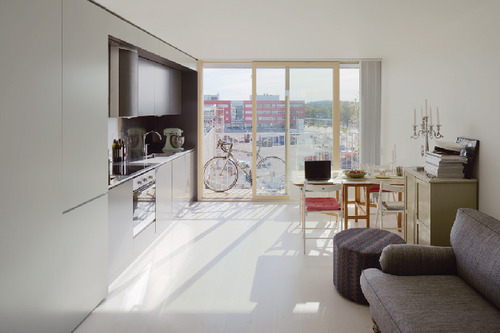
    But that perception changed over time and, today, these rent-controlled apartments are apparently highly sought after. (Here’s a listing to give you a taste of what they’re like.) Originally on the fringe of cities like Stockholm, they are now very well located and offer a high standard of living. (You also can’t go wrong with white walls and pale woods.) To learn more about the evolution of Stockholm’s depression-era housing, click here.

    Photo by Jon Flobrant on Unsplash

  • Hotel room as shop

    Vipp is a 3rd generation family-owned Danish company that makes everything from kitchens and lighting to prefab homes. But it all started with a pedal-controlled waste bin that Holger Nielsen – a metalworker – crafted for his wife Marie’s salon in 1939.

    I love their design philosophy. It is centered around “fewer but better products” and around lasting function over ephemeral trends.

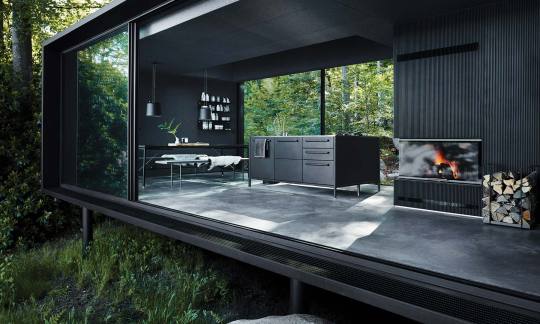
    But equally interesting is what they are doing with their Vipp Hotels. Instead of large hotels, they offer individual rooms in unique locations, such as this 55 square meter design object in the Swedish wilderness (pictured above).

    The rooms they have crafted are, not surprisingly, stunning. And that’s because they are deliberately designed as a tool to showcase their kitchens, bathrooms, bins, and other products. 

    Here is a quote from their CEO taken from a recent Surface article:

    “Traditional retail seems to be losing its power, but what is not losing power is our desire to see or do something interesting. I see our hotels as the experience economy coming alive,” says Kasper Egelund, CEO of Denmark-based Vipp.

    Clever.

    Image: Vipp

  • What it’s like to live in darkness

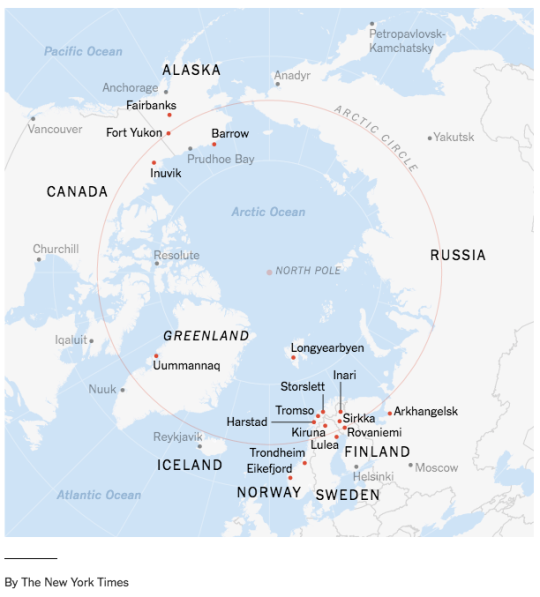
    The New York Times recently asked its readers – specifically the ones who live near or above the article circle – what it is like to live in darkness for part of the year. 

    Almost 700 people responded with photos and stories, both of which can be found here. The photos are absolutely spectacular. Make sure you watch the video.

    I love snow and I love being in the mountains, but I can only imagine what it must be like to live for months with no (or minimal) light. It must do a number on your mental state.

    At the same time, there is something so sublime and beautiful about these places. I can’t say I’m ready to move, but I would like to experience it one day.

  • Oh boy bicycle house

    image

    A new “bicycle house” recently opened up in Malmö, Sweden. It is a 7 storey apartment building that has been designed entirely around the bicycle. It’s called Cykelhuset Ohboy.

    Bicycle house means:

    – There’s no parking for cars in the building. Apparently it’s the first building in Sweden to do that, which is surprising to me. I thought that would be more common.

    – All of the access corridors were made wider so that it’s easier to maneuver your bike around, larger bikes can fit, and there aren’t any access issues when bikes are left outside of your apartment.

    – All of the doors in the complex are 10cm wider than they need to be (and have door openers). The elevators are also larger and open up on both sides so you don’t have to turn your bike around.

    – The building is equipped with cargo bikes and kid friendly bikes so that you can grocery shop and wheel your family around. The building does have larger family sized apartments and, according to Copenhagenize, the building is fully occupied.

    In most, if not all, condo buildings here in Toronto, you’re usually not allowed to take bicycles in the elevators. And bikes sitting on balconies is considered a highly undesirable outcome.

    But clearly that’s just one frame of reference for how the world should work.

  • Sixth facade

    A new treehouse at the Treehotel in northern Sweden just opened up this week. (Their website wasn’t working at the time of writing this post.) 

    It was designed by the Oslo and New York-based Snøhetta. All 6 of the cabins at the Treehotel were designed by Scandinavian architects.

    The treehouse is clad in charred-timber (on trend right now) and is raised 10m (~3 storeys) up into the air to provide views out to the landscape. The underside of the treehouse, which is visible as you walk up its stairs, is finished with a black and white image of a forest. According to Dezeen, the architect calls it the sixth facade.

    Below is what that looks like. (Photo by Johan Jansson via designboom.)

    The net you (hopefully) see in the middle of the treehouse is so that you can sleep outside and stare up at the aurora borealis. The treehouse itself is 55 square meters (almost 600 square feet) and is designed to accommodate 5 guests. It has 2 bedrooms. I guess the 5th person has to sleep outside on the net terrace.

    Seeing this project has me excited to be back in the mountains next month.

  • #LoveWins in the United States

    https://500px.com/embed.js

    By now, I am sure that all of you know that the U.S. Supreme Court made a landmark ruling yesterday (Friday, June 25, 2015). In a 5-to-4 vote, it was decided that the U.S. Constitution guarantees the right to same-sex marriage.

    Here is Justice Anthony Kennedy’s closing paragraph. What a great read.

    image

    With this decision, the United States joins the Netherlands, Belgium, Spain, Canada, Norway, Sweden, and many other countries who already allow same-sex marriages nationwide. And I am delighted to see that happen with Canada’s neighbor.

    I am also proud to say that it has already been a decade (2005) since Canada became the 4th country in the world – and the 1st country outside of Europe – to allow same-sex marriages. Not because it had a direct impact on my life, but because it is the right thing to do.

    It is the right thing to do because it creates “equal dignity” among all men and women (as Justice Kennedy states above) and because it’s the right thing to do for our economies.

    I believe that the strongest economies are the ones that can remain open and tolerant to new ideas and all kinds of people. 

    Cities like Toronto and New York (as I’ve argued before) became successful precisely because they opened themselves up to new ideas and new people (immigrants).

    But many studies show that as people age, “openness” declines. We become less intellectually curious and our preference for variety wanes. Perhaps this is where the expression “set in your ways” comes from and why political orientation often correlates with age.

    Thankfully the U.S. wasn’t so set in its ways that it couldn’t provide equal dignity to its citizens.

  • Architect and developer partner to build affordable prefab housing in Sweden

    image

    In this month’s issue of Monocle magazine (#80) they profile an interesting prefabricated and affordable housing project in Knivsta, Sweden.

    A collaboration between architect Andreas Martin-Löf and developer Junior Living, the project contains 124 single occupancy units, each of which has 32 square meters of interior space (that’s about 344 square feet).

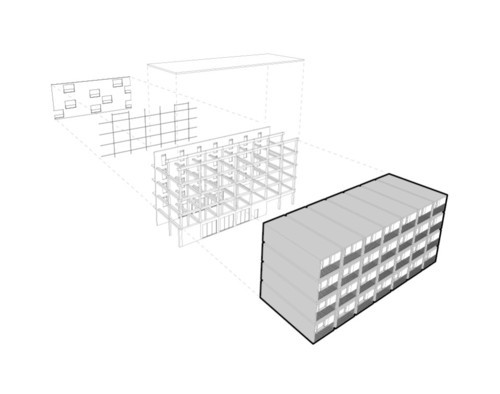
    The way it was built is quite simple. The modular housing units were fabricated off-site and then inserted on-site into a prefabricated concrete frame. Think bottles going into a wine rack. Here’s a diagram showing how it works:

    image

    What’s truly amazing about this project though is how quickly it was built and how cost effective it actually was for end users. Construction started in January 2014 and residents started moving in about 3 months later. The sale prices ranged from €50,000 to €87,000 per unit. That’s roughly $62,000 to $98,000 in US dollars.

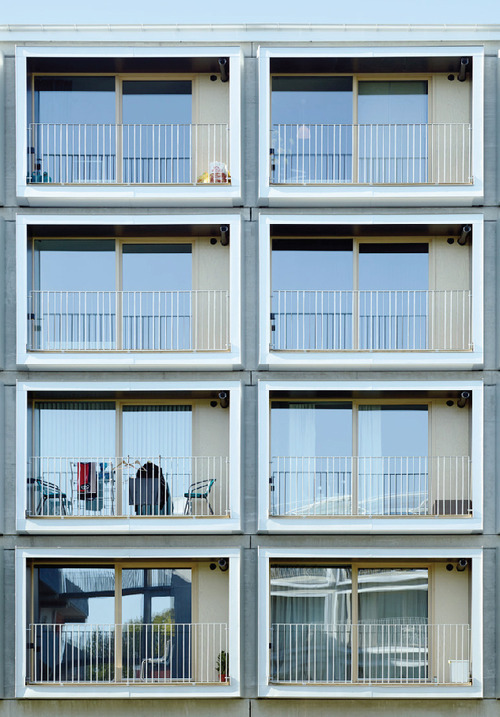
    Finally, here’s a shot of one of the interiors:

    image

    What do you all think of this project?

    Photography by Åke E:son Lindman via Andreas Martin-Löf Arkitekter

  • Housing tenure in Europe

    Yesterday I came across an incredibly fascinating chart from Eurostat, analyzing housing tenure (in 2011) across Europe. Here it is:

    image

    And here’s what I found interesting.

    Working from left to right, there seems to be a clear difference between Eastern and Western Europe in terms of the amount of leverage they use to buy homes. If you look at Romania, not only does over 90% of the population own a home, but they also don’t seem to have any outstanding mortgage or housing loan. That means they’re buying their homes in cash.

    By the time you get to the United Kingdom, you start to see numbers that are comparable to Canada and the United States. The percentage of owner occupied homes is sitting at or below 70% and the majority of them have a mortgage or loan.

    But as a whole, Western Europe seems much more likely to rent than Eastern Europe. And in the case of Switzerland, more people rent than own. Why is that? This seems odd given its economic strength. But the same could be said for Germany and Austria, which also show relatively low ownership rates. Here’s one possible explanation.

    Finally, I found it interesting that in Denmark, the Netherlands, and Sweden, there’s virtually no such thing as subsidized rental housing. If you rent, you’re paying market rate (at least according to this chart). I wonder if this has something to do with there being less income inequality.

    If anyone has any insights on some of these points, I’d love to hear from you in the comment section below.