Daily insights for city builders, delivered every morning at 6 AM ET. I’m Brandon Donnelly — a Toronto-based real estate developer and founder of Globizen. I’ve been writing here since 2013.

Tag: survey

  • Three in four Americans believe it’s better for the environment if houses are built farther apart

    Living in a low-density place with lots of greenery and open space can feel like a pretty “green” way to live. Maybe you’ve even got a little garden where you grow delicious tomatoes. And indeed, a lot of people seem to think this is the case. According to this recent YouGov poll (which surveyed 1,000 Americans), 75% of US adult citizens believe that “it’s better for the environment if houses are built farther apart.” The number drops slightly to 68% for Democrats, but we’re still talking about a clear majority.

    Most experts will tell you that the opposite is, in fact, true. One of the best ways to be green is to live in a high-density urban setting and get as far away as you can from the natural environment so that you don’t screw it up. There are multiple reasons for this, but it generally comes down to the fact that cities use land and other resources far more efficiently on a per capita basis. Smaller living spaces, fewer cars, more things that are shared, and so on.

    The reason why this isn’t so obvious is that per capita thinking is perhaps harder to grasp. Living in the countryside certainly feels more green than living in the middle of New York City. But what if the 8.5 million or so people in New York City suddenly decided to sprawl outward into the countryside to consume more housing (that would then need to be heated and cooled), and then started driving everywhere (in lieu of taking transit, cycling, and walking)?

    This would be a less green outcome. It’s about the collective here, not what feels nice and green for any one individual.

  • Cities are not going away

    Here are the results from a recent survey by The Harris Poll and the Chicago Council on Global Affairs, which asked 1,200 residents from the six largest metropolitan areas in the US how they were feeling about urban and suburban life during this pandemic. (The exact timing was last fall.)

    The bar color indicates where the respondent current lives. So for example, of the respondents who currently reside in an outer suburb (blue bar), 73% said that they wouldn’t change where they live. They seem to be feeling pretty good about their life decisions right now.

    But for respondents who live in an urban area (black bar), 50% also said that they wouldn’t change where they live. And interestingly enough, 25% of all respondents living in a city responded by saying that they were actually more likely to move to another urban area. (Perhaps Miami?)

    For these urbanites, of which I would include myself, the city is far from dead.

  • yongeTOmorrow

    Yonge Street divides Toronto between east and west. It’s an iconic street (though it has its ups and downs). Since 2018, the City has been studying ways to redesign and improve the stretch that cuts through the middle of downtown.

    It is a story that we have seen in many other cities around the world, perhaps most famously in NYC. Here is a street where pedestrians outnumber vehicles and yet we allocate more space to the latter (within a fixed ROW). This study hopes to fix that.

    They’ve narrowed things down to four Alternative Designs (downloadable, here). All of them prioritize pedestrians, but in different ways. As of right now the preferred option is Alternative #4. It looks like this:

    The section around Dundas Square (from Dundas Sq up to Edward Street) is fully pedestrianized with only emergency vehicles having access during the day. This segment has the highest pedestrian volumes. The other blocks allow for a combination of one-way and two-way vehicular traffic.

    Vehicular access is obviously still important for things like loading, but it’s pretty clear that the future of Yonge Street is pedestrian priority. We should probably be doing this right now. If you’d like to voice your own opinion, you can do that here until Friday, December 6, 2019.

  • Public perception of drone delivery

    Back in 2016, the United States Postal Service published a report on the public perception of drone delivery in the US. This was nearly 3 years after Jeff Bezos announced on 60 Minutes that Amazon was working on a drone delivery service and that it would arrive within the next 5 years (so by 2019). I think USPS was trying to figure out how to be, or appear, more innovative.

    Not surprisingly, the report found that Millennials were significantly more supportive of drone delivery (65%) compared to Baby Boomers (24%), who strongly dislike the idea. Generally, the report indicates that the percentage of people who think it’s a good idea declines with every preceding or older generation. Again, I don’t find this at all surprising.

    But what I did find interesting was that, irrespective of age, respondents were primarily concerned with some sort of “malfunction.” This was at the top of the list. Next in line were concerns around “intentional misuse,” such as drones being used to transport illicit goods or to spy on people and/or property.

    Closer to the bottom of the list was a concern that drone delivery “might make the sky less pleasant to look at.” My own view is that visual clutter and noise pollution are critical problems to address here. There’s talk of “drone highways in the sky”, but how do you really manage the sheer volume of drones that would be needed to service a dense urban environment?

    Photo by Goh Rhy Yan on Unsplash

  • A moral compass for autonomous vehicles

    One of the challenges that self-driving vehicles present is not about technology per se, it is about ethics. The typical example scenario is this one: If a pedestrian were to step out in front of an autonomous vehicle illegally, should the car be programmed to hit the pedestrian or veer off the road at the risk of potentially harming its passengers?

    I believe that self-driving vehicles will ultimately result in fewer accidents. Statistically they will be safer. But self-driving vehicles, particularly early on, are going to get a lot of attention when they do get into accidents, even if they are still safer as a whole. And that’s because they will make for good headlines.

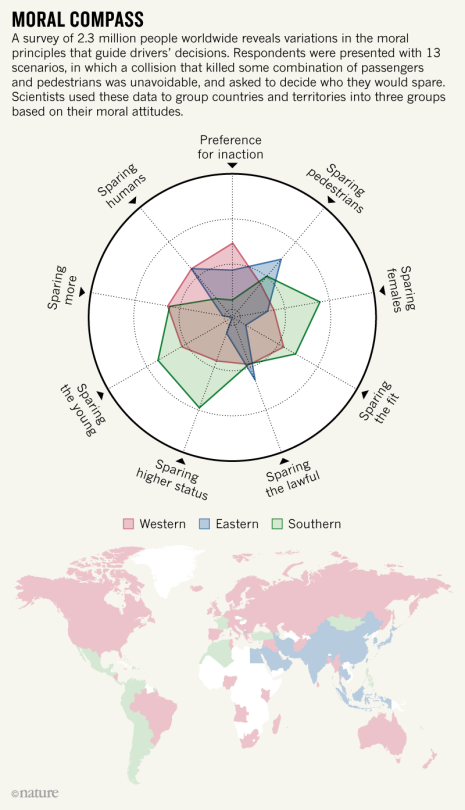
    Safety and statistics aside, in turns out that the answer to the above moral question could depend on where you’re from. Nature recently published what they are calling the largest ever survey of “machine ethics.” And out of this survey they discovered some pretty distinct regional variations across the 130 different countries that responded.

    The responses were able to be grouped into 3 main buckets: Western, Eastern, and Southern. Here is the moral compass that was published in Nature:

    And here are a few examples. In North America and in some European countries where Christianity has historically dominated, there was a preference to sacrifice older lives for younger ones. So that would guide how one might program the car for the case in which a pedestrian steps out in front.

    In countries with strong government institutions, such as Japan and Finland, people were more likely to say that the pedestrian – who, remember, stepped out onto the road illegally – should be hit. Whereas countries with a high level of income inequality, often chose to kill poorer people in order to save richer people. Colombia, for example, responded this way.

    Also interesting is the ethical paradox that this discussion raises. Throughout the survey, many people responded by saying that, in our example here, the pedestrian should be saved at the expense of the passengers. But they also responded by saying that they would never ever buy a car that would do this. Their safety comes first in the buying decision. And I can see that.

    There’s an argument that these are fairly low probability scenarios. I mean, the last time you swerved your car, you probably weren’t driving on the edge of a cliff where any deviation from the path meant you would tumble to your death. But I still think that these are infinitely interesting questions that will need to be answered. And perhaps the answer will depend on which city you’re in.

  • The most popular building amenities (according to a small subset of people)

    Here are the results from my primitive multi-unit building amenities survey:

    Gym is number 1. No surprise there. 46% of respondents said it was in their top 3. 

    Rooftop outdoor space at number 2 was perhaps a bit surprising. But then again, who doesn’t love a good rooftop patio?

    As for concierge service, I tend to think this was driven by package delivery. That’s certainly the biggest value add for me.

    One standout near the top, for me at least, is co-working space. Andrew LeFleur made mention of this on Twitter and I think he’s right: The changing nature of work is making these spaces more valuable in multi-family dwellings.

    And now some color on the above results.

    436 amenity selections were made as part of this survey. 

    About half of the respondents were from the Greater Toronto Area, followed by Calgary, San Francisco, Ottawa, Boston, New York City, Denver, Los Angeles, Paris, Miami, and many other cities. Shoutout to whoever responded from Kuala Lumpur and Porto Alegre.

    In terms of “Other” amenities, there were suggestions for a band rehearsal space, a vending machine, a grassy area for sports, and programming the helps you meet your neighbors.

    In terms of this one last, it can be tricky for condo buildings. Developers only provide the space. It’s then up to management. But I’ve seen it done very well in rental buildings.

    Are you surprised by any of the results from this survey?

  • Most people still want to raise kids in a house (not an apartment)

    https://500px.com/embed.js

    Yesterday I ran a quick 3-4 question survey on ATC called homes for families. The objective was to get a sense of people’s preferences for apartment vs. ground-related housing (house or townhouse) when it comes time to raise a family.

    The results are public so anybody can take a look at the data. At the time of writing this post there were already 70 responses. That’s not a huge data set, but the data is more or less what I expected to see. 

    Here’s what I found (if the data set was larger, I would have made charts):

    The vast majority of respondents were from Toronto. No surprise there. That reflects the readership of this blog, which itself can be quite Toronto-centric at times. (I’ve been trying to branch out more, I swear.) That said, I was thrilled to also see respondents from cities like Seattle, Denver, Chicago, Porto, and Sydney.

    Of the people who specified that they have kids, 11% live in an apartment. 17% live in a townhouse. And 72% live in a house. If you add houses and townhouses together, you get 89% of people with kids living in some kind of ground-related dwelling.

    Of the people who specified that they don’t have kids, 61% live in an apartment. 6% live in a townhouse. And 33% live in a house. This is the kind of split that I generally expected to see for Toronto.

    For the people who specified that they don’t have kids, they were then asked where they plan to move if/when they do have kids. 13% plan to move to another apartment. 8% plan to move to a townhouse. 33% plan to move to a house. 23% don’t plan to move (i.e. they are planning to stay put). And 23% don’t plan to have a family.

    Interestingly enough, 100% of the people who said that they were not planning to move, were already living in a ground-related housing unit (a house in almost all of the cases). So in reality – and if you exclude the people who don’t plan to have kids – about 83% of respondents expect to raise their kids in a house or townhouse.

    Again, this isn’t a big sample size, but the trend appears more or less flat. 89% of respondents who already have kids are already living in a ground-related unit. And when people were asked to project where they would like to be living once they have kids, 83% said they want a house or townhouse.

    Do you think these numbers accurately reflect consumer preferences in your city?

  • Where are Millennials going to move when they start having children?

    Photograph Kembangan by Jason Waltman on 500px

    Kembangan by Jason Waltman on 500px

    Earlier this week I attended RealNet’s Q1 2015 market update webinar for the Greater Toronto Area. If you don’t already subscribe to RealNet, you should consider it. They’re one of the best sources for Canadian real estate market information.

    During their webinars, they occasionally run interactive surveys where they ask the audience a question and participants respond using their web browser. On this particular webinar, they asked the following question, which I thought was interesting:

    What is the likely housing moving by Millennials in raising their families?

    A) Move Up – Embrace urban high-rise housing forms

    B) Move Out – Accept extended commutes (including the Greater Golden Horseshoe and Hamilton Area) to find affordable ground oriented housing

    C) Move In – Cohabitate parental homes

    It’s an interesting question because it’s one that I’ve asked myself a number of times. Sure, Millennials are rushing back to cities and living in high density and walkable communities, today, but what are they going to do and where are they going to move when they start having children?

    As a Millennial myself, I know that I’ve always told myself that I want to stay urban for as long as I can (i.e. Move Up). But I’m only one data point. And given the seemingly endless demand for low-rise housing in Toronto, I always felt like I was in the minority. I figured that the majority of people, at least here in this city, still want a ground-related home when it comes time to raise a family.

    Putting aside economics, I still think that may be the case for a lot of home buyers. But the majority of people on this week’s RealNet webinar (which would be almost exclusively folks from the real estate industry) either think that preference is going to change (or already has) or that consumers won’t have a choice due to affordability.

    50% of the people on the call answered A – move up and embrace urban high-rise housing forms. The balance was about 44% for B and 6% for C.

    That’s not the outcome I expected to see. So today I’d like to re-ask this question to the Architect This City Community. Where do you think Millennials are going to move once they start having children? Please let us know in the comment section below.

  • How are you being shaped?

    image

    “We shape the cities, and then our cities shape us.” That’s one of my favorite lines from the documentary The Human Scale, featuring Danish architect and urban designer Jan Gehl. I like it because I don’t think many of us think enough about the way in which the built environment – that we create – ultimately goes on to influence the way we live our lives.

    One of the most interesting connections for me is the link between urban form and public health. There’s been a lot of talk over the years about how suburban sprawl is, or might be, making us fat (among other things). We’ve created environments that are only navigable by cars and that has forced many of us into sedentary lifestyles. We sit in our cars, and then we sit in our offices.

    So today I’d like to conduct a bit of a poll. If you’d like to participate, please share the following 3 things in the comment section below: 1) your city, 2) the type of neighborhood you live in (urban, suburban, rural, etc.), and 3) the amount of time you spend walking or doing something active on an average day.

    Here’s me:

    I live downtown Toronto in the St. Lawrence Market neighborhood (urban). I take the subway to work and the station is a 10 minute walk from my place. So as a bare minimum, I spend at least 20 minutes a day walking. But since I also walk to do most of my regular errands, and since my gym is another 10 minute walk from my place, I’d say I average a good 30-45 minutes of walking each day.

    Now it’s your turn 🙂

    This is a pretty crude survey, but with the advent of things like smartwatches and health monitors, I think we’ll soon have lots of great data on the ways in which our cities might shape our health.

    Image: The Economist

  • Your thoughts on the real estate marketplace, please

    If you know me at all, then you’ll know that I’m a big proponent of introducing more technology into the real estate space. I think the industry is one that has been incredibly slow to embrace technology, but that it’s only a matter of time before it does.

    Two months ago I wrote a post talking about how entrepreneur and venture capitalist Keith Rabois is working on a home buying startup codenamed Homerun — now called Opendoor. Here’s how he recently described the state of affairs:

    “My friend [PayPal and Palantir cofounder] Peter Thiel suggested that I come up with an idea to innovate in residential real estate,” Rabois told VentureBeat in April. “It’s the largest part of the economy unaffected by the Internet. And that was definitely true then, and even with things like Trulia and Zillow, it’s fundamentally true today. But the process of [selling a home] hasn’t been transformed by technology.”

    What Opendoor is trying to do is really interesting, but I have a different idea. It’s called Unlyst. And today I’d like to ask the ATC community for a small favor. I’ve created a short home buying and selling survey (embedded below) that will take you at most 2 minutes to complete.

    If you could please take the time to do that, I would greatly appreciate it. I’ve made the results public as well, so you’ll be able to see how buyers and sellers currently feel about the real estate marketplace. If you can’t see the survey below, please click here. Thanks for your help!

    [googleapps domain=”docs” dir=”forms/d/1bKvHYdSUfYH3AGX7LcLIK0_-i7nt7WIdTmHeaJ8P7pY/viewform” query=”embedded=true” width=”760″ height=”500″ /]