Daily insights for city builders, delivered every morning at 6 AM ET. I’m Brandon Donnelly — a Toronto-based real estate developer and founder of Globizen. I’ve been writing here since 2013.

Tag: supply

  • Is radical rezoning the solution to gentrification and displacement?

    image

    “If I meet one more anti-gentrification activist who moved to Seattle ten minutes ago, I shall scream.” –Dan Savage

    So it’s not just developers who are frustrated by the many paradoxical desires that we have of cities. We are concerned about housing affordability and we want to minimize displacement, but we do things that restrict new supply and put increasing pressure on our existing housing stock. 

    Below is another excerpt from Dan Savage. It’s from an article called: Doing Something Real About Gentrification and Displacement. Dan writes a sex-advice column, but clearly also feels passionate about urban issues. When he talks about “this city” he’s talking about Seattle.

    “Housing scarcity—exacerbated by the ridiculous amount of this city zoned for single-family housing—deserves as much blame for the displacement crisis as gentrification. More. And unlike gentrification (“a once in a lifetime tectonic shift in consumer preferences”), scarcity and single-family zoning are two things we can actually do something about. Rezone huge swaths of the city. Build more units of affordable housing, borrow the social housing model discussed in the Rick Jacobus’ piece I quote from above (“Why We Must Build”), do away with parking requirements, and—yes—let developers develop. (This is the point where someone jumps into comments to point out that I live in a big house on Capitol Hill. It’s true! And my house is worth a lot of money—a lot more than what we paid for it a dozen years ago. But the value of my house is tied to its scarcity. Want to cut the value of my property in half? Great! Join me in calling for a radical rezone of all of Capitol Hill—every single block—for multi-family housing, apartment blocks and towers. That’ll show me!)”

    His overarching point is that lots of highly-educated people with money are choosing, today, to live in urban centers. And whether we like it or not, that is going to cause gentrification. We can’t stop that. But what we can do is try and alleviate housing scarcity. 

    His other solution involves building lots of transit to address geographic isolation. I agree with him on this point and I’ve argued it before on the blog. If we can all agree that one of the issues is land/housing scarcity, then transit is certainly another way to “pull in” new supply. Though I think we need to be realistic about the level of service required to make areas desirable.

    If you have a few minutes, check out Dan Savage’s article. It’s a good and entertaining read.
  • The urban wealth pendulum

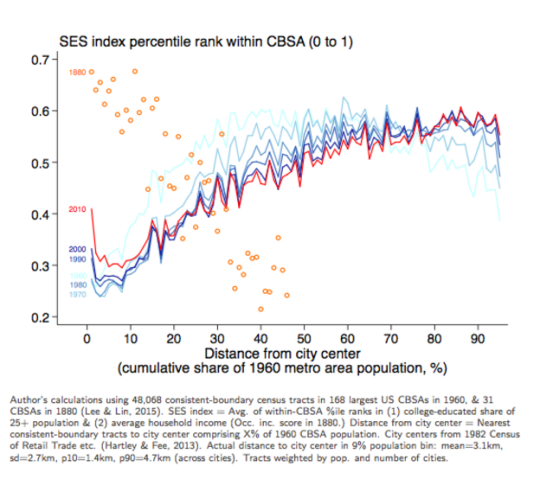
    Jeffrey Lin, who is an economist at the Federal Reserve Bank of Philadelphia, recently published the following chart:

    image

    I found it in this Washington Post article. And it’s packed full of fascinating information.

    The chart compares the socioeconomic status in US cities (y-axis) against “distance from city center” (x-axis) in 1880 and then in recent years (1960 to 2010 census data). The orange circles represent the 1880 data and the red and blue lines represent the recent census data.

    What this chart and research tells us is that in 1880, rich people overwhelmingly lived in the center of cities. And as you moved further away from the city center, socioeconomic status fell off pretty precipitously. This makes sense given that, at the time, it was hard to get around and travel long distances.

    However, in the post-war years, the exact opposite became true. We began driving and wealth decentralized. This should surprise no one. 

    But what’s interesting is how this appears to be reversing. In 2010 (the red line), there’s a sharp increase in socioeconomic status for people living basically right in the center of cities. And for the 30 – 60 km range, there has been a decrease in socioeconomic status essentially from the 1960s onwards. 

    The important takeaway here – which is spelled out in the Washington Post article – is that the neighborhoods which appear to be in high demand today are also in very short supply:

    “We have 80 years of essentially zero production of neighborhoods with these qualities,” Grant says. “We’ve spent the last 80 years building car-oriented suburbs. Then when the elites decide they want to go back into the city, there’s not enough city to go around.”

    This is one reason why supply matters.

  • In search of affordable housing

    Earlier this week I stumbled upon this entertaining article from the Guardian talking about how expensive housing is in London. The author’s tongue-in-cheek suggestion was to setup a new miniature London in the middle of nowhere where everyone could flock for affordable housing, but where many of London’s attributes could be exported: “We can all refuse to wear socks and sell each other overpriced cocktails in jam jars.”

    All joking aside, the article is yet another reminder that big global cities are expensive places to live. And in these cities, one of the most precious commodities is, quite simply, personal space. That’s why a garage in London can sell for £550,000 and why a 35 square foot storage cage in New York can sell for $75,000

    But affordable housing is not the reason why people want to live in places like London and New York. If it were, they wouldn’t be coming. Instead, they come for lifestyle, wealth creation, and the dating market – among other things. However, at a certain point, usually when they form families and start to need/want more space, they start looking around.

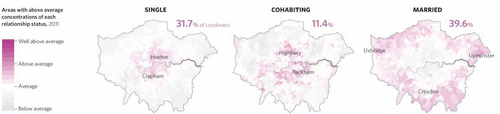
    Here’s an infographic via the Atlantic showing how relationship status impacts where people tend to live in London. The purple areas indicate an “above average concentration” of a particular relationship status. As you can see, single people tend to live in the core of the city, and when they get married, they move out to the periphery. Intuitively, this probably makes sense to you.

    image

    However, I’m always curious as to whether this trend happens more because of consumer preference (people don’t want to raise kids downtown) or because of economic necessity (they can’t afford anything beyond a shoe box apartment). Because if it is largely out of economic necessity (and the Guardian article would suggest it is), then we’re not creating the inclusive cities and neighborhoods that all city builders like to talk about.

    So how do we get better at this?

    In my view, and I’ve argued this before, the first step should be about improving supply. That is: get more housing built. And the way to start doing that is to make land available and improve the approvals process for new developments. In a recent McKinsey report, they referred to my first point as “unlocking land.”

    “Land cost often is the single biggest factor in improving the economics of affordable housing development. It is not uncommon for land costs to exceed 40 percent of total property prices, and in some large cities, land can be as much as 80 percent of property cost.”

    The reason this is important is because most big cities operate with massive supply deficits. There simply isn’t enough housing. And so if you can address that at a fundamental level, you can actually do a lot to start improving affordability.

  • Real Estate Startups: Supply Side or Demand Side?

    I was reading True tales from the real estate wars of 2012 (Toronto Life) this morning and reminded me that, first, Toronto real estate remains a topic everyone seems to love to talk about and, second, that most real estate startups are focused on the supply side of real estate. 

    One thing I always find when I tell people I work in real estate is that they automatically assume I’m in sales. Sales are only one part of the real estate business — albeit an important one — but still only one part. As a result of this automatic association, I find that real estate startups tend to centre themselves around creating better listing platforms.

    Another way of thinking about this is that they’re focused on the supply side of real estate. When real estate comes up for sale, available supply is increased. How do I then improve the way these listings are delivered to the marketplace?

    But what about the demand side? If you read through Tale #1 from the real estate wars article, you’ll see that Matthew Slutsky and Carlie Brand ended up canvassing a St Clair West neighbourhood in order to find a private sale (after losing a few bidding wars). A smart and proactive move, for sure. 

    However, why is there no easier way to do this? We’ve all been so focused trying to improve listing delivery that we’re forgetting that there are owners out there who are willing to sell given the right opportunity. 

    This is one of my primary goals with Dirt. I want people to engage with real estate all the time — not just when they’re looking to buy/sell — and I want to shift the focus to the demand side of real estate: what neighbourhoods do people like, what houses do they like, what’s happening with this property, etc.

    I’m reminded of a piece I recently read by Matthew May called Observe First, Design Second: Taming the Traps of Traditional Thinking. Often we can be so quick to jump to final solutions that we forget to take a step back and contemplate whether or not we’re even headed in the right direction.

    If you like building mobile apps and are interested in real estate, I’d love to hear from you. Feel free reach out at @donnelly_b.