Daily insights for city builders, delivered every morning at 6 AM ET. I’m Brandon Donnelly — a Toronto-based real estate developer and founder of Globizen. I’ve been writing here since 2013.

Tag: superstar cities

  • Introducing the Meta City

    During the pandemic, there was a lot of erroneous talk about the death of cities. Much like when the consumer internet first came around, the thinking was that technology would make geography irrelevant. I was and am vehemently against this idea, but it’s hard to not feel like technology is doing something. But what exactly? According to Richard Florida, Vladislav Boutenko, Antoine Vetrano, and Sara Saloo, it is creating something called the Meta City:

    The various communities that make up the Meta City may be in different time zones and noncontiguous locations, but they function together as a coherent network with a distinct structure and logicThe Meta City combines physical and virtual agglomeration, in seeming defiance of the laws of physics, making it possible to occupy more than one space at the same time. As a result, urban areas within the Meta City network can share economic and social functions.

    The narrative is compelling. Cities have always responded to and been a product of new mobility technologies. Streetcars, subways, and the car have all reshaped the geography of our cities. Some would argue for the worse. What the Meta City proposes is that technology today is not a disruptor of cities, it is simply another mobility shift. Rather than make cities irrelevant, it actually makes them more important by expanding their reach:

    The pandemic-era shift to remote work is yet another technology stretching the boundaries of the city into a new and larger geographic unit. But instead of doing so physically, it does so by enabling virtual expansion. The share of American workers engaged in remote work tripled from roughly 6% in 2019 to almost 18% in 2021. Remote workers can access significant quality of life at far more affordable prices in smaller cities, suburbs, and rural areas.

    Some specific examples:

    Many of these rising places are critically connected to established cities. As we will see, Austin’s rise is best understood as a satellite of San Francisco’s long-established tech hub. Miami is enmeshed in New York City’s finance and real estate complex. The rise of the Meta City informs a counterintuitive logic: Leading superstar cities are seeing their role as economic hub expand, even as some talent and some industry disperse to satellite centers.

    Finally, here’s their ranking:

    If you believe this to be true, then it should be good news for the real estate located in the cities listed above. But it also means that we are now facing a new kind of hub-and-spoke model of urbanism. London and New York remain at the center, but tech is only strengthening their reach and influence. This is a new way of thinking about the flow of human capital around the world, and I’m sure it will have impacts on how we plan and build our cities.

    Image: Harvard Business Review

  • How new technologies spread (and what that means for superstar cities)

    We know that innovation and economic growth tends to be unevenly distributed. This is the bull case for living in cities and, more particularly, for living in certain cities. But of course, the big question these days is whether or not our little work from home experiment has proven that, for the first time ever, work can now decentralize.

    Well here is a unique study that looked at 29 disruptive technologies over the last two decades in the United States. Using three main sources — patents, job postings, and hundreds of thousands of earnings calls — the team traced where new innovations/technologies have tended to emerge and then how they spread (or didn’t spread) across the rest of the US.

    Their initial findings won’t surprise regular readers of this blog. There are indeed a certain number of pioneering superstar cities. Within their list of new disruptive innovations, the team found that about 40.2% of them came from California. The next “super-cluster” was along the Boston-Washington corridor in the northeast with ~21.2%. By narrowing down their list to “disruptive patents”, as opposed to all patents, innovation looks even spikier.

    Next the team looked at how these disruptive technologies tend to diffuse across the country. This is where job postings and earnings calls come into play. New technology gets created in California garage. Cool. But at what point do CEOs across the country start talking about it and hiring people who are capable of doing things with it? This next figure shows that diffusion at various time intervals.

    Now here are the important takeaways. New disruptive technologies clearly take time to spread. However, high-skilled hiring tends to spread much more slowly than low-skilled hiring. This kind of makes sense as you’ve got a built up and entrenched knowledge base in these pioneering locations.

    But what this also means is that pioneering locations tend to maintain their hegemony for quite some time — decades. The high-paying jobs stick closer to home for much longer, presumably because geography makes it harder to transfer knowledge. This is, of course, based on historical data. But I remain highly suspect that Zoom calls can really disrupt the importance of our superstar cities.

    Maps: Vox

  • The many forces shaping our cities

    Richard Florida has a three-part essay over on Bloomberg CityLab about the forces that are currently shaping American cities. In part three, he argues that this pandemic will likely accelerate many of the trends that were already underway — families will continue to like the suburbs and young people and businesses will continue to cluster in dominant global cities. At the same time, he argues that we will see a kind of “urban reset.” A window of opportunity where we just might be able to rebuild our cities to be more affordable, more inclusive, and more productive. Could this be the moment where we commit to transforming our suburbs into more walkable mixed-use communities? Could this crisis actually strengthen our cities, as I have argued before on the blog? At this point in time, the only thing I really know for sure is that most of our predictions will be wrong.

  • Economies of agglomeration in London

    The media tends to describe agglomeration economies — one of the benefits of big urban areas — as being entirely serendipitous. Minimize travel. Maximize chance encounters at the local coffee shop. And then all of a sudden patents will go up and new startups will emerge. That does that happen, I’m sure, but there’s a bit more structure to a lot of these encounters. Economies of agglomeration is not just about serendipity. It is about the benefits of and the decision to concentrate economic activity.

    Last week, a think tank in the North of England (IPPR North) published a report outlining, among other things, job creation and productivity across England. Based on these metrics, London and the South East dominate, with “productivity” in London being by far the highest. Almost half of England’s new jobs over the last decade were in these two regions. Above is a chart from the Financial Times. The trade-off is wealth and income inequality. And the report does look to how the government could address this centralization of power and wealth.

    Like Singapore’s low fertility rate, this is an instance of leaning into the wind.

  • How superstar cities can continue to scale

    Aaron Renn’s latest article in the Manhattan Institute is about how America’s top cities can “grow to new heights.” Usually when we talk about urban problems, it is because of failures. But in this case, it is about problems of success (though I suppose you could argue these are still failures).

    Cities such as New York and San Francisco have, in his view, stopped thinking like growth cities and that is leading to high home prices and overburdened infrastructure. But we all know that these problems are not unique to only “superstar cities.”

    Not surprisingly, Aaron argues that we need to stop implementing land use policies that only exacerbate our housing supply problems. Things like rent control and inclusionary zoning. And in some cases, it may be time for states to start intervening in local planning decisions.

    For the full article, click here.

  • Winner-take-all cities

    Richard Florida, Charlotta Mellander, and Karen M. King have a new working paper out called Winner-Take-All Cities.

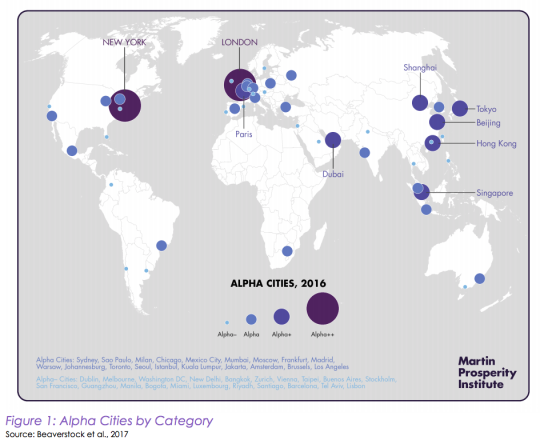
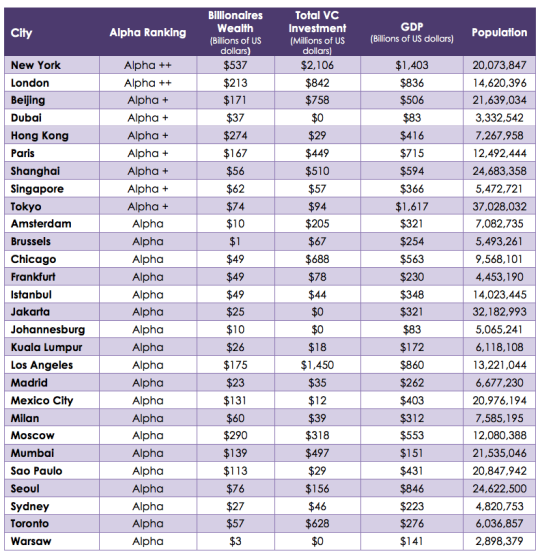
    It is about the phenomenon of “winner-take-all urbanism” and how a select number of alpha cities seem to overrepresent when it comes to talent, economic activity, innovation, and wealth creation.

    In this study they look at economic output, innovation (venture capital-backed startups), and billionaire wealth in each city. They then compare these factors to the distribution of the population.

    Here are the Alpha cities they looked at:

    In some cases the above concentrations were multiples of what the city’s population would lead you to predict. Their conclusion: “We find clear evidence of a winner-take-all urbanism
    across the global economy and the world’s cities.”

  • Superstar or bubble?

    “The term “bubble” refers to a substantial and sustained mispricing of an asset, the existence of which cannot be proved unless it bursts.” – UBS

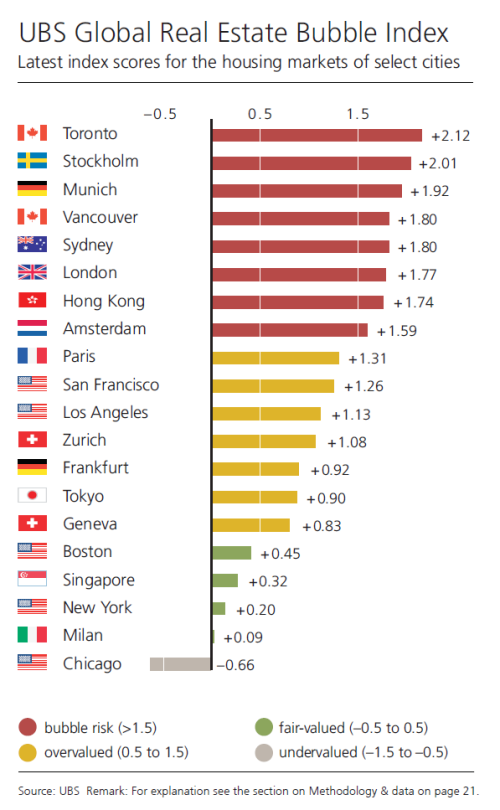
    Last week UBS released its 2017 Global Real Estate Bubble Index. At the top of the list was none other than Toronto, followed by Stockholm, Munich, Vancouver and Sydney. And at the bottom of the list was Chicago – a city that UBS feels is undervalued.

    Here is the full list of index scores:

    image

    The UBS index is a weighted average of the following five sub-indices:

    1. Price-to-income
    2. Price-to-rent (fundamental valuation)
    3. Change in mortgage-to-GDP ratio
    4. Change in construction-to-GDP ratio (economic distortion)
    5. Relative price-city-to-country indicator

    If you look at their price-to-income benchmark in isolation, Toronto drops down to the middle of the pack along with Geneva and San Francisco. Hong Kong, London and Paris sit at the top with the most unaffordable housing. 

    Still, UBS credits “an overly loose monetary policy”, foreign demand, tight zoning, and rental market regulations for the eroding housing affordability in Toronto and Vancouver.

    One of the challenges, of course, is that the capital flowing into real estate is not all local – it’s also global. And many cities around the world are seeing high price-to-income multiples, perhaps because of that. 

    So exactly how much decoupling from local fundamentals should now be considered reasonable in our globalized world? And to what extent is this a result of “superstar economics?”

    Here’s an excerpt from the UBS report:

    The economics of Superstars explains why, in some professions, show business for instance, “small numbers of people earn enormous amounts of money and dominate the activities in which they engage.” By analogous reasoning, prices in the most attractive cities are expected to outperform average cities or rural areas in the long run. Hong Kong, London and San Francisco are exemplars of this theory.

    The intuition is that the national and global growth of high-wealth households creates continued excess demand for the best locations. So, as long as supply cannot increase rapidly, prices in the so-called “Superstar cities” are supposed to decouple from rents, incomes and the respective countrywide price level.

    I guess this is one of the reasons why bubbles are proven after the fact. If you would like to download a copy of the full UBS report, click here.

  • Crane capital of America

    When people like Richard Florida talk about today’s “superstar cities”, the usual suspects include London and New York for finance, the San Francisco Bay Area for tech, Milan for fashion and design, and so on.

    And you can certainly find the data to back up these claims. For instance, if you look at venture capital dollars invested, many of these same cities reappear near the top: San Francisco, San Jose, New York, etc.

    One city that doesn’t often appear on these sorts of lists, though, is Seattle. 

    However, clearly something special is taking place in the city. For the second year in a row, Seattle has been named the construction crane capital of America. No other American city comes close right now. (However, Toronto is still #1 in North America.)

    At the same time, if you think about all of the companies that have come out of Seattle over the years, you start to realize that maybe VC dollars invested isn’t enough to tell the entire entrepreneurial story.

    Venture capitalist Fred Wilson once said on his blog that if you look at dollars in and dollars out, Seattle outperforms – by a lot. And that’s very interesting to me. Is this simply the lasting legacy of Microsoft? Or are there other – transferable – lessons to be learned here?

  • The geography of superstars

    We often talk about superstar cities such as New York, London and, in the case of tech, San Francisco. But what about the superstar people that drive these economies?

    Aaron Renn recently wrote a post called “The Superstar Gap”, where he argues that the interior of the U.S. is suffering from a big handicap because of its lack of superstars. Chicago is one example he gives. Very good, but not the best.

    He also cites a 2010 analysis by Carl Wohlt that shows the “100 Most Creative People in Business” predominately living in the West and Northeast, compared to the Midwest and South.

    This is interesting because – if we assume this gap to be true – it gets me thinking about a number of important questions:

    • Is it that the interior isn’t effectively fostering superstar talent?
    • How much superstar talent is actually latent and untapped?
    • Is it that superstar talent is getting sucked into a select few superstar cities, away from other places? Definitely happening.
    • How many superstar cities (filled with superstar people) can sustainably exist in today’s world?

    Now by definition, superstar talent is going to be a smaller segment of the population – it’s one tail of the bell curve. 

    But I do think we should be careful not to assume that the raw talent doesn’t exist in certain cities. People and place are linked, and superstar cities are arguably just empowering new forms of individual superstardom.

    If we are to use successful startups as one measure of superstardom, it’s important to keep in mind that they are incredibly fragile in their nascent stages. The right people need to come together. The right funding has to fall into place. And the list goes on. 

    Below is an excerpt from a 2006 essay by Paul Graham (Y Combinator) called, Want to start a startup?

    Successful startups are almost never started by one person. Usually they begin with a conversation in which someone mentions that something would be a good idea for a company, and his friend says, “Yeah, that is a good idea, let’s try it.” If you’re missing that second person who says “let’s try it,” the startup never happens.

    That someone might have been a superstar.