Daily insights for city builders, delivered every morning at 6 AM ET. I’m Brandon Donnelly — a Toronto-based real estate developer and founder of Globizen. I’ve been writing here since 2013.

Tag: sun

  • The Great Recession only paused suburbanization

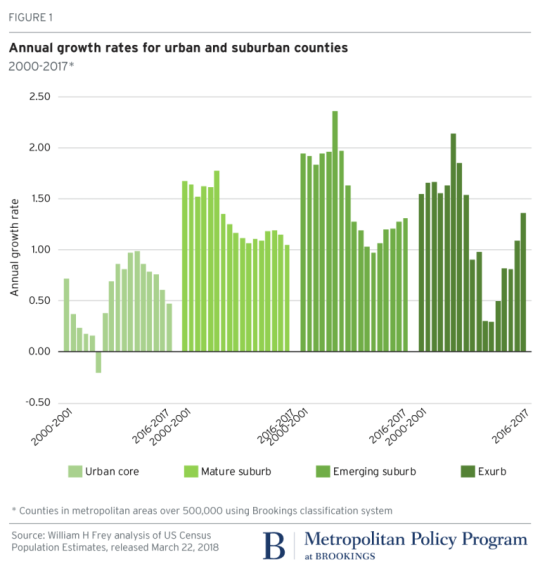
    According to newly released US census data for 2010-2017 – which Brookings analyzed here – the “back to the city” movement appears to have peaked in 2012. (This is something that we’ve looked at before on the blog.)

    Here is a graph from Brookings showing the annual growth rate for urban and suburban counties. Note how growth in the “urban core” peaked in 2012 and how growth in both the “emerging suburb” and “exurb” have increased since then.
    image

    The other finings from Brookings are that growth has slowed in large metropolitan areas (small metro areas and non metro areas, on the other hand are up) and that people are continuing to move from the Snow Belt to the Sun Belt.

    If you look at population gains and losses from 2016-2017 for the 100 largest US metro areas, the only Snow Belt gainers within the top 20 are New York (15th), Columbus (19th), and Boston (20th). Dallas, a Sun Belt city, was first with a gain of 146,000 people.

    So what’s going on? The narrative is that soon as the US economy and housing market recovered from the Great Recession of 2008, the trend lines simply reverted back to business as usual: sun and sprawl.
  • Strandkorb — a low tech solution to the elements

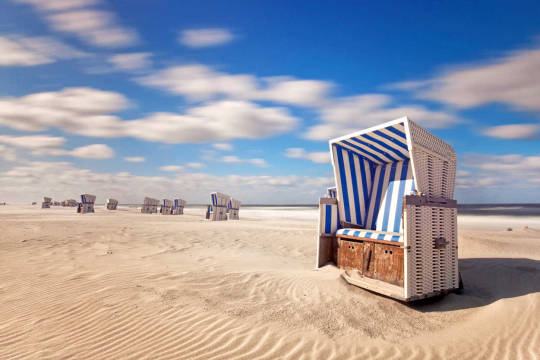
    I recently discovered this marvelous chair (image from here):

    image

    It’s called a strandkorb, which is a German word that translates into something along the lines of “hooded beach chair.” It was invented in the late 19th century by a basket maker looking for protection from the elements on the beach.

    Apparently they are fairly ubiquitous at resorts along the North Sea and Baltic Sea and are a bit of a cult object in Germany. They are a symbol of holiday fun, but also, to some, a symbol of German resiliency in the face of adverse weather.

    For me, the beauty of these beach chairs is that the “hood” blocks the wind. So if you orient yourself toward the sun, you could actually feel quite warm even when it may not be the perfect beach weather. They extend the season, which is paramount in cooler climates.

    I guess that’s why they have stuck around since the 1880′s. If you check out some of the (Google) photo spheres in beach towns in northern Germany, you will definitely find many a strandkorb.

  • Follow the sun and sprawl

    image

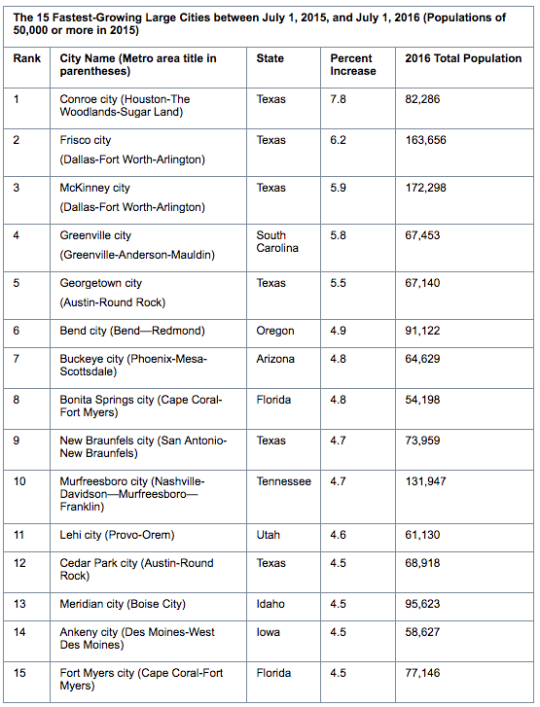
    The U.S. Census Bureau recently released it’s 2016 city and town population estimates. The press release can be found here.

    The headline isn’t a new one. Southern cities continue to grow quickly. This is not a new trend. Humans seem to like warm weather and the housing supply in southern cities tends to be more elastic. This keeps home prices relatively in check and allows the cities to more easily accommodate growth.

    From July 2015 to July 2016, 10 of the 15 fastest growing large U.S. cities were in the south (based on % growth). 4 of the top 5 were in Texas. 

    From 2010 to 2016, the population in large southern cities grew an average of 9.4%. Cities in the west clocked in at 7.3%. And cities in the northeast and midwest were at 1.8% and 3.0%, respectively.

    Two outliers near the top are Seattle and Denver. Since 2010, the population of these two cities grew 15.39% and 14.87%, respectively. I’m going to say it’s because of the skiing and snowboarding. Half-joking. For the top 25 large cities ranked by 2010-2016 growth rate, click here.

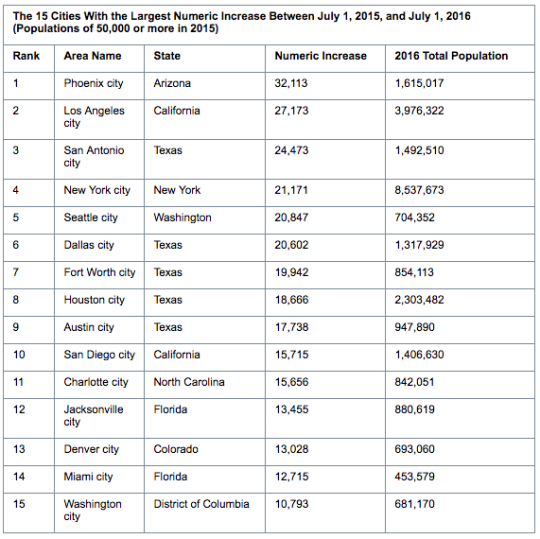
    In terms of absolute humans, Phoenix had the largest numeric increase between 2015 and 2016: 32,113 or about 88 people per day. After Phoenix it’s Los Angeles (27,173), San Antonio (24,473), New York (21,171), and Seattle (20,847). These are all city proper figures.

    It’s also worth noting which large cities aren’t growing. From 2015 to 2016, Chicago fell -0.32% and Detroit fell -0.52%. Philadelphia was only slightly positive at 0.19%. Going back to 2010, Chicago is still flat at 0.27% and Detroit is even more negative at -5.39%. Philadelphia is 2.5%.

    Follow the sun and the sprawl.

    The below charts are from the United States Census Bureau.

    imageimage

  • View From A Blue Moon

    image

    I don’t surf. I would like to learn, but I haven’t yet done that. I snowboard. That’s my thing. It’s what I look forward to doing every single winter. 

    But even as a non-surfer, I can’t begin to tell you how much I enjoyed the movie View From A Blue Moon. A friend told me about it last weekend and I immediately rented it on my Apple TV. (That’s the only thing I have to watch things.)

    It’s a movie about John Florence, who is arguably the world’s best surfer right now. He’s from Hawaii. But in addition to John’s incredible surfing abilities, it’s the cinematography and soundtrack that make this movie so special. 

    As soon as the movie ended, I immediately went on Soundcloud to find all of the songs. Quentin Tarantino once said that when you pick the right song for a particular scene/movie, you can then never listen to that song ever again without thinking of the movie. That’s how I now feel about this song.

    Here’s the trailer (apparently it’s the first surf movie filmed entirely in 4K):

    [youtube https://www.youtube.com/watch?v=bTqVqk7FSmY?rel=0]

    If you’re at all interested, I highly recommend you give it a watch. There are also some great urban shots for all of the city geeks who read this blog. Let me know what you think if you end up watching it or if you’ve already seen it.

    Image: View From A Blue Moon

  • Let there be light

    My condo has an east exposure. That means I get direct sun in the morning and no direct sun in the afternoon, once the sun has crossed over onto the other side of my tower.

    But a funny thing happens in the late afternoon and early evening. The sun reaches just the right angle and begins to reflect off the apartment across from me. That apartment is about 11m away.

    Once this happens, it then feels like I’m getting direct sun again. It floods my apartment. This may seem like a small thing, but I love it when this happens. It’s happening right now as I write this post.

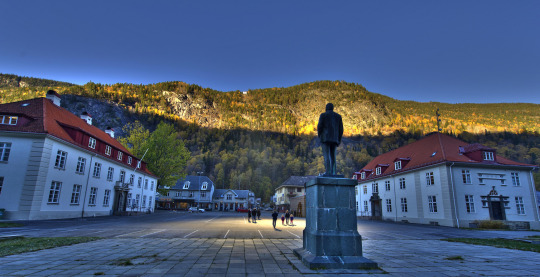
    So I can only imagine what it must have felt like for the residents of Rjukan, Norway when they got their first taste of winter sun back in 2013.

    Rjukan is a small town of approximately 3,400 residents. It’s located about 2.5 hours west of Oslo and is situated within a deep east-west valley. 

    As a result of its geography, the town is cast in shadow for about half of the year, from September to March. The elevation of the sun is simply too low for direct light to reach down and into the valley.

    So what the town did was install a set of solar powered mirrors on top of the mountains. The mirrors – also called heliostats – track the sun and reflect it down into the town’s main square. Now the town gets winter sun.

    Interestingly enough, many residents opposed the mirrors before they were built. They viewed it as a frivolous expenditure. Petitions and Facebook pages were created. But now that the mirrors have been installed, most of the naysayers seem to have changed their tune.

    I think it goes to show just how important light is, but also how difficult change, of many varietals, can be.

    Image: Flickr