
This is an excellent video that I would encourage all of you to watch. It provides a visual look at city finances and explains how car-dependent suburbs are usually heavily subsidized by productive urban places. These are the kinds of analyses that all cities should be doing and, among many other things, I think it could go a long way to positively influencing how we plan our cities. Want to keep densities low and new development to a minimum in your community? Well then you should expect to see a commensurate increase in property taxes. If that doesn’t make sense to you right now, it will once you watch the video.
Tag: suburbia
-
The density delusion
Joel Kotkin and Wendell Cox recently published a piece in the Orange County Register called, “California’s housing crisis and the density delusion.” I’m sure you can guess where this is going, even if you don’t follow the work of Joel Kotkin. But if you do, you will know that he is an ardent supporter of suburbia and the single-family home.
Here is an excerpt from the article:
In reality, the YIMBY’s suggestion that new, dense housing will improve affordability for all is patently absurd. Decades of densification in Los Angeles has seen ever higher rents, displacing low-income, especially minority households. Many former transit customers have been driven to lower-rent areas with less transit service, precipitating a massive decline in ridership, even as billions continue to be spent building new rail lines. The Wiener Bill [my link, not theirs] could exacerbate this trend, and likely increase the need for low-income housing, already well beyond the capability of public coffers.
I fully appreciate the argument that high-density housing isn’t for everyone and that we shouldn’t be “forcing everyone back to the ‘glory’ days of the city of tenements.” But I disagree with many of their points, including the argument that density doesn’t encourage transit ridership. Density isn’t everything, but it’s an important something.
The article is definitely worth a read, particularly if you disagree with their positions. That’s how you avoid confirmation bias. I was trying to keep that in mind as I read it. Maybe it worked.
-
Can starchitecture trump soul-crushing sprawl?
Hunter Oatman-Stanford just published a longish read over on Collectors Weekly that talks about the history of suburban office complexes in America. That part alone makes it an interesting read.
But he also makes the argument that innovative companies like Apple and Google are still stuck in a midcentury suburban mindset with their new mega headquarters:
“I look at Apple’s Norman Foster building, and it’s 1952 all over again,” Mozingo says. “There’s nothing innovative about it. It’s a classic corporate estate from the 1950s, with a big block of parking. Meanwhile, Google is building another version of the office park with a swoopy roof and cool details—but it does nothing innovative.”
Others have made this same argument. Back in 2013, Wired published an article talking about why Apple’s new Norman Foster spaceship could result in them losing the war for tech talent.
And if you read the piece in Collectors Weekly, you’ll see just how little, in some cases, the office environment has changed since the middle of the 20th century.
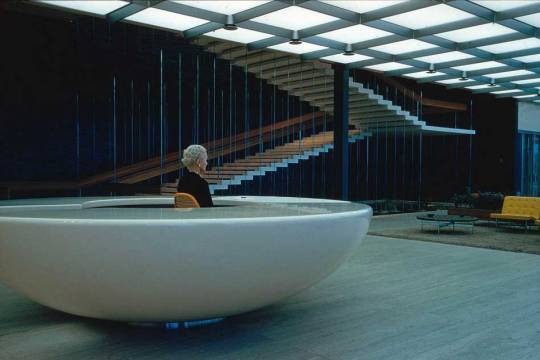
Back then, we also had big name starchitects designing suburban head offices for innovative companies. Below is a photo from the GM Technical Center in Warren, Michigan. It was designed by Eero Saarinen and it opened in 1956.
There’s lots of research that suggests that, today, both entrepreneurs and capital are flocking to urban centers, instead of the suburbs. And I certainly don’t need to repeat that to this audience.
But given this shift, I think we will increasingly view the suburban sprawl of places like Silicon Valley as a serious competitive disadvantage. I mean, I am sure these new buildings will be lovely, but I certainly wouldn’t want to work there.
Would you?
-
The big challenge is suburban infill
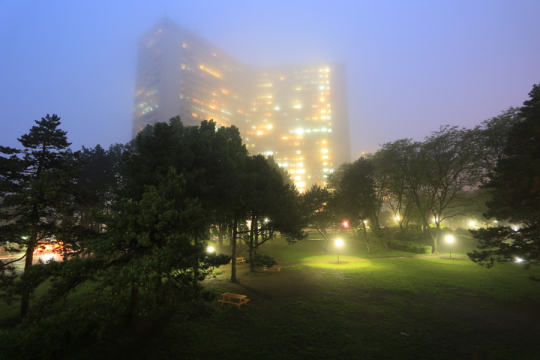
Thorncliffe Park Drive (TORONTO) by Jenver Rosales on 500px
Between the 1950s and 1980s, Toronto built a lot of towers. A 2010 report by the Centre for Urban Growth and Renewal identified 1,925 rental apartment towers of 8 storeys or more across the Greater Toronto Area.
That’s the second largest inventory of apartment towers in North America – many or most of which are in car-oriented suburban neighborhoods.
Of course, Toronto continues to build a lot of towers. But this second and current wave of towers is quite different than the last. Virtually all of them are now condo (as opposed to rental) and most are concentrated in central neighborhoods that are generally well-serviced by transit.
This has created a lot of positives for the city. It brought more people into the core to live, which in turn brought more retailers and employers into the city. It has created what I believe is a more vibrant and exciting 24/7 city.
But this return to city centers (as well as the economic spikiness it has created) is now well established both in Toronto, as well as in other cities all around the world. Every real estate conference or panel you go to now talks about Millennials and their desire to be in walkable communities. We got it.
And relatively speaking, those kinds of communities aren’t that difficult to create when you’re infilling city centers. Certainly not at this point. The street grid and bones are usually all in place. And the urban form is often conducive to transit.
The real challenge – and thus opportunity – for Toronto and lots of other cities is how to urbanize the (inner) suburbs and in particular these “towers in a park”. If you follow this space, you’ll know that there’s a lot more that we could be doing.
How do we rethink their relationship to the rest of the city? How do we better connect them through transit? How do we plug them in economically? In my opinion, these are far more difficult tasks. But they’re important ones for the long-term success of our cities.