Daily insights for city builders, delivered every morning at 6 AM ET. I’m Brandon Donnelly — a Toronto-based real estate developer and founder of Globizen. I’ve been writing here since 2013.

Tag: style

  • “BRAND”

    image

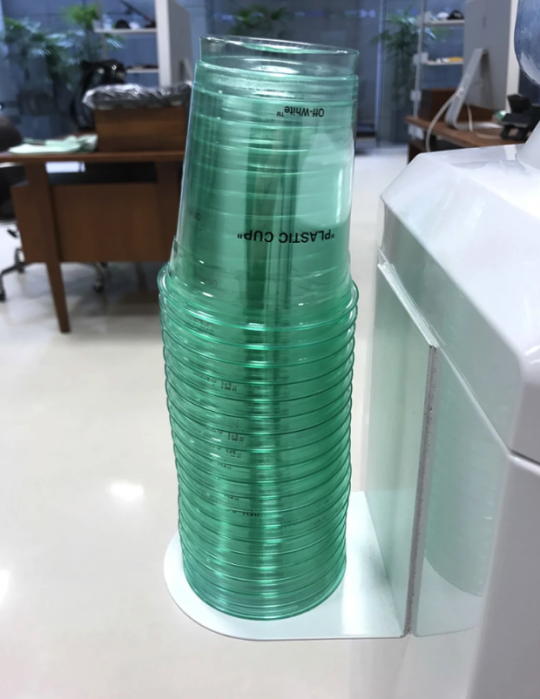
    For a number of reasons, I am fascinated by the streetwear label, Off-White

    It is one of the hottest labels in fashion, and yet there’s a part of me that doesn’t really get it. It’s mostly bold text, usually in quotations, on various apparel items. A set of Wellington boots might be plastered with “FOR RIDING.” A winter coat might be plastered with “DOWN JACKET.” And when they collaborate with Nike, the shoes might be tagged with “AIR.” Quotations included. Is that fashion?

    But then you hear Virgil Abloh – the founder of Off-White, who by the way was also trained as an architect before becoming creative director for Kanye West – talk about his brand and it starts to make more sense. The quotation marks are supposed to signal “ironic detachment and a comment on the idea of originality.” Okay, so a little more sense.

    Part of his inspiration comes from the work of Marcel Duchamp. In 1917, Duchamp shocked the art world with, Fountain. Some would consider this to be the most pivotal art piece of the 20th century. It was an off the shelf urinal that he simply signed, dated, and placed on a pedestal. Though initially rejected as art, it eventually redefined what art could be, shifting it from, “new physical creations to [the] moulding [of] ideas.”

    The corollary to this was that anything could be art, even something as utilitarian as the catch basin that you pee into. And this insight is something that Abloh has used to fuel his label. But he has taken it a step further. He has leveraged the ubiquity of these everyday-items-elevated-to-art as a way to elevate his own brand. Here’s a quote by Abloh from the Guardian:

    “The idea [that] an everyday object is art. Branding is generic and if I adopt the generic, then it becomes my branding, but it normally occurs in life.”

    In other words, he is co-opting generic and ubiquitous items – like, for instance, the patterning on caution tape – for his Off-White designs. And if you believe that a bit of brand equity is at least partially driven by brand ubiquity, well then you might start to see the value in this approach. He is simply assigning authorship to things that are already omnipresent.

    But, is that fashion? I guess that depends on whether you consider Duchamp’s Fountain to be art.

    Image: SSENSE
  • Saks x Dim Mak

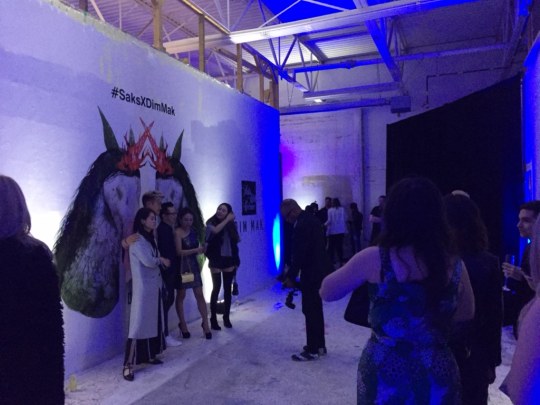
    Steve Aoki was in Toronto today for a collaboration with Saks Fifth Avenue – namely the launch of his fall/winter Dim Mak Collection

    The after party was at Junction House (the pre-development version). Here is a photo:

    I actually wasn’t there (because I’m fighting off some sort of cold), but a friend sent me this photo. 

    It’s such a great space for events and production. It used to be an artist studio, but they moved out because they outgrew the space.

    If you have a need for a large warehouse space, you can actually rent it by visiting here.

  • That emotional connection

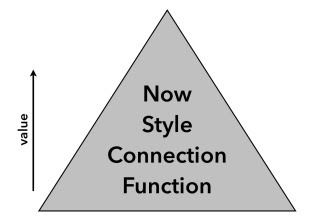
    Marketing guru Seth Godin recently published this value
    triangle on his blog
    :

    image

    No matter what business you’re in, it’s worth giving some thought to this. What do you offer?

    At the bottom of the triangle is function. A hotel room functions as a place
    to sleep. A smartphone functions as a device to make calls, send text messages,
    and download some apps. A condominium functions as a place to live, eat, sleep, have sex, and so on. But all functions being equal, most of us will buy whatever product is the cheapest.

    That is until there’s an emotional connection. I love the
    way Seth frames it: “Where do people like me do things like this?” It is about defining
    who you are. Am I the kind of person who buys A or am I the kind of person who buys
    B? If I care deeply about the environment and B promises to respect that, I am
    likely to buy B.

    But then, moving even further up the triangle, if two items offer the same function and the
    same emotional connection, many of us will go for the one that appears sexier, shinier (the new iPhone 7 is very shiny), and more
    stylish. It just deepens the connection.

    Finally, at the very top of the triangle is now. This is
    about scarcity. What’s hot right now?
    Think of that new restaurant that just opened downtown that you haven’t been
    able to get a table at. It’s now and you want to Instagram the food so badly so
    that you can show everyone you were there. You want to be now.

    The point of all of this is that we consume things for
    reasons that go well beyond simple function. That’s just the start of it all.
    One could argue that all of this is simply smoke and mirrors, but that’s a
    topic for another blog post. This is our reality.

    To relate this topic back to architecture and real estate, I
    am curious how many of you have made a housing decision that you believe went
    beyond function. How much of it was based on connection and style?

    Not surprisingly, for me, architecture and design matter a
    great deal.

    Earlier this summer I was driving around the city with my
    father and he was pointing out to me all of the new build single family homes
    that were sprouting up. He then asked me what I thought of them. I responded: “They’re
    shit.”

    What I was really saying with that glib remark was that
    those homes – no matter how expensive – didn’t reflect my own belief system
    about the world. Sure they served their function, but they didn’t offer the
    connection and style that “people like me” like to praise. To borrow once again
    from Seth: we are all part of a certain tribe.

    What tribe do you belong to? And does your housing choice
    reflect that?

  • The value in small retail spaces

    image

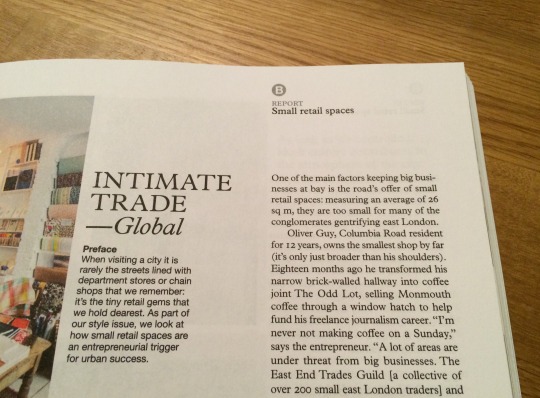
    This month’s issue of Monocle is centered around fashion, style, and retail. And one of the most interesting pieces is a report on small retail spaces. 

    The argument (which you can read in the preface shown above) is that micro retail spaces are incredibly important for entrepreneurship and urban vitality. Because if all a city has is large retail spaces, then you’re creating impossible barriers for new retail startups. The rents simply become too high.

    It’s on page 79 in case you have this month’s issue or want to go pick it up.

    After reading the article, I immediately thought of 2 posts that I recently wrote on related topics. The first is “Incubating new ideas in cities” and the second is “The hard things about retail.”

    In the first post, I questioned how cities might be able to encourage and incubate new ideas alongside new development and buck the Jane Jacobian truism that new ideas require old buildings. And in the second post, I expressed my concern for a micro retail condo complex here in Toronto that appears to be struggling.

    But maybe that micro retail complex is on to something (just with the wrong tenure: condo instead of rental). Maybe it’s as simple as starting with great urban design and small (affordable) retail spaces. 

    It seems to be working for Columbia Road in London, Knez Mihailova in Belgrade, and Tower Theater in Los Angeles (the 3 examples that Monocle gives).

  • Spring forward with Apple’s new watch

    image

    Today was Apple’s big “Spring Forward” event. We already knew the Watch was coming, but now we know that it’ll be available for sale on April 24, 2015 and that their high-end “Edition” line will start at just $10,000.

    Within the tech community, there are mixed opinions when it comes to the Apple Watch. Some think it’ll be a total flop. Some think it’ll be the next iPhone. And some think it’ll do reasonably well, but that it just won’t be the next category killer for Apple.

    I personally think it will do really well. 

    I think there are enough use cases for which looking at your wrist is a better experience than pulling out your phone – particularly for quick glance activities. Think payments, transit fares, airline tickets, location-based notifications, and so on. 

    However, one of the big challenges for Apple Watch will be that they’re trying to replace an entrenched fashion piece. So not only is Apple trying to solve a problem that most people didn’t know they had, but they’re also trying to get people to give up their Movado or Patek Philippe – which is why they created a super high-end line.

    Whatever the case may be, I plan to pre-order a Watch next month (just the regular one, not the $10,000 one).

    I’m excited to try the health features (it’s a passion of mine). I’m excited to see what kind of data this new device generates both for me personally and in aggregate. And I’m excited to see what clever software developers end up creating for this new platform. Because that’s where the real potential lies.

    It might not seem like a big deal to move a computer from your pocket to your wrist (assuming people are willing to do that). But I think we’ll all be surprised at what kind of new ideas that generates.

    Hopefully I’ll soon be able to board a Toronto streetcar and tap my wrist to pay the fare. That would certainly be a civilized way to travel.

    What about you? Do you plan on buying an Apple Watch?