
Daily insights for city builders, delivered every morning at 6 AM ET. I’m Brandon Donnelly — a Toronto-based real estate developer and founder of Globizen. I’ve been writing here since 2013.

Tag: strong towns

  • Informal settlements are the desire lines of housing

    Toronto’s new garden suite (accessory dwelling unit) policies are headed to Planning and Housing Committee this week for approval. If you’d like to leave a supportive comment, you can do that over here by clicking “submit comments” at the top of the page. I just finished doing exactly that.

    Given that this is happening, I figured I would share this related article from the New York Times talking about ADUs and informal housing in Los Angeles. I discovered it through this Strong Towns article by Jay Strange. And I love how he refers to informal structures as the “desire paths” of housing.

    Desire paths, for those of you who may be unfamiliar, are the naturally formed paths and lines that get created when people just walk where they want to walk. Usually these are the shortest and/or most logical routes and, by definition, they don’t align with any designed paths or walkways.

    Jay’s point with informal housing is that it is similarly what people actually want to do, but maybe can’t, usually because of restrictive zoning and/or building codes.

    The New York Times gives the example of a family that illegally built an accessory dwelling unit at the back of their house in the 1990s. It was rented to friends and family, and it helped them get through some difficult financial times. But again, it wasn’t lawful.

    According to some researchers at UCLA, Los Angeles County is estimated to have some 200,000 informal units. Many are forced into demolition, but many, like the above example, manage to sneak under the radar because lots of other people are building them and nobody in the community wants to disrupt things.

    Of course, Los Angeles now allows backyard cottages. And so what was once illegal is now not only permitted, but encouraged. Funny, isn’t it? I don’t know if it was the “desire housing” that ultimately made it happen. But it is clear that many people wanted it and they were voting with their actions.
  • We should build more nice places to live

    Nice places to live — however you want to define that — tend to be expensive places to live. There are all sorts of reasons why this might be the case. Perhaps it’s on a body of water, next to a park, or it has some other redeeming qualities.

    Daniel Herriges of Strong Towns makes a cogent argument, here, that when it comes to nice and desirable places it usually comes down to one thing: scarcity. Demand > supply. But on top of this, he argues that in most cases, the supply constraint is artificial.

    Here’s an excerpt:

    In fact, our shortage of nice places is almost totally self-imposed. And it’s precisely because 98% of the North American built environment is so blah that the 2% of places that are really well-designed environments quickly get bid up by the rich and become inaccessible to the rest of us. The solution to this isn’t to stop creating such places, but to create vastly more of them.

    He goes on:

    The same story applies to the countless row house neighborhoods of the Northeast, Chicago, and San Francisco. In city after city, the mass-market, working-class housing of its time has acquired a distinctly bourgeois reputation today. In all cases, the reason lies in economics, not design. What’s abundant becomes culturally coded as middlebrow; what’s scarce becomes culturally coded as elite.

    We have talked before on the blog about how tastes change over time and how housing that was previously undesirable can sometimes/oftentimes become desirable given enough time.

    My sense is that there are a number of factors at play here and it’s perhaps a bit difficult to decode where new “cultural coding” truly starts. But I very much appreciate Daniel’s scarcity argument. Scarcity drives so much in markets (just look at the NFT art market right now and the fixation on rarity tables).

    But let me be the devil’s advocate. If we were to be successful at building no blah and all nice stuff, wouldn’t the rich just seek out a new 2% rarity? And if so, would the 98% still seem just as nice?

    Either way, more nice places to live should always be the ambition.

  • Pretextual planning

    Strong Towns recently published an interesting set of articles talking about something they refer to as “pretextual planning.” Articles here and here. What they mean by this is that sometimes we create planning rules not necessarily because we think they are the right thing to do, but because they serve as good bargaining chips when dealing with developers and builders. For example, let’s not eliminate parking minimums but instead concede on it during the entitlement process. This, the articles argue, is not good practice. And I would of course agree with that.

    But here is another very valid point that is made: when you make building so painfully complicated you end up creating a whole bunch of negative externalities. Not only does the cost of housing and building go up, but you also 1) make it more difficult for smaller builders to participate in the market and 2) you end up increasing the minimum size of new developments. And that is because as projects get more complicated and expensive, you end up needing larger and larger projects to amortize / justify the development expenses.

    It’s really too bad.

  • The suburban Ponzi scheme

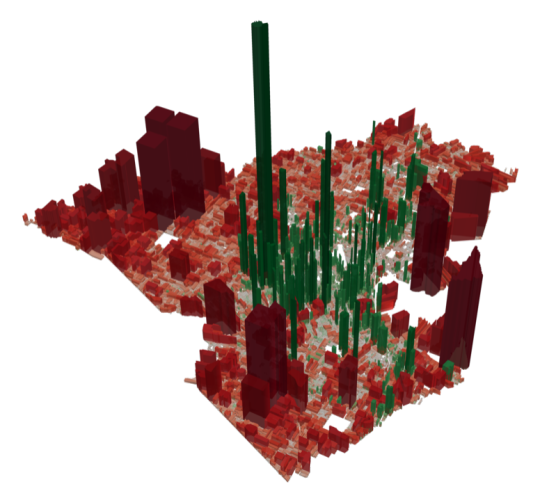
    The following image is a geographic representation of Lafayette, Louisiana’s finances. It is from this excellent article by Charles Marohn.

    What this 3D map shows is the city’s revenues and expenses by land parcel. The green areas are where the city is making a profit (revenues exceed expenses) and the red areas are where the city is operating at a loss (expenses exceed revenues). The height of each extrusion indicates just how much profit is being made and how much loss is being incurred.

    The glaring takeaway from this study is this: not only are post-war land use patterns environmentally unsustainable, but they are also fiscally unsustainable. The tax base is simply not there to pay for the infrastructure that gets built alongside it.

    They – the authors of this study – estimate that the infrastructure revenue gap for the median home in Lafayette is about $8,000 per year (median household income is $41,000). And yet despite this shortfall, it is common to look at infrastructure spending as a desirable economic stimulus.

    The following paragraph really brings this point home:

    “All of the programs and incentives put in place by the federal and state governments to induce higher levels of growth by building more infrastructure has made the city of Lafayette functionally insolvent. Lafayette has collectively made more promises than [it can] keep and it’s not even close. If they operated on accrual accounting – where you account for your long term liabilities – instead of a cash basis – where you don’t – they would have been bankrupt decades ago. This is a pattern we see in every city we’ve examined. It is a byproduct of the American pattern of development we adopted everywhere after World War II.”

    Thank you Daniel for sharing this article with me. 

    If you only read one other thing today (besides my blog), I recommend you read Charles’ article. It’s called: The real reason your city has no money.

  • #BuildHereNow — Crowdsourced city building

    image

    This week Strong Towns has been running a great social media campaign called #BuildHereNow

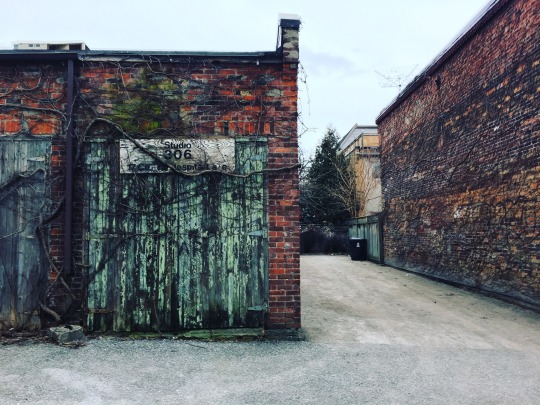
    The way it works is very simple. They asked people to get outside and take photos of vacant and/or underutilized properties in their town or city and post them to Twitter or Instagram using the hashtag #BuildHereNow. The goal was to start to identify properties that could “use a little love" and to encourage city builders who might need a little push to develop a particular property.

    I’m a big fan of crowdsourcing information and I love the idea of digitally annotating buildings and spaces. In this case, it’s about pulling together the desires of the community,

    Hashtags are a great way to quickly make something like this happen, but I would love to see a purpose-built tech platform do this in a more permanent way. Of course, it doesn’t just have to be about developing. Buildings are rich in information; hopefully so rich that a platform like this could survive.

    If you think about it, property titles are already a form of annotating real property. So this isn’t really a new idea. 

    But now technology allows us to harvest all kinds of other information – such as what people would like to see built. Imagine the possibilities if we became more effective at collecting, organizing, and leveraging this data at scale.