Daily insights for city builders, delivered every morning at 6 AM ET. I’m Brandon Donnelly — a Toronto-based real estate developer and founder of Globizen. I’ve been writing here since 2013.

Tag: streetcars

  • Bordeaux’s tramway network

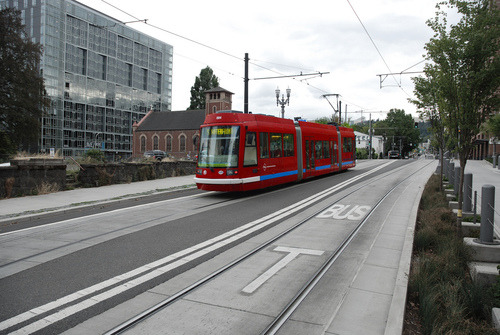
    I was very impressed by Bordeaux’s tramway network. It felt like no matter where you were in the city, there was a tram gracefully passing you by. Here’s a high-level summary of the system:

    • The network has 4 lines and a total route length of 77.5 km.
    • The first line opened in 2003.
    • The network has 130 stops, which crudely results in an average stop spacing of around 600 m.
    • The system pioneered ground-level power supply for the trains, which means no overhead wires. Supposedly this caused some issues upfront, but now it seems to be working just fine.
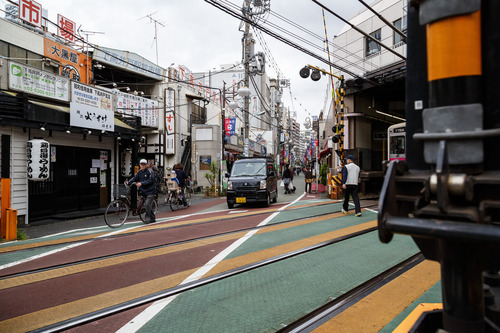
    • Most of the network runs on a dedicated right-of-way (en site propre). Meaning, the trains don’t compete with car traffic. Many of the lines are quite beautiful too – see above video.
    • In 2018, the network carried close to 100 million people. This is in a city of ~260k people and a metro area of ~1.4 million people (2020).

    The key differentiators for me are (1) the stop spacing and (2) the fact that most of the system runs on its own dedicated right-of-way. These are two reasons why Toronto’s streetcars perform so poorly. They stop too frequently. And most of the lines have to compete with traffic.

    So why bother? Walking can be faster.

    Bordeaux shows that — if you implement light rail correctly — you can actually move a ton people efficiently. With surface rail, you can also build out a robust network in a relatively short period of time.

    Twenty years isn’t that long in city-building years. It has already been 10 years since Toronto was first promised SmartTrack.

  • Fundamental and enduring

    I admire Warren Buffet’s humility:

    In the physical world, great buildings are linked to their architect while those who had poured the concrete or installed the windows are soon forgotten. Berkshire has become a great company. Though I have long been in charge of the construction crew; Charlie [Munger] should forever be credited with being the architect.

    This is an excerpt from his recent letter to Berkshire Hathaway shareholders, which, this year, he opens up with an obituary to his late partner, Charlie Munger.

    I don’t agree with everything Warren says and writes. He, for instance, doesn’t seem to like crypto and streetcars. Though, surely, he’d really dig my CryptoParisian.

    That said, I never miss his letters and his thinking has been broadly instrumental in how I tend to think about real estate.

    If you take his description (same letter) of what Berkshire does, and replace businesses with properties, this is what you get:

    Our goal at Berkshire is simple: We want to own either all or a portion of [properties] that enjoy good economics that are fundamental and enduring. Within capitalism, some [properties] will flourish for a very long time while others will prove to be sinkholes. It’s harder than you would think to predict which will be the winners and losers.

    This is a good way to think about real estate.

  • Warren Buffet doesn’t like crypto and streetcars

    I have a great deal of respect for Warren Buffet. Much of what I know (or think I know) about investing has come from listening to and watching him and his partner Charlie Munger. Surely they have got to be the most successful investors living today.

    But there are some things that I don’t always agree with them on. The first and most obvious one is crypto. Warren thinks it is speculative rat poison and I think it is the future of the internet. I understand where he is coming from in that it does not produce cash in the same way as say a farm or an apartment building. But that doesn’t mean it won’t have value.

    The second one, as I have learned today, is maybe streetcars. As a rule, Warren doesn’t typically engage in local politics. But he recently decided to break that rule through a letter he wrote to the editor of the Omaha World-Herald, lobbying against a new $306 million project that I believe is going ahead regardless.

    Here’s an excerpt from the letter:

    “Residents can be far better served by extended or more intensive service by the bus system,” Buffett wrote. “As population, commerce and desired destinations shift, a bus system can be re-engineered. Streetcars keep mindlessly rolling on, fuelled by large public subsidies. Mistakes are literally cast in cement.”

    I should, however, be clear that (1) I know nothing about Omaha and this streetcar project, and (2) “streetcars” can be nuanced. There are streetcars that compete with car traffic and have short station spacing, and there is light rail transit on its own dedicated tracks and with farther station spacing. One size does not fit all.

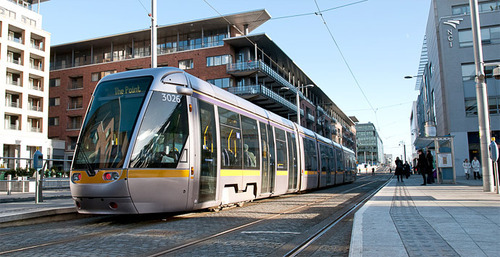
    Here in Toronto, we have lots of the former and they generally move you around at the slowest possible speeds. Sometimes it is faster to just walk. But we are also getting a new light rail line next year and that should move much faster. I can also tell you that when I worked in Dublin many years ago, I took their Luas to the office every day and loved it.

    Again, I don’t know the specifics of Omaha’s streetcar project. Maybe Warren is right or maybe he is wrong. And that’s why I was careful to say “maybe” above. But I do know that in the right urban contexts and when done well, I am a fan of light rail transit.

  • My life as a tram

    Love them or hate them (I happen to love them), Toronto’s streetcars are part of this city’s identity. Most North American cities got rid of their streetcars around the middle of the 20th century. But Toronto didn’t. And that has left us with the largest first generation streetcar network in the Americas in terms of total track length, number of cars, and ridership. That’s something. If you’re also a fan of streetcars (or just like geeking out about cities), you may enjoy this little ode to Zürich’s tram network by Monocle. It’s called, “My life as a tram.”

  • We are all selfish bastards

    cyclist on bike lane by Axel Bueckert on 500px.com

    https://500px.com/embed.js

    We are all selfish bastards when it comes to sharing road space and public space.

    When we drive, we complain about pedestrians jumping out in front of us, crazy cyclists who get in our way, and under-utilized bike lanes that are taking away valuable driving space and creating traffic jams.

    When we take surface transit (such as buses and streetcars), we want all the cars out of the way so that we can move more efficiently. And we complain about drivers who don’t stop to let us off and on when the streetcar doors open. (Toronto specific reference.)

    When we cycle, we complain about cars parked in the bike lanes, people who don’t look before changing lanes or opening their car doors, and drivers who honk at you because they just want you off the road and onto the sidewalk.

    And when we walk, we complain about cyclists who ride on the sidewalk (they should be on the road!), cars that don’t stop to let us go, and slow walking groups who linearly block the entire sidewalk so you can’t pass.

    We are never happy. And we automatically assume that we could do it better. (I know I’m guilty of this.)

    But here are a few things to consider the next time you’re flipping the bird to someone on the streets. Here are a few things that we do know about urban mobility.

    There is an unprecedented number of condominiums in the development pipeline right now in Toronto. For argument’s sake, let’s assume 75,000 condominium suites – many of which will be built in central areas of the city.

    At a parking ratio of 0.6 stalls per unit, which isn’t an unreasonable assumption today, that’s 45,000 new parking spots and potentially 45,000 new cars in the city. 

    If you think that 45,000 new cars will be able to get fully absorbed into the core and somehow move around in an unfettered way, then I believe you are mistaken. 

    If you think that there’s something that can be done to magically expand road capacity to handle all of these additional cars in the city, then I believe you are mistaken.

    And if you think that adding a bike lane is the only reason you are currently stuck in traffic, then I believe you are missing the bigger picture.

    Over a decade ago, we made a decision in this region to encourage building up, instead of building out. And along with that decision came a necessary rethink of how we get around. That transition is what we are living through right now.

    The other thing we know is that the 4 modes of mobility that I started this post with are ordered from least sustainable to most sustainable. 

    Electric self-driving vehicles will reduce the impacts of driving, but it will also transform it into something that feels more like transit and less like the driving we know today. That will be a very good thing.

    But I’m not yet convinced that it will solve all of our problems. To do that I think we will need to adopt a much more balanced and unselfish view of what it takes to move around a city. That, of course, isn’t always easy.

  • Multi-modal cities are the new reality

    CityLab published an article last week on multi-modal cities that caught my attention (because it used a picture of Toronto with about 3 or 4 streetcars stacked up along Queen Street). The premise of the article is that all of this car vs. transit debate is actually missing the bigger picture: our cities are multi-modal and we need to be planning for that.

    That’s not to say that the shift away from cars isn’t a good thing. It is. But it’s not as simple as saying that, instead of driving, people should now only take transit. In today’s cities people walk, bike, take streetcars, take buses, take subways, take taxis, take private shuttles, use Uber, and, yes, they still drive.

    From my own experience, this is absolutely how I get around Toronto today. I walk to the gym. I ride my bike whenever I’m going somewhere downtown. I take the subway to my office in midtown because it’s far and I would be too sweaty if I biked there. I use Uber and Hailo when I’m going out at night. And I drive when I need to go to the suburbs or leave the city.

    But the key takeaway here is that we now have a much tougher challenge on our hands. When we were only optimizing for cars – however detrimental to our cities that was – we only had one mode to plan for. Now we have several. Some of which are public and some of which are private.

    However we also have access to technologies that we didn’t have before. We are networked in ways that weren’t possible before and we’re at the dawn of many profound mobility changes, such as driverless cars. (Have you read about Tesla’s new Autopilot feature yet?)

    So as I’ve said before, I really believe that we need to look at this, not as a war on the car, but as a war on inefficiency. The problem we are trying to solve relates to mobility: What’s the best way to move lots of people around dense urban regions? Stop focusing so much on the technologies and focus more on the people.

    Image: Flickr

  • Dimensioning pedestrian happiness

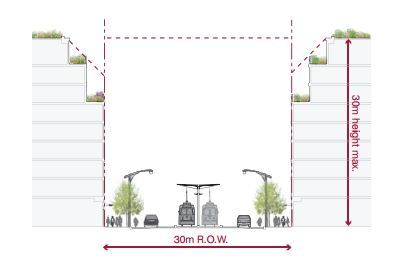
    The area that stretches between the property line on one side of a street and the property line on the other side of a street is called a public right-of-way here in Toronto. It may be called something different in other cities and countries.

    In the example below (taken from Toronto’s Avenues & Mid-Rise Buildings Study), it includes the sidewalks, the car lanes, and the streetcar lanes. But it could also include other public elements. In this instance, the buildings on either side of the street are assumed to be built right up against their property lines.

    ROWs obviously serve an important public function. But their size also has important urban design implications. As a pedestrian, it feels different to walk on a narrow street than it does on a broad street.

    The width of a ROW can also be used to inform what the preferred height of the buildings along it should be. In the example above, they’re talking about a 1:1 relationship between the width of the ROW and the preferred height of the buildings.

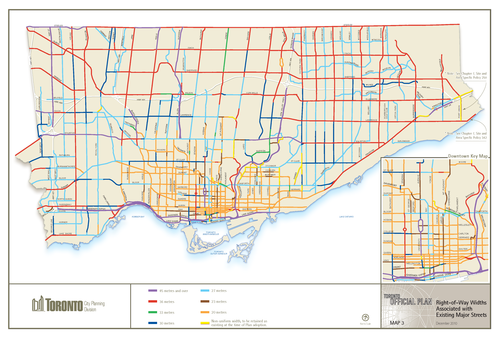
    Given their importance, I thought it would be interesting to share this map of Toronto (dated 2010) showing ROW sizing throughout the city. The mustard colored lines in the core of the city represent 20 metres, the red lines 36 metres, and the purple lines 45 metres or more. The rest of the colors fall somewhere in-between. For the most part, the purple lines represent highways, although there are a few other instances of purple.

    What’s interesting – but not surprising – to see is how we basically kept expanding the size of our ROWs as Toronto grew outwards. This was obviously to make more room for cars on the road.

    But the other, perhaps more interesting thing about this map, is that it could also serve as a guide to pedestrian happiness. The mustard/yellow lines are where it’s most enjoyable to walk. And the red and purple lines are where it’s least enjoyable to walk.

    If you’re from Toronto, give this framework a try and see if it holds true.

  • The Globe and Mail: Why Toronto is still a streetcar city

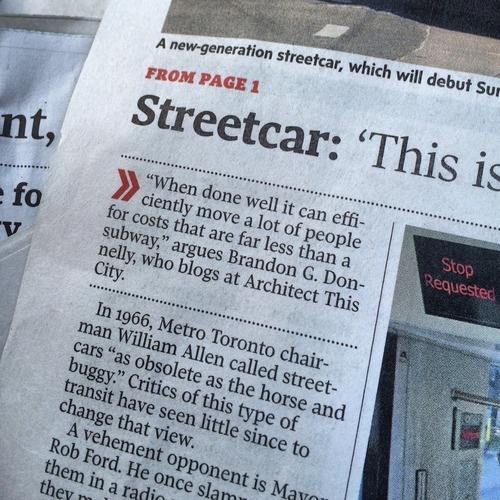
    In anticipation of our new streetcars beginning service this Sunday, the Globe and Mail published an article on Friday called: Why Toronto is still a streetcar city. And I was quoted as saying the following:

    I had no idea that I was going to be cited, but I like the quote that was chosen. The key words are: “when done well.” There are a myriad of different ways in which a city can implement streetcars, and each will have varying degrees of performance.

    So if you’re one of those people who are critical of streetcars, I would encourage you to think about streetcars not just in terms of how they’re implemented today in Toronto, but also in terms of how they could be implemented going forward.

    All streetcars lines are not created equal.

  • Streetcars are just a tool

    Earlier this month the Toronto Star published an article talking about the resurgence of streetcars in American cities. According to the Star, 89 cities in the US are currently implementing or at least considering building some form of surface-rail system.

    But the article also goes on to argue that it could be a snobbish fad. Streetcars are new. They’re shiny. And they make yuppies –  who don’t like taking buses – feel better about themselves. But is the ROI really there? Is the economic impact of streetcars as big as people are making it out to be?

    To support this argument, the Star quoted transportation planner Jarrett Walker, who I’ve mentioned here before on Architect This City. But according to a follow-up post that Walker did on his blog, it would appear that he was misrepresented in the article. Here’s a snippet of his response:

    Here’s the bottom line. Streetcars are just a tool. They can be used in smart ways and in stupid ways. Asking a transit planner for an opinion about a transit technology is like asking a carpenter what his favorite tool is. A good carpenter sees his tools as tools and choses the right one for the task at hand. He doesn’t use his screwdriver to pound nails just because he is a “screwdriver advocate” or “hammer opponent”. Yet the Toronto Star assumes that nobody involved in transit debates is as smart as your average competent carpenter.

    I wanted to share this because I think it’s a great way to approach transportation planning and because I think it gets at a larger issue that we continue to face here in Toronto: We keep politicizing mobility tools. Cyclists have become pinkos. Streetcars are a war on the car. And the list goes on. How about we just look at the problem, and figure out what solution would work best?

    Image: Flickr

  • Why light rail isn’t a waste of money

    Last weekend a friend of mine sent me an article from The Economist talking about why trams, streetcars, and light rail are a waste of money. The argument is basically that steetcars are expensive, less efficient, and that – despite North America’s renewed interest in them – we should instead be spending our scarce public dollars on more buses.

    Here’s a snippet from the article:

    …but cash spent on streetcars displaces spending on other, more cost-effective forms of public transport like buses, which offer cheaper and more-efficient service but are considerably less sexy. The capital cost per mile of a streetcar is between $30m and $75m, while a rapid bus service costs anywhere between $3m and $30m, according to the American Public Transportation Association.

    Now, there’s no question that buse routes are initially cheaper to implement. You don’t have track to build. But I don’t agree that the cost structure is quite that simple if you consider the number of people you need to move in your city. I struggle to see buses as a more efficient service.

    The big difference between modern light rail and buses is capacity. Toronto’s new streetcars will move about 3 times as many people as your typical bus. So you’d need to triple the number of buses and triple the number of drivers – adding to your labor costs – if you want to have a chance at moving the same number of people. 

    Streetcars are also electric, which means they run on a renewable energy source. We’re in the process of making this switch with private transport, so why go backwards when it comes to public transport? You can certainly run electric buses as well, but then you’re building overhead power lines and bringing up your initial costs.

    I think the challenge is that when people think of light rail, they think of slow lumbering streetcars. I agree that many of these lines are inefficient and I’ve written about it. But there are a number of ways to implement light rail. And when done well it can efficiently move a lot of people for costs that are far less than a subway.

    Image: Aecom