Daily insights for city builders, delivered every morning at 6 AM ET. I’m Brandon Donnelly — a Toronto-based real estate developer and founder of Globizen. I’ve been writing here since 2013.

Tag: street life

  • Does above-grade parking kill street life?

    Here’s an unproven hypothesis that you can all challenge me on: many or most people only care about the environment while it is convenient to do so. Said oppositely, once it becomes inconvenient to care about the environment, we tend to start prioritizing other objectives.

    The example I have in my mind right now is parking. Now, to be clear, cars are not the best mobility solution for the environment. But let’s assume for a minute that you need parking and you have only two available options: below-grade parking or above-grade parking.

    The former is worse for the environment. If you were to look at the embodied carbon in below-grade parking versus above-grade parking, it would be higher. So from an environmental perspective, you want above-grade parking.

    It also makes for more flexible spaces. It’s hard to convert below-grade parking to much else. Again, this strengthens the environmental case, because now you’re building something that can be repurposed in the future.

    However, unless you’re forced to only build above-grade parking (as is the case in Miami), many/most cities tend to shun it. The most common objectives are (1) that it’s unsightly, and therefore needs to be wrapped with occupiable spaces, and (2) that it kills street life.

    What this suggests is that (1) and (2) are seen as being more important than the environment. And I think this is noteworthy in its own right. But here’s the other thing: this is arguably a false dichotomy. I mean, does above-grade parking necessarily kill street life?

    The above two street view images are from 1111 Lincoln Road in Miami Beach. It’s a parking structure and area of the city that I have visited many times. And I have to say, the street life seems fine to me. What do you think?

  • Street-level offices

    One of the things that I have noticed while walking around Lyon is that there seems to be a lot of office space right at street level.

    And most of it does not seem to have a consumer-facing element where people just walk in off the street.

    There’s something nice about seeing beautiful spaces and people sitting at their desks (I walked past people sitting on exercise balls). It’s another way of animating the street.

    Personally, I’d love to have an office right at ground level, similar to the above. But it’s not usually where our minds immediately go. We usually default to retail. Or at least I do.

    So I’m going to work to remove this blind spot from my mental models. Office right on the street can clearly work really work.

  • Shutdown and restart

    Very few of us have a mental model for the macro conditions that we are living through right now. We have been through economic downturns, but most of us haven’t lived through a pandemic. I am an optimist and I know that we will get through this and normalcy will return. But one of the questions that we’re all asking ourselves right now is: What will “normalcy” look like on the backend?

    Here is an interesting piece of evidence for the current shutdown:

    When I see pictures of our cities, like these from Italy, I can’t help but think of the life that normally plays out in the streets. The conversations. The chance encounters. And even the smells. Some of that activity has moved to every single balcony in Italy and that is a beautiful thing. But it’s no substitute for true street life. Thankfully, we know that public life will both return and prevail.

    Along the way there will be changes. There are going to be winners and losers. Some companies are going to go bankrupt. And there will be adjustments that we have made that will invariably stick. Are we all going to video conference more? (The obvious one.) Will we all travel less? Will this macro event accelerate our transition to a knowledge-based digital economy? I’m sure it will. Also consider all of the new companies that are being started right at this very moment.

    But as I said on Twitter today, we are social beings. That is one of the reasons why we choose to live in cities. And I am certain that isn’t going away.

    Photo by Kristijan Arsov on Unsplash

  • Video: New York 1911

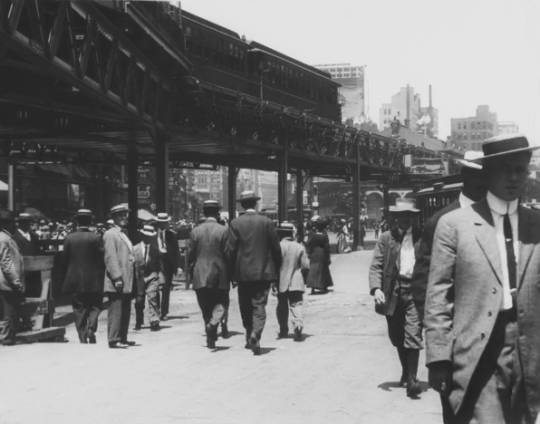
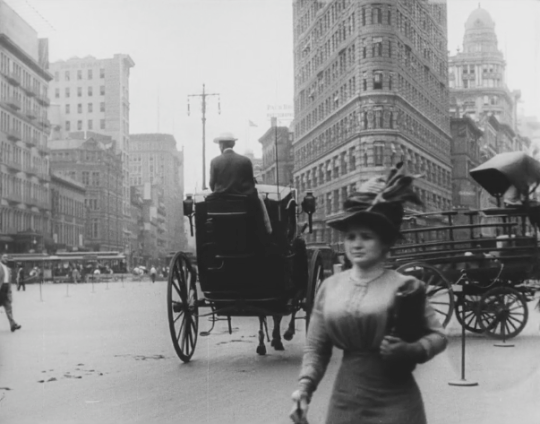
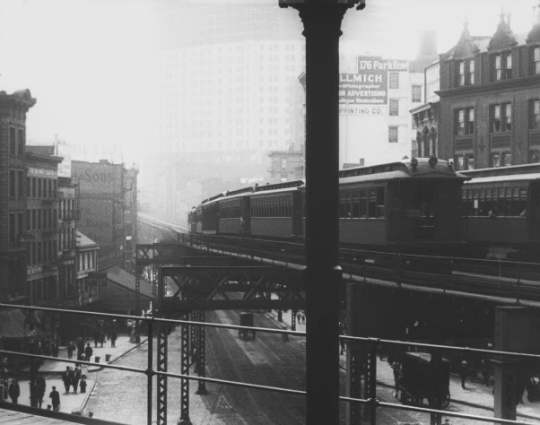
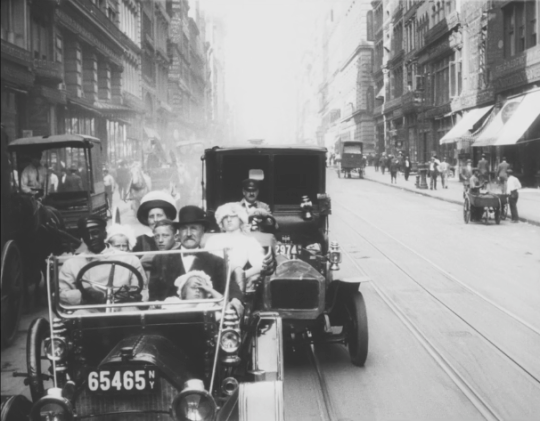
    The Museum of Modern Art (MoMA) recently restored and published a “documentary travelogue” of New York City from 1911. 

    It was originally filmed by a Swedish company, called Svenska Biografteatern, that went around the world filming noteworthy places such as Niagara Falls, Paris, Monte Carlo, and Venice.

    Not surprisingly, New York City is a vibrant and bustling place at the beginning of the 20th century. But it somehow feels serene. Maybe it’s the soundtrack. It’s also interesting to think that this was filmed only 3 years before World War I broke out.

    I particularly enjoyed seeing all of the streetcars (trams) and elevated rail running through the streets.

    Below is a screenshot of a young girl – clearly bored and/or disinterested – being chauffeured down Fifth Avenue in what was almost certainly a fancy convertible at the time.

    MoMA doesn’t allow you to embed the video, but you can watch it here through July 14. It’s 9 minutes and, if you’re a city nerd like me, I think you’ll really enjoy it. The street life footage kicks in around the 3 minute mark.

    Screenshot Images: MoMA

  • Place is dead anyway

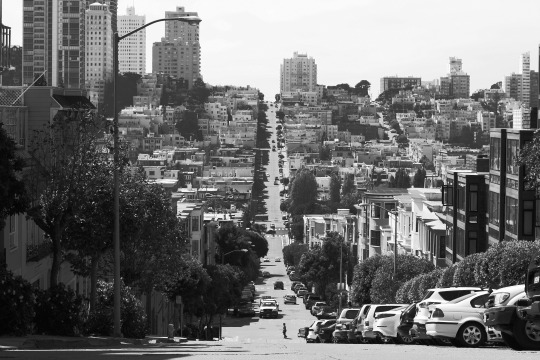
    Aaron Renn has a few observations up on his blog from a recent trip to San Francisco. Number 2 is as follows:

    “A curiously low energy city.  It’s tough to judge any American city’s street energy after living in New York, but San Francisco felt basically dead. Tourist areas around Union Square and the Embarcadero were crowded, and the Mission on a Friday night was hopping, but otherwise the city was very quiet. Haight-Ashbury was nearly deserted and many neighborhoods had the feel of a ghost town. It’s very strange to be walking around a city with such a dense built fabric but so few people.”

    I feel this way every, single, time, I visit San Francisco. I love San Francisco, but outside the main draws, the city feels eerily quiet. I have never understood why that is the case.

    This is something that I am sensitive to because I find it even impacts my own energy levels. For instance, Sundays in Toronto often feel too quiet for me. Fewer pedestrians. Slower drivers. Our collective metabolic rate slows down.

    I love the hustle of a busy city.

  • Life below zero and underground

    image

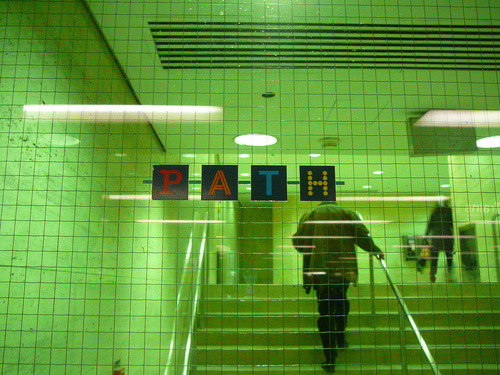
    A few years ago, I was touring a friend from the US around Toronto’s Financial District and the first thing he said to me was: “You have no retail.” And that’s certainly what it might look like at first glance.

    But there’s actually lots of retail. It’s just all underground in an over 30 kilometer long network of walkways called the PATH.

    Initially conceived of as the antidote to Canadian winters, “underground cities” are a kind of uniquely Canadian form of urbanism. Toronto and Montreal have the largest ones in the world and they continue to grow. As new towers are built, new connections are added.

    But the downside to all of this is that it pulls street life down underground. And it can conceal a lot of the urban vibrancy that is actually take place. So maybe we need to come up with design solutions to better connect these subterranean cities back to street level and also not forget about the street.

    I’m thinking about this today because of a CBC documentary I watched this morning called Life Below Zero. It basically argues that – unlike other cold climate cities and countries – the vast majority of Canadians actually hate winter. And underground cities are our way of trying to ignore it.

    Well, I don’t hate winter. In fact, I love it because it signals snowboarding season for me. But I may be in the minority. What’s your position on winter?

    Image: Flickr