Daily insights for city builders, delivered every morning at 6 AM ET. I’m Brandon Donnelly — a Toronto-based real estate developer and founder of Globizen. I’ve been writing here since 2013.

Tag: storefront

  • Glass curtains in Amsterdam

    For the same reasons that I liked the Interlock in London, I am a big fan of this storefront in Amsterdam by UNStudio. It is contextual, but it also something entirely new. To me, it resembles a triptych of curtains being pulled to the side, which is probably a fitting metaphor for a high fashion street. The developer is Warenar and it looks like the space is still available. So if you’re in the market for a retail storefront on Amsterdam’s PC Hooftstraat, here you are.

    Photos by Evabloem

  • What e-commerce may do to our streetscapes

    Sidewalk Labs recently ran a thought experiment where they came up with 5 possible scenarios for the future of retail and, more specifically, what they may mean for our streetscapes. You can read all about them here, but my mind lumps them into 3 broad categories.

    First, there’s the temporary/pop-up/independent scenario. This one is all about flexibility and speed. It’s about web-first retailers who don’t have, need or want permanent stores and about empowering small scale business owners. This makes sense. The internet has decentralizing forces.

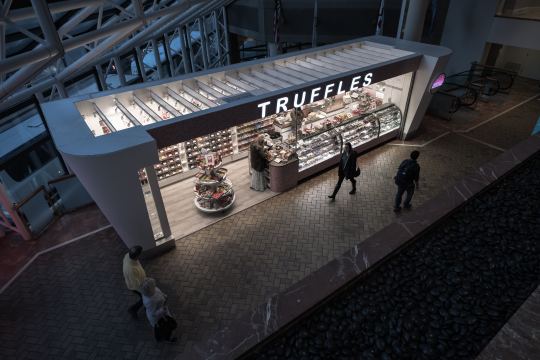
    The second one takes retail in the opposite direction. It’s about going all in on physical stores; upsizing them and making them even more over the top and Instagram-able. This one also seems intuitive given that we’re already seeing this trend with malls. Many/most are dying and the surviving ones are trying to go as high end as possible.

    The last scenario takes vacant and underutilized retail on the fringe and turns them into “digital dispensaries.” This one is entirely utilitarian and void of any streetscape/urban considerations. It’s about autonomous electric vehicles picking up your goods through drive-thrus and on-demand drones dispatching your toilet paper after you hit that Amazon Dash Button.

    This feels like a good list. I think you could argue that the writing is on the wall for all of these scenarios.

    Photo by Lance Anderson on Unsplash

  • The Storefront Index

    The folks over at City Observatory have recently developed something called The Storefront Index

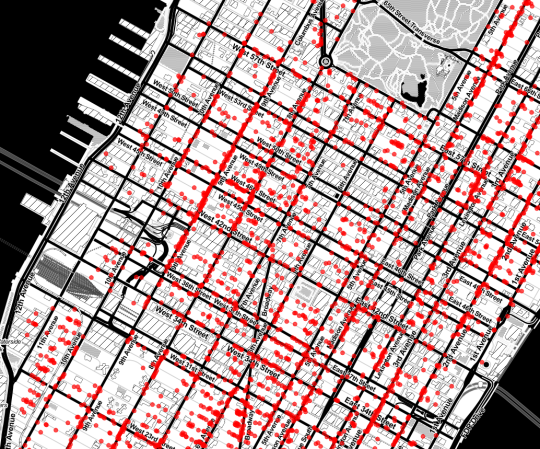
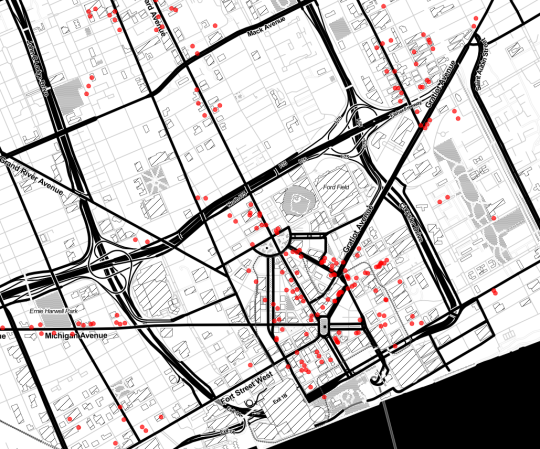
    It is a mapping of “clustered” consumer-facing storefront businesses across the 51 largest cities in the United States and within a 3-mile radius of their CBD. (Their definition of cluster is that the business is located within 100m of another business.)

    At the top of this list is New York (no surprise here) with 9,905 storefronts and at the bottom of this list is Detroit (probably no surprise here either) with 411 storefronts. On average, they found that the “typical” city has about 900 storefronts within this 3-mile radius.

    Here’s a screenshot of New York:

    image

    And here’s a screenshot of Detroit:

    image

    They should be at the same scale.

    If you’d like to read their Storefront Index Report, you can do that here. And if you’d like to explore their interactive maps, you can do that here. City Observatory has made all of this available as a free tool for city builders – which is really great to see. (You can even download their shapefiles if you’re into that sort of thing.)

  • Airbnb for retail spaces raises $7.3 million

    Though it’s sometimes common to downplay “this for that” startups (that is, derivative startups that try and borrow a model and use it in another market), Storefront–which can be described as Airbnb for retail spaces–has just raised a $7.3 million Series A round.

    Storefront is a marketplace for short term retail space (think pop-up shops). People with space simply create a listing and decide how much they would like to charge per day, per week or per month. In doing so, Storefront “helps all sorts of brands, sellers, and merchants to create their first brick and mortar retail experience.”

    What I find interesting about Storefront, and other startups like Airbnb, is that they’re really rewriting the way real estate marketplaces work. Instead of large retail landlords (Storefront) and multinational hotel operators (Airbnb), technology is allowing individuals to now participate in these marketplaces. Supply is being decentralized and anyone with extra space can participate.

    You could argue that these sorts of informal and short term rentals are nothing new, but I don’t think there’s ever been the possibility of scaling up like there is today. I mean, just look at how much attention Airbnb has been getting in New York. These startups are having an impact on the way the larger market functions.

    Change is coming. And I think we’ll see a lot more of it in the real estate space.