Daily insights for city builders, delivered every morning at 6 AM ET. I’m Brandon Donnelly — a Toronto-based real estate developer and founder of Globizen. I’ve been writing here since 2013.

Tag: startup

  • In support of narrative memos

    This is not new. It has been reported on before. But I just finished reading this article about Jeff Bezos’ relentless commitment to “high-quality and high-velocity decision making” at Amazon.

    Here are a couple of high level points:

    – There are decisions that cannot be easily reversed (Type 1) and there are decisions that can be (Type 2). Knowing which is which is important. To help get better at this, they are very diligent about tracking the outcomes of previous decisions.

    – Make decisions without all of the info you wish you had, because if you don’t, you’re probably moving too slow. Speed is paramount. If you’ve categorized your decisions properly (see above), being wrong may not actually be that costly.

    – There’s a company philosophy centered around “disagree and commit.” It is about moving forward – since speed is so important – without full consensus. In other words: We may not all agree, but can we disagree and commit to this?

    Perhaps the most interesting, and seemingly paradoxical, aspect of Amazon’s “high-velocity decision making process” is that it is built upon narrative memos, instead of PowerPoint decks. In fact, decks have been banned at the company since 2004.

    The reason for this is that narrative memos are more difficult to write, which means you really have to understand what you’re talking about. It encourages deeper thought and it allows nuances and interdependencies to come through.

    Apparently important meetings start with everyone just sitting in a room reading the narrative memo, which are often between 4-6 pages. Once everyone has read the memo and is on the same page, the meeting starts.

    As someone who writes a daily narrative, this approach really resonates me. It would be a hell of a lot easier if I could just show up here every day and throw down a few bullet points. But then both of us would get far less out of this practice.

    Writing takes time. Bezos has acknowledged that these memos cannot be written in a day or two. But clearly there’s a belief that more time spent up front translates into greater overall speed. Their market cap suggests that is working.

  • The vertical farmer

    Bloomberg is running a video series right now called Next Jobs. It is a look at the careers of the future. Episode four is about a vertical farmer named Katie Morich and a startup called Bowery Farming, which does this out of a nondescript building in New Jersey. 

    The video focuses more on Katie’s life and less on vertical farming. But it did introduce me to Bowery Farming, which I am intrigued by. So I thought I would share both the video and the company. It is a compelling pitch: local production; ideal conditions; no pesticides; and software that optimizes it all.

    [youtube https://www.youtube.com/watch?v=AGcYApKfHuY&w=560&h=315]

  • Any decision over no decision

    The Hard Thing About Hard Things is a book that I read a number of years ago (Amazon just told me that I purchased it on March 12, 2014), but that I frequently come back to in my mind. 

    One of my favorite themes in the book can be summed up with this quote: “Often any decision, even the wrong decision, is better than no decision.”

    Decisions can be scary. What if I make the wrong decision and things go horribly wrong? Then things are on me.

    In some organizations, indecision may feel like the safest decision. Let’s do one more study just to make sure that we’ve got this right. 

    But in a startup (which is what Ben Horowitz’s book is about) and in organizations that would actually like to grow, innovate, and accomplish things, indecision can mean death. Without decisions, organizations lock up.

    None of this is to say that bad decisions are okay. Executives must make high quality decisions as fast as possible, and as a rule of thumb you probably want to make more good decisions than bad decisions. 

    But speed, momentum, and organizational clarity also matter a great deal. 

    One of the reasons why I mentally come back to this book is because oftentimes I find that things can get hung up on relatively inconsequential decisions. So I like to remind myself that go is better than stop.

    As Ben points out in his book: “The only mistake you cannot make is running out of cash.” And time has a funny way of burning through cash.

  • Learning about O-zones

    I spent this evening reading about Opportunity Zones, or “O-zones”, in the United States. 

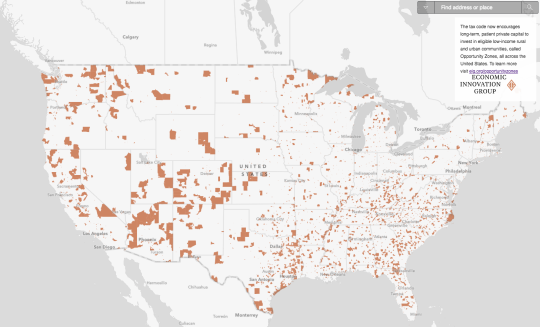
    For a census tract to become an O-zone, it has to have a poverty rate of 20% or higher, or the median household income has to be less than 80% of the surrounding area. Governors are also only able to designate 25% of their eligible census tracts.

    Here is a map of the areas that have been designated as Opportunity Zones.

    image

    Here is how these O-zones work. (All excerpts taken from this Forbes article.)

    The law’s engine is a new breed of financial product, the opportunity fund, that offers investors a trifecta of attractive tax breaks. Here’s how it works. Investors who sell assets have 180 days to plow their taxable capital gains into an approved opportunity fund, which must hold 90% of its assets in Opportunity Zone projects. To put money to work fast, the law requires that the funds invest all of their cash within some specified time frame. (The Treasury Department is still deciding on that and other crucial details.) Tax on the original reinvested gain isn’t due until 2026, and the taxable gain is cut by 15%. Meanwhile the new opportunity investment grows tax-free, like a Roth IRA, provided it’s held for at least ten years. (If it’s sold earlier, it can be rolled into another opportunity fund and remain tax-free.)

    Here is how it could get the real estate industry to take action.

    For real estate developers, O-zones offer cheap real estate and unlimited, untaxed upside if a neighborhood takes off. Developers must do more than stash cash in crumbling property. To qualify for tax perks, they must make swift and significant upgrades (at least equal to the cost of the initial purchase). With real estate projects come new office buildings, industrial districts, restaurants and affordable housing—all of which can lay the groundwork for an economic boom. “The real estate aspect is a great catalyst to attract new businesses,” says AOL founder Steve Case, an early supporter of the O-zone initiative, whose Rise of the Rest Fund invests in backwater areas. “But it’s the startups that will be the real job creators.”

    And here is how it could influence where new businesses decide to locate.

    “If Facebook could have chosen to locate itself in an Opportunity Zone, like the Tenderloin in San Francisco, the investors would’ve paid no capital gains on their equity,” says Parker, who presumably would have been one of the big winners. The promise of mega-returns could send VCs, investment banks and private equity firms scrambling to launch their own opportunity funds to create incubators, scour second cities for overlooked talent or move portfolio companies into O-zones. “It wouldn’t surprise me if a lot of Silicon Valley VCs started to tell founders, ‘We’d like you to go over the bridge to Oakland, or we’d like you to go to Stockton,’” Parker says.

    If you’d like to learn more about Opportunity Zones, check out the Forbes article.

  • Value of distribution and reach for consumer facing products

    image

    Forbes recently pegged social media influencer Kylie Jenner’s net worth at somewhere around $900 million. That makes her the youngest (she’s 20) person on Forbes’ annual ranking of “America’s Richest Self-Made Women.” 

    And if the trend line continues, she’ll be the youngest self-made billionaire, ever. Mark Zuckerberg apparently holds that title right now. But he was a classic underachiever and only became a billionaire at age 23.

    Most of Kylie’s net worth is derived from Kylie Cosmetics, which launched less than 3 years ago, but did an estimated $330 million in revenue last year. Forbes values the company at almost $800 million. And Kylie owns every bit of it. 

    The reason I am mentioning this today is because I was fascinated by the above Forbes article. It’s such a powerful example of social media leverage. Forbes put it differently: “Social media has weaponized fame.” 

    Kylie has 111 million followers on Instagram (plus many more on her other social channels) and that’s really the most important part of this equation. She has the distribution and reach to acquire boat loads of customers. It doesn’t matter what you’re selling if nobody knows you’re selling it.

    The rest of her business is pretty much outsourced. Seed Beauty (out of Oxnard, California and Nanjing, China) handles the manufacturing, packaging, and shipping fulfillment. Shopify (headquartered in Ottawa) is her e-commerce platform.

    We could of course have a debate about whether a celebrity-fueled business is really all that sustainable. And perhaps there’s risk in relying so heavily on social for customer acquisition. But youngest billionaire is youngest billionaire.

    Image: Forbes

  • Going dockless

    A couple of months ago I wrote about Bird, the electric scooter sharing company that is trying to solve the last-mile problem. They are expanding across the US and it is seemingly wildly popular.

    But its popularity is also leading some people to call them a public nuisance. Perhaps the biggest contributor to that is the fact that the system is dockless. That is, when you get to your destination you can park the Bird wherever you want.

    That’s obviously a great feature for users (who wants to look around for a docking station?), but it’s also causing a proliferation of “Bird litter” in the cities and neighborhoods where they are widely used. 

    I am sure this will eventually get resolved.

    The other thing about going dockless is that you now have a charging problem. Where and when do these scooters get charged and by whom? Bird solves this problem through decentralized contract workers called “Bird hunters.”

    You register to be one and then Bird pays you $5 to $20 for every scooter charged, depending on how difficult the Bird is to find. And as you can expect, these scooters are getting left all over the place.

    I thought this was a clever solution. And apparently it is popular with high school students looking to earn extra cash. Some are making several hundred dollars a day by spending their evenings picking up and dropping off Birds.

  • 1 out of 5 commuters in Manila relies on ride-hailing

    Earlier this year Uber sold its Southeast Asia business to Grab. At the time, it was estimated that Grab had 95% of the ride-hailing market in Southeast Asia. That’s why Uber decided to sell. Instead of continuing to bleed, they figured it would be better to instead merge businesses in exchange for a “sizeable stake in Grab.” This is similar to the deal that it struck in China with Didi.

    It’s clear evidence of cultural advantage. Though maybe you could argue it’s first mover advantage. Either way, many, including Wired, have argued that while Uber has dominated in the West, it has often struggled in the developing world. Different markets. When Grab launched you could pay with cash because so many users didn’t have a credit card.

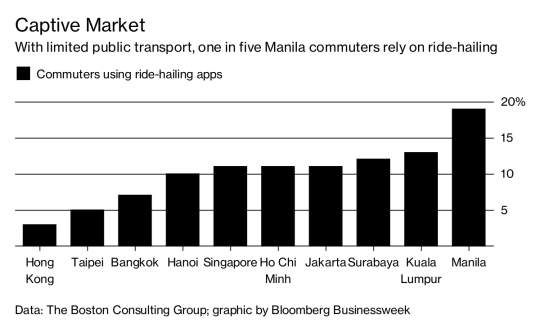
    Here is another interesting insight from Bloomberg (see above): Nearly 1 out of every 5 commuters in Manila relies on a ride-hailing service because the public transit situation is allegedly so dire. Grab controls 90% of the market with 35,000 vehicles receiving somewhere around 600,000 requests a day.

    When Uber launched it was positioned as “Everyone’s private driver.” It was expensive. It was luxurious. And it was done because they knew they weren’t going to be able to compete on speed and/or price in the early days. But now ride-hailing services are tackling the very opposite end of the spectrum.

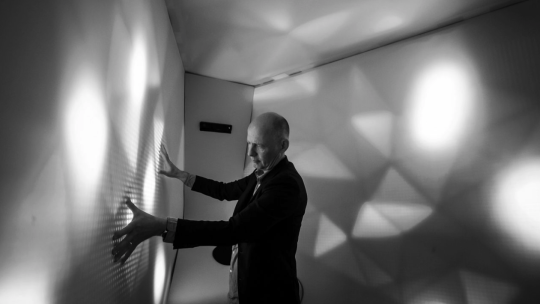
  • UNStudio announces new tech architecture company (and thoughts on the smart home)

    Dutch architecture firm UNStudio has just launched a new company called UNSense, whose purpose is to explore and develop “new sensor-based technologies that are specifically designed to positively impact people’s physical, mental and social health.” They are calling the new business an “arch tech company” and it is their belief that, at some point, all architecture firms will become arch tech companies. You can learn more about UNSense, here.

    This announcement got me thinking about the state of smart home technologies, which, of course, is this massive buzzword that everyone is throwing around these days. Many of us have smart thermostats, voice assistants (that may be listening to our every word), wifi lights, and so on. And you can do some pretty neat things with software like IFTT, such as program your lights to come on at sunset or when you walk in the door.

    But as cool as they may be, these smart home devices have always felt like patchwork add-ons to me. I understand that this is partially driven by what customers can easily adopt and I don’t mean to discredit the value that they bring, but today’s post is about reminding us to also think more fundamentally, as opposed to just incrementally.

    Smart thermostats, for instance, give us the functionality to adjust our heating/cooling from our phone. But at the end of the day, they still control the same underlying system, which, by the way, is a fairly simple one. When it gets cold (because of our R-3 windows), the heat turns on. When it gets warm enough, the heat turns off. Zoned systems certainly add another layer of sophistication, but are we optimizing for the right variables?

    UNSense works at three scales: Cities, Buildings, and Interiors. And if you look at what they are trying to do at the building scale, it is around the interface between inside and out. Designing transformable facade systems and buildings that can respond to their environment and our changing needs. These are not new ideas, but in today’s tech-driven world, the timing may just be right.

    If you think about the climate we have here in Toronto, it is actually an incredibly difficult design problem. We have cold winters and hot humid summers, which means we have to solve for two different extremes. Mechanical systems have made that a lot easier to do, but if we’re going to meet the energy and greenhouse gas emission targets that we’re all talking about, we’re going to need a hell of a lot more than just smart thermostats.

    Image: UNSense

  • Last-mile electric scooters — will they work?

    I’ve been hearing a lot about Bird recently. Perhaps it has something to do with the $15 million Series A round they raised last month (February 2018) and the $100 million Series B round they announced earlier today.

    A “Bird” is small electric scooters that look like this and can be rented from your phone for short haul trips. They are currently available in Santa Monica, Venice, UCLA, Westwood, and San Diego, and they are intended to be ridden in existing bike lanes.

    What may be particularly interesting to this blog audience is the fact that Bird is calling itself a “last-mile electric vehicle sharing company.” The pitch: 40% of car trips (in the US?) are less than 2 miles long. Let’s replace those using electric scooters.

    One of the first things that came to my mind is that this feels more accessible than cycling. Cycling to work can be a commitment. You have to think about your attire and the sweat factor, among other things.

    Would you agree?

  • InsurEye acquires the Dirt

    Back in 2013, my friend Mike Lerner and I designed, developed, and launched a condo review platform called the Dirt (thedirt.co). It’s hard to believe that it’s already been five years.

    Our mission was to empower real estate consumers through greater transparency in the marketplace. And we did this by crowdsourcing condo building reviews, as well as pricing comps.

    Today we are excited to announce that InsurEye Inc. has acquired the Dirt. InsurEye began as a moderated insurance review platform for home, auto, and life insurance, but it has since grown to include condo reviews.

    The team at InsurEye shares a very similar goal of creating greater transparency in the marketplace, and so we are thrilled that they will be picking up where we left off.

    Press release, here.

    P.S. The Dirt is the reason why I started the daily blog that you are reading right now. I started writing for the company and fell in love with it as a discipline and practice. Life is lived forwards, but understood backwards.