Daily insights for city builders, delivered every morning at 6 AM ET. I’m Brandon Donnelly — a Toronto-based real estate developer and founder of Globizen. I’ve been writing here since 2013.

Tag: starchitect

  • Starchitecture is dead — how OMA thinks about preservation

    I somehow stumbled upon this transcript from Columbia University’s Graduate School of Architecture, Planning and Preservation (GSAPP), covering a talk that architect Rem Koolhaas did at the school back in, I think, 2014. 

    The title: “Preservation is overtaking us.” It’s all about how his firm OMA thinks about and approaches preservation. 

    The overarching theme is that preservation, for them, has become a kind of refuge from the market forces – which they call the “The ¥€$ Regime” – that currently drive architecture and demand constant novelty. It is refuge from “starchitecture.”

    Here is an excerpt:

    At some point, I don’t know who was responsible, the word, “starchitect” was invented. And we all know what it is: a term of derision. And at some point, it becomes very hard to avoid. I would say that preservation is, for us, a type of refuge from this term. What we are hoping to do is propose a number of strategies in which we are working to undo, or escape, from this label.

    And here is a summary of “OMA’s Preservation Manifesto” taken from the GSAPP transcript:

    1. Starchitecture is dead
    2. New forms are no longer relevant
    3. Preservation is architecture’s saving retreat
    4. Preservation creates relevance without new forms
    5. Preservation is architecture’s formless substitution

    It’s a substantial read, but a fascinating one. In case you don’t get to it (understandable), I would like to leave you with this final excerpt:

    What we started to do was look at preservation in general and look a little bit at the history of preservation. Now, the first law of preservation ever defined was in 1790, just a few years after the French Revolution. That is already an interesting idea, that at the moment in France when the past was basically being prepared for the rubbish dump, the issue of preserving monuments was raised for the first time. Another equally important moment was in 1877, when, in Victorian England, in the most intense moment of civilization, there was the second preservation proposition. If you look at inventions that were taking place between these two moments—cement, the spinning frame, the stethoscope, anesthesia, photography, blueprints, etc.—you suddenly realize that preservation is not the enemy of modernity but actually one of its inventions. That makes perfect sense because clearly the whole idea of modernization raises, whether latently or overtly, the issue of what to keep.

    I like the notion that preservation is one of the inventions of modernity, rather than an enemy of it.
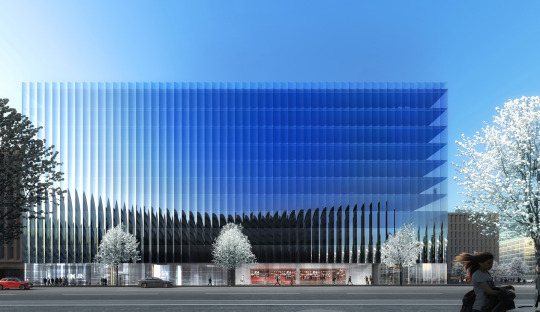
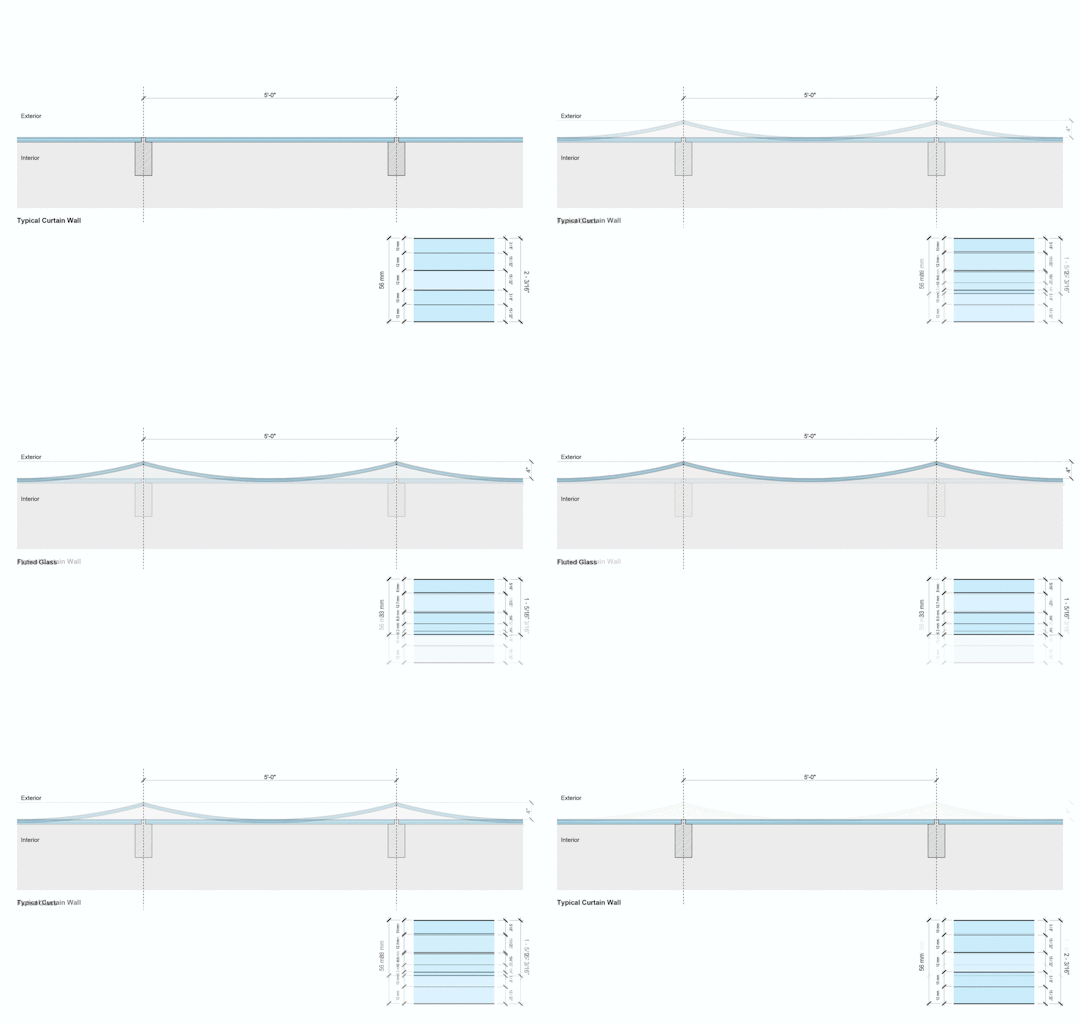
    Photo by Reginar on Unsplash

  • 121 E 22nd

    My friends in New York tell me that if you want to sell a luxury residential building, you need a name brand architect. People care about architecture and it’s part of the buying process: “Oh, it’s a Herzog building.”

    To that end, Toll Brothers City Living just released the following video for their 121 E 22nd project in New York. If you can’t see it below, click here. What’s notable, is that it is OMA’s first full building in New York. So the story is: star architect + first building in the city.

    [youtube https://www.youtube.com/watch?v=dSQq8W8od9g?rel=0&w=560&h=315]

    But there’s more. It’s almost unbelievable that, until now, OMA hadn’t designed and constructed a full building in New York. I reread this Dezeen article 5 times just to make sure I wasn’t missing something.

    So much of Rem Koolhaas’ career (founding partner of OMA) is centered around New York City. In 1978, he published Delirious New York, where he both dissected and celebrated the city’s “culture of congestion.” Oysters at the downtown athletic club, anyone?

    This book was so influential that I bet you’d be hard pressed to find an architect that doesn’t have it in their collection. I have his approximation of New York hanging on my wall. So this was clearly overdue. Kudos Toll Brothers City Living.

    Note: OMA’s New York office is led by Shohei Shigematsu.

  • Franchise starchitecture

    Back in 2014, Witold Rybczynski (who taught at Penn while I was there) wrote an article in The New York Times Style Magazine called The Franchising of Architecture. In it, he argued against the trend of “starchitecture.” 

    Here’s an excerpt:

    “Architecture, however, is a social art, rather than a personal one, a reflection of a society and its values rather than a medium of individual expression. So it’s a problem when the prevailing trend is one of franchises, particularly those of the globe-trotters: Renzo, Rem, Zaha and Frank. It’s exciting to bring high-powered architects in from outside. It flatters a city’s sense of self-importance, and fosters the perception of a place as a creative hotbed. But in the long run it’s wiser to nurture local talent; instead of starchitects, locatects.”

    Following this, James Russell (a longtime architecture critic) wrote a searing rebuttal called The Stupid Starchitect Debate. He called Witold’s story a piece of utter laziness and urged us to stop whining about celebrity architecture.

    Here’s an excerpt:

    “Celebrity architecture is not a franchise (McDonalds is a franchise), but branding. Branding is repellently ubiquitous, and it is pure romanticism to think architecture can escape a trend that so powerfully guides spending. A friend became a museum director in part because building a new building was part of the job. I thought he would bring up an energetic young local talent, but he ended up with an international big name because, he said, only the stars would bring in the donors. That’s sad, but emblematic of an era when private wealth builds the cultural facilities the public won’t pay for. That’s why celebrity architects are brands—a title none of them sought, though all are adept at exploiting. Even wealthy, sophisticated trustees like to bask in the glow of a name that’s got cachet, rather than look hard for someone with obvious talent but who is not well known.”

    This is a fascinating debate. And I would be curious to hear your thoughts in the comment section below.

    My own view is that, yes, it is wonderfully romantic to think that we can go back to a period of time when London architecture was designed only by English architects, Paris architecture designed only by French architects, and so on. But the world has changed. The genie is out of the bottle on that one.

    I also don’t think that brand needs to be a dirty word in the context of architecture. There’s value in brand equity. And everything can be construed as a brand. This blog is part of my personal brand. That’s our world.

    The problem I have with this line of thinking is when architecture gets reduced to style, to form, to a veneer. Architecture is an opportunity to solve problems and respond to real (including local) constraints. That also creates value – arguably much more value. And I don’t believe that only “locatects” have the ability to respond to that challenge.

    There’s so much more that can be said about this topic.

  • 3 thoughts from Rem Koolhaas

    Earlier this year, architect Rem Koolhaas of OMA spoke with Mohsen Mostafavi (dean of the Harvard Graduate School of Design) to close out the 2016 AIA convention

    I still remember my first architectural theory class where the professor told us all that Koolhaas was the most important living architect of our time. And today, if you think about all of the stars that have grown out from his firm – such as Bjarke Ingels and Joshua Prince-Ramus – it is certainly a defensible argument.

    Koolhaas is generally very critical of globalization and the market economy when it comes to creating good architecture. His view is that “pure profit motives” are leading to cities that are basically not designed.

    This is a fairly common belief within architectural circles, which is why many celebrated names would rather work on a museum over a residential condo project. The latter is too motivated by profit. It’s not architecturally interesting.

    I, on the other hand, have always believed in working within the confines of the market to try and promote great architecture and city building. I’m not saying that the market is perfect, but profitability is a constraint that every industry deals with. Architecture is no exception.

    That said, there are other things that I agree with Koolhaas on. Below are 3 verbatim highlights taken from a Fast Company article summarizing his talk with Mostafavi: 

    Communication needs an overhaul.

    “Architecture has a serious problem today in that people who are not alike don’t communicate. I’m actually more interested in communicating with people I disagree with than people I agree with.”

    "To have a certain virtuosity of interpretation of every phenomenon is crucial. We’re working in a world where so many different cultures are operating at the same time, each with their own value system. If you want to be relevant, you need to be open to an enormous multiplicity of values, interpretations, and readings. The old-fashioned Western ‘this is’ ‘that is’ is no longer tenable. We need to be intellectual and rigorous, but at the same time relativist.”

    Architecture’s greatest value in the future might not even be architecture.

    “Architecture and the language of architecture—platform, blueprint, structure—became almost the preferred language for indicating a lot of phenomenon that we’re facing from Silicon Valley. They took over our metaphors, and it made me think that regardless of our speed, which is too slow for Silicon Valley, we can perhaps think of the modern world maybe not always in the form of buildings but in the form of knowledge or organization and structure and society that we can offer and provide.”

    Preservation is a path forward.

    "We’ve tried to discover domains and areas in architecture which are not a simple vulgar multiplication of uninspired global projects. Recently, we have looked at preservation. The beautiful thing about preservation is you begin with something that already exists and therefore is already local. By definition, a preservation project is an homage to earlier cultures and mentalities to which you can add a new dimension, a new function, a new beauty or appeal. Almost every impulse signals that globalization needs rethinking or adjustment.”

  • Fluted glass curtain wall

    New York architecture firm REX is working on a new office building in Washington DC that will incorporate a beautiful fluted glass facade. Here’s a rendering of what it is intended to look like:

    Here’s what that looks like in plan (it’s a GIF that should show typical curtain wall vs. proposed fluted glass):

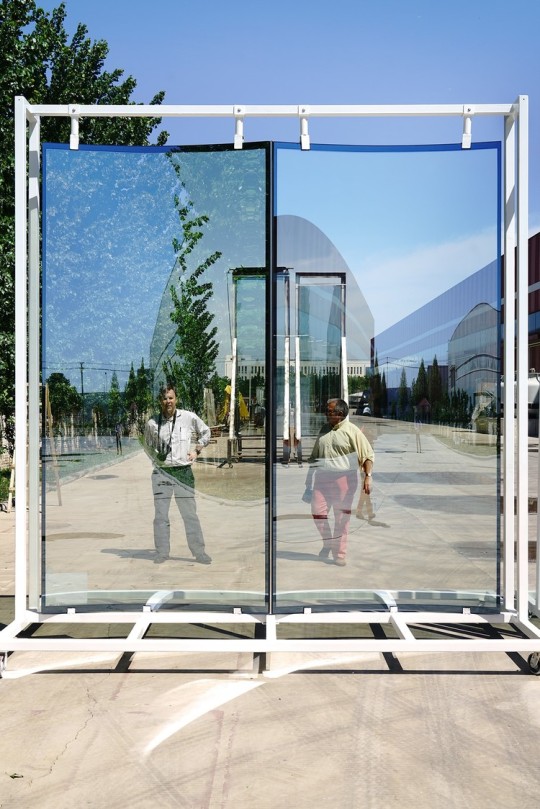
    Here’s a photo of the 1:1 mockup:

    And here’s a description from the architect:

    The façade’s approximately nine hundred identical, insulated-glass panels—3.2 m tall by 1.5 m wide (11’-6” tall by 5’-0” wide)—are subtly curved to a 2.9 m (9’-6”) radius through a heat roller tempering process. The curve yields structural efficiency, which meets wind load requirements and enables a thinner monolithic outer lite than normal, providing greater transparency. 

    Because of the curve’s inherent rigidity in compression, only the top and bottom edges of the panels are supported from the floor slabs, while the mullionless vertical edges are flush-glazed for a minimalist aesthetic that improves sight lines, while gaining usable floor area.

    They are working in collaboration with Front Inc., which if you haven’t heard of, you should check out. They are a design/engineering consultancy that specializes in facades and building envelopes. They work with many of the big name starchitects. The developer of the project is Tishman Speyer.

    It’s worth noting that part of the impetus for the fluted glass facade was to try and innovate within the confines of DC’s draconian zoning – which mandates that no building can be taller than 130 feet. Because of this, developers and architects are usually forced to build out to the allowable area, leaving little room for architectural variation. 

    But in this case, the fluted glass removed the need for thick mullions and also allowed them to extend out beyond the lot area by 4 inches every 5 feet (the curves are considered “architectural features”). So this move has created both architectural variation and more rentable area.

    It doesn’t appear that the building will have any operable windows, but other than that, I think it promises to be quite beautiful. What do you think?

    All images from REX.

  • Mirvish+Gehry and the story of 4 heritage buildings

    I am a real estate developer and I believe in progress. But I also fundamentally believe in balancing progress and preservation. I’ve said this before.

    This morning, Alex Bozikovic of the Globe and Mail, published a piece on the epic Mirvish + Gehry proposal for Toronto’s Entertainment District. It’s called, “Frank Gehry and David Mirvish’s tall order in Toronto.

    Now, I’ve said before that I like this project. I don’t mind the height and I don’t buy the argument that there aren’t enough public spaces in the area. There’s David Pecaut Square directly to the south that could use a few more warm bodies in it.

    But as I also said before, I think the key concern here is one of heritage. There are 4 heritage designated buildings on the site dating back to as early as 1901. Here’s where they sit:

    image

    The Anderson Building (1915) is particularly unique. Here’s a larger photo (via blogTO):

    image

    So while I’m excited by the prospect of a real Gehry project in Toronto, I think we need to figure out a way to find a balance. Preserve the facades, build on top, or relocate them. Do something besides wipe the slate clean.

    As Bozikovic rightly points out in his article, “Toronto has a sophisticated culture of working with heritage buildings.” There are lots of great examples of how we managed to move forward as a city, without erasing our past.

    And in many ways, I see this ability to work with and build upon heritage buildings as an emerging Toronto vernacular. I mean, what could be more appropriate for the most diverse city on the planet than an architectural style—of our own—that blends and layers history with disparate design ideologies.

    I sense an opportunity.

    We could have Gehry’s white sinuous curves drape over the heritage buildings. Make them become a literal unveiling of Toronto’s past and a metaphor for the sophisticated way in which we build upon legacy.

    It’s too easy to just demolish everything. We’re better than that.