Daily insights for city builders, delivered every morning at 6 AM ET. I’m Brandon Donnelly — a Toronto-based real estate developer and founder of Globizen. I’ve been writing here since 2013.

Tag: stanford university

  • Impact of temperature on economic production

    In 2015, Marshall Burke, Sol Hsiang, and Ted Miguel published a paper in Nature that looked at the relationship between temperature (climate) and economic output. They examined the historical impact of temperature changes (1960-2010) on 166 countries and then used this data to try and predict the potential future impacts of climate change on GDP per capita.   

    What they discovered is that temperature has a non-linear impact on economic production. Put differently, there’s an optimal annual average temperature. And it turns out to be 13 degrees celsius. If a country sits below this average number, then warming increases productivity. But if a country sits above this number, then warming has a negative impact on productivity. And the impact gets worse (stronger negative correlation) at higher temperatures.

    Some of you are probably wondering whether the correlations they found should be interpreted as causation. For what it’s worth, the study tries to correct for non-temperature related economic changes (such as a recession or policy changes) and it also looks at how individual countries perform against themselves during temperature fluctuations. So the control and treatment groups are arguably pretty tight.

    All of this suggests that there are a number of countries that stand to benefit from climate change (at least from this perspective). They are the ones that are cold today. 

    For more on the study, click here.

  • What cars can tell you about a neighborhood

    This is an interesting study from a team of AI researchers at Stanford. What they did was use car images taken directly from Google Street View (so images of cars parked on-street) to predict income levels, racial makeup, educational attainment, and voting patterns at the zip code and precinct level.

    Admittedly, it’s not a perfect survey, but when they compared their findings to actual or previously collected data (such as from the American Community Survey), it turns out that their study was actually remarkably accurate. Google Street View allowed them to survey 22 million cars, or about 8% of all cars in the US.

    Here are some of the things they found:

    –  Toyota and Honda vehicles are strongly associated with Asian neighborhoods.

    – Buick, Oldsmobile, and Chrysler vehicles are strongly associated with black neighborhoods.

    – Pickup trucks, Volkswagens and Aston Martins are strongly associated with white neighborhoods.

    Interestingly enough, the ratio of pickup trucks to sedans, alone, is a pretty reliable indicator of voting patterns. If a neighborhood has more pickup trucks than sedans, there’s an 82% chance it voted Republican in the last election.

    Perhaps this isn’t all that surprising given that car purchases are highly symbolic. But given that the American Community Survey costs $250 million a year to administer, this study is a good preview of what cheaper and more realtime data collection might look like.

  • Barrels and ammunition

    A few weeks ago I watched a talk by Keith Rabois called, How to Operate. Keith is a venture capitalist with Khosla Ventures, the former COO of Square, and a member of the PayPal Mafia.

    The talk was primarily geared towards startups, but much of what he talked about could be applied to any organization where people are managed. So whether you’re an architect, real estate developer, or governmental organization, I bet you’ll find the lessons relevant.

    One in particular that stood out for me was the idea of barrels and ammunition.

    For a lot of organizations, the thought is often that by adding more people you’ll be able to increase output. More people = greater velocity. But Keith’s reasoning is that most people are actually ammunition. And just like in war, it doesn’t exclusively matter how much ammunition you have. You can only shoot through the number of barrels you have. Output depends on barrels.

    So who exactly are barrels?

    Barrels are the kind of people who can take something from idea all the way through to completion, while at the same time taking a group of people along with them. They are, in other words, your leaders.

    But, they are difficult to find.

    There are fewer barrels than ammunition. And, the culture of the organization itself will impact every person’s ability to be a barrel. Here’s how Keith puts it:

    Barrels are very difficult to find. But when you have them, give them lots of equity. Promote them, take them to dinner every week, because they are virtually irreplaceable because they are also very culturally specific. So a barrel at one company may not be a barrel at another company.

    That’s something for you to think about as you start your workweek.

    Image: Flickr

  • Doing new things

    image

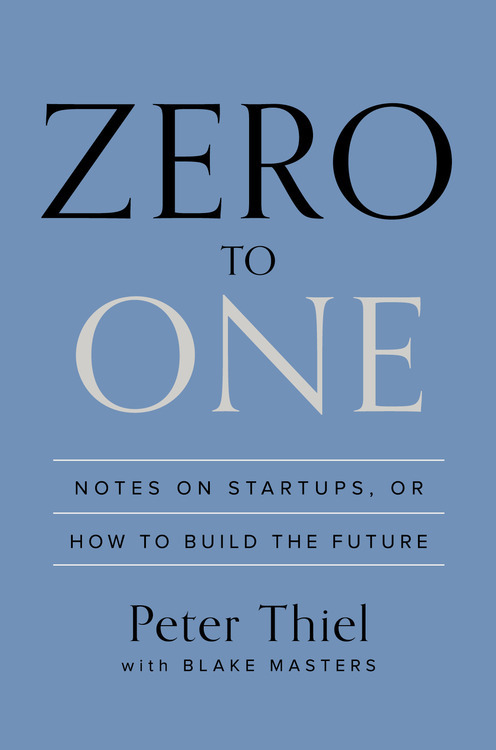
    I just finished reading Peter Thiel’s new book, Zero to One: Notes on Startups, or How to Build the Future. For those of you who may not be well-versed in the world of technology geeks, Peter Thiel is an entrepreneur and investor. He was one of the founders of PayPal back in 1998 and was the first outside investor in Facebook in 2004. He invested $500,000 for a 10.2% stake in the company!

    While the focus of the book is obviously on technology startups, it’s less about “here’s how you build a startup” (there is no formula) and more about “here’s how to think about the world, humanity, and the future of our civilization.” So even if you’re not a founder, or startup and technology enthusiast, I think you’d still find it really interesting.

    As one example, Thiel makes the distinction early on in the book between what he calls “vertical or intensive progress” and “horizontal or extensive progress.” The specific example he gives is of typewriters and word processors. If you take one typewriter and figure out how to make 100 of them, you’ve made horizontal progress. However, if you’ve just replaced typewriters with word processors, you’ve made vertical progress.

    In other words, vertical progress is doing new things and horizontal progress is just copying things that we know already work. In the grand scheme of the world, he argues that globalization is really just a form of horizontal progress. The rise of China is a result of them copying what has already worked in developed countries. But the true way to advance our economy and civilization is to not just copy – that’s easy – it’s to do, new, things.

    That, of course, is a lot harder to do. But to build the future, you need to build things and do things that haven’t been done before.

    Which is why Thiel actually gives $100,000 to a handful of college students every year so that they can drop-out and pursue a startup. In his mind, our education system is just perpetuating the status quo. MBAs move money around without creating anything new. Lawyers just preserve value and mitigate risk, also without creating anything new (Thiel is trained as a lawyer). And so he doesn’t believe that is the best way forward.

    This may not sit right with many of you, but questioning the status quo is a prerequisite if you’re trying to do new things.