Daily insights for city builders, delivered every morning at 6 AM ET. I’m Brandon Donnelly — a Toronto-based real estate developer and founder of Globizen. I’ve been writing here since 2013.
San Francisco’s Board of Supervisors recently voted 8-3 in favor of rejecting a new 495-unit residential project at 469 Stevenson Street in SoMa. The property is currently a parking lot used by Nordstrom.
Of the project’s 495 units, 73 were to be offered at affordable rents (about 14% of the project). In addition, the developer was prepared to donate a nearby parcel for additional off-site affordable housing. This would have brought the total count up to 118 units (or about 1/4 of the project).
Apparently gentrification was a serious concern with this project:
“It’s very clear to me that this will have a very significant displacement and social-economic impact on the Sixth Street corridor, on the Filipino community, and the broader low-income community here,” said District 10 Supervisor Shamann Walton.
The mayor seems to get it though:
“This project met all the criteria for approval, and it would have created 500 new homes on what is currently a parking lot surrounded by tall buildings, located near transit,” Breed told the Chronicle. “We can’t keep rejecting new housing and then wondering why rents keep rising.”
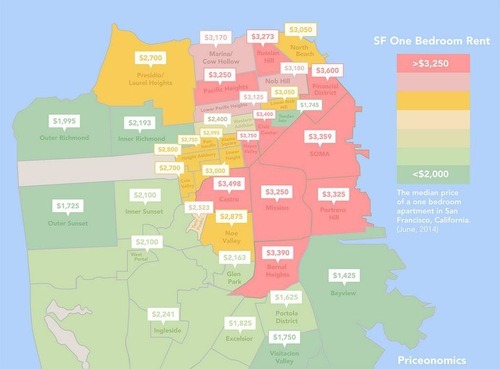
Recently Priceonomics posted a piece on San Francisco’s “rent explosion.” In it, was the infographic above showing the median rental rate for a 1 bedroom apartment in the city. The most obvious takeaway is that San Francisco is real expensive. In the core of the city, you’re easily looking at $3,000 per month.
That is with one exception: the Tenderloin (the green area just northwest of SOMA in downtown). The first time I ever visited San Francisco, I actually stayed on the outskirts of this area, which is a neighborhood well known for seediness, homelessness, crime, drug trade, strip clubs, and so on. And it was actually named after a similar neighborhood in New York that was also a center of vice in the late 19th and early 20th centuries.
But when I saw this diagram, I immediately asked myself: How could it be that the Tenderloin was holding out so well against the forces of gentrification? How is this island of seediness being preserved in the center of downtown? Particularly in a city like San Francisco where there’s a perpetual housing supply shortage and lots of wealth. The Tenderloin has some of the lowest rents in the city.
So I tweeted the good folks at Priceonomics and they responded with this article. It’s a few pages long, but the reasoning seems to come down to the following: active community groups that fought to keep developers out of the area (and that also own many of the buildings), downzoning, and a high percentage of rooming houses. According to that same article, the Tenderloin contains approximately 100 single room occupancy residential hotels (or SRO’s as they’re called). These were initially built to house the city’s transient and seasonal population after the great fire of 1906.
So it would appear that there are some significant barriers to entry.
But at the same time, it generally seems like a bad idea to concentrate poverty, homelessness, drug users, and so on. Interestingly enough, the article talks about how when the Bay Area’s transit system went on strike for a period of time, the supply of drugs actually dried up in the Tenderloin. This underscores how regional the drug business is, but also makes me think that dealers are almost surely benefiting from the clustering of their client base.
In any event, this is a much larger problem than just a real estate development one. I don’t know what the solution should be, but I’m pretty sure that things are being made worse by concentrating everything in one neighborhood and by rising income inequality in the city. Inequality seems to lead to all kinds of negative externalities and, from my experience, mixed-income neighborhoods perform better than 100% poor ones.