Daily insights for city builders, delivered every morning at 6 AM ET. I’m Brandon Donnelly — a Toronto-based real estate developer and founder of Globizen. I’ve been writing here since 2013.

Tag: solar power

  • Ontario should have more solar energy

    I have a very close friend (Peter Vogel) who is in the solar business. He runs business development for a company called Otter Energy. And by volume, I believe they are the largest in Ontario. Since 2009, they have installed over 350,000 panels.

    So when Peter and I hang out, I get the benefit of learning about solar. And he is great at reminding me that installing panels on the roof of buildings in Ontario makes a ton of sense from both an environmental and financial standpoint.

    Generally speaking, the amount of benefit you will see depends on the building’s ratio of roof area to overall building area. Low-rise buildings with a lot of roof area (think industrial assets), are absolute no brainers. But it can also work very well on many other asset classes, including mid-rise multi-family.

    Here are some high-level figures that he recently walked me through:

    • As a rule of thumb, solar in Ontario typically generates between 12-14 kWh’s per year per square foot of roof area (usable flat roof).
    • The average payback period for an install is usually somewhere between 4.5 to 7 years.
    • However, on income producing properties, the permanent decrease in operating expenses and the corresponding increase in net operating income (NOI) will increase your asset value on day one.
    • Consider spending $100k on solar panels to increase your NOI — through lower electricity costs — by $10k. If you were to then capitalize this increase in NOI by 5%, it would mean your asset value has right away increased by $200k. If the cap rate for this asset is even lower, say 4%, the increase goes up to $250k.
    • These multiples can get even better with larger installs. Here are some numbers from a real-world 100,000 sf commercial building in Ontario. In this case, the solar system cost about $800k (net) and resulted in annual operating cost savings of about $140k. This means, that at a 5% cap rate, the owner spent $800k to increase the value of their asset by $2.8 million on day one.
    • Of course, in addition to all of this, you get long-term energy cost certainty. That’s worth something too.

    The business case is compelling. So I think more building owners should be looking at solar. We are certainly looking at it from a development perspective. If you’re interested in learning more, feel free to reach out to my friend. There are a lot of details that help strengthen the case for solar, including depreciation allowances and tax credits.

  • Comparing innovative technologies

    This is an interesting chart from Bloomberg Green comparing some of today’s innovations against innovations of the past. At the top of today’s innovations are EV batteries, which from 2010-2020, saw annual deployment growth similar to that of US WWII aircrafts. However, when it comes to reducing costs, both EV batteries and solar PV modules come out on top with annual declines approaching almost 20%.

    Of course, these probably aren’t perfect comparisons. If you look at EV batteries and solar PV modules from 2020 to 2023, their growth rates jump to 72% and 39%, respectively. So who knows if these are the right time slices to be using in order to accurately capture the “key expansion periods.” Regardless, it does provide some historical context and it does say something. These are important innovations.

  • Insufficient electrical capacity until 2035

    One of the things that you need to do when you’re constructing a building is arrange for new utility connections. Sometimes there’s enough capacity to support what you’re building and sometimes the capacities need to be upgraded (which usually becomes the responsibility of the developer).

    But according to this recent Financial Times article, some new applicants in west London are now being told that there won’t be “sufficient electrical capacity for a new connection” until, oh I don’t know, maybe 2035. And it could affect all new housing projects with 25 or more units.

    This is a pretty wild piece of news. And it certainly won’t be good for overall housing supply. The three west London boroughs that are being impacted by this capacity issue were responsible for about 5,000 new homes between 2019-2020. That’s about 11% of London’s total housing supply.

    So what and who is to blame for this? The Greater London Authority is saying that data centers are at least partially responsible. Too many new data centers in the area with high electrical loads.

    I don’t know exactly what is going on here (maybe some of you do), but now feels like a good time to turn our attention to solar power. I recently visited a large 3,000 panel rooftop installation here in the Greater Toronto Area, and so naturally there is a blog post in the works. Stay tuned.

  • PAPILIO: Wind-powered streetlight

    Well here is a clever idea by Berlin designer Tobias Trübenbacher. It is a wind-powered streetlight — one that also detects when people are nearby and emits an insect-friendly light spectrum. Lots of cities already rely (partially) on solar powered lights and signage. But that doesn’t always work if the street doesn’t get a lot of direct sunlight or if you happen to be in a darker city. So perhaps wind is the answer. I could imagine this working very well here in Toronto in the middle of the winter at the intersection of Bay and King. And if you remember my post from earlier in the week about a roadmap to net zero energy, it is pretty clear that both solar and wind electricity are going to need to become far more prominent in our cities.

    If you can’t see the embedded video above, click here.

  • Current state of renewable energy

    image

    The United Nations and Bloomberg New Energy Finance recently published a report covering global trends in the renewable energy space for 2017

    Here are some of their key findings:

    – 2016 was a record year in terms of renewable power capacity installed worldwide. This includes wind, solar, biomass and waste-to-energy, geothermal, small hydro, and marine sources.

    – The share of global electricity generated from renewable sources rose from 10.3% (2015) to 11.3% (2016).

    – However, overall investment in renewables declined in 2016 for two main reasons. Costs went down (good news). And China and Japan exhibited a dramatic slowdown in terms of investment activity (bad news).

    – Acquisitions of renewal assets, such as wind farms and solar parks, hit a new peak at $72.7 billion.

    – A number of promising new pricing records set in 2016: $29.10 per MWh for solar in Chile and $30 per MWh for onshore wind in Morocco.

    – In one year, the cost of solar generation dropped on average about 17% and onshore wind dropped about 18%.

  • Abu Dhabi signs cheapest electricity contract, ever

    The Abu Dhabi Water and Electricity Authority recently completed a 350 MW solar tender. They received a total of 6 bids and the low bidder was Japan’s Marubeni Corp and China’s JinkoSolar Holding Co Ltd. Their bid was USD $24.2 per MWh or 2.42 cents per KWh.

    This is really low.

    According to the U.S. Energy Information Administration, the average cost of a new natural gas-fired plant is 5.6 cents per KWh. More than double the above solar bid.

    In fact, author, blogger and futurist Ramez Naam calls the above bid, “the cheapest contract for electricity ever signed, anywhere on planet earth, using any technology.” (Blog post here.) 

    Huge.

    Now, Abu Dhabi is obviously a very sunny locale. No shortage of bluebird days there. But that doesn’t negate the fact that we are seeing a rapid decline in solar power prices.

    This, along with the growing adoption of electric vehicles is excellent news for us sustainability dorks. Just this morning I was thinking to myself that the car I currently own will likely be the last gasoline-powered car I ever own.

    Hopefully they start making an electric version of the G-Class.

  • Peer-to-peer solar startup

    Airbnb is a platform that connects people who have extra space with people who need space. It’s a peer-to-peer hospitality company.

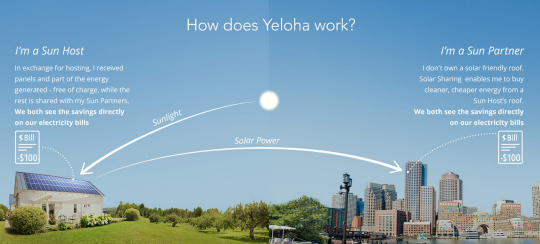
    Yeloha, which is a startup I just discovered today, is a peer-to-peer solar company based out of Boston. 

    In the same vein as Airbnb, it connect people who have extra roof space (that’s suitable for solar collection) with people who want to buy solar energy (but may not have a solar friendly roof).

    Here’s an image from their website that explains how it works:

    image

    Basically, if you have a solar friendly roof, Yeloha will come and install solar panels on top of your place for free. You get to keep some of the energy that’s generated (about 1/3 apparently) which becomes a credit to your electricity bill. You are then known as a “Sun Host.”

    The remaining energy gets fed back into the grid and, if you don’t have a solar friendly roof, you can purchase this excess energy, which also results in a credit to your electricity bill. The solar electricity is less expensive than the regular grid electricity. In this case, you are known as a “Sun Partner.”

    I think this is a pretty neat idea. Neither party has to pay anything upfront. Both parties save money. And the result is more solar through a distributed and virtual net metering setup.