
Daily insights for city builders, delivered every morning at 6 AM ET. I’m Brandon Donnelly — a Toronto-based real estate developer and founder of Globizen. I’ve been writing here since 2013.

Tag: snowboarding

  • Avoiding driving

    If you’ve been reading Architect This City since last winter, you might know that every year I go on one big snowboard trip with a group of guys I went to grad school with at Penn. Last year we went to Jackson Hole and Vail, and this year the plan is to go to Banff and Revelstoke.

    We start planning it by the fall and so already we’ve been trying to sort out the details for this winter’s trip. But as we finalize the plans, one thing I’ve noticed is how I’ve automatically been trying to minimize the amount of driving that we’ll need to do. In fact, in a perfect world, we wouldn’t have to rent a car at all.

    Now, small mountain towns aren’t usually the best for public transit, but there are often ways to get around that. When we were in Jackson, we took the public bus to get to the mountain every day, as did most people who lived or stayed in town.

    This winter, the plan is to fly into Calgary and stay in Banff for the first leg of the trip. So I’ve been trying to figure out if there’s a train that can get us from Calgary to Banff and which hotels offer shuttle buses to the mountains. Because I’d rather not drive, and I know many of my friends feel the same way. It’s an added cost and it gets in the way of après ski.

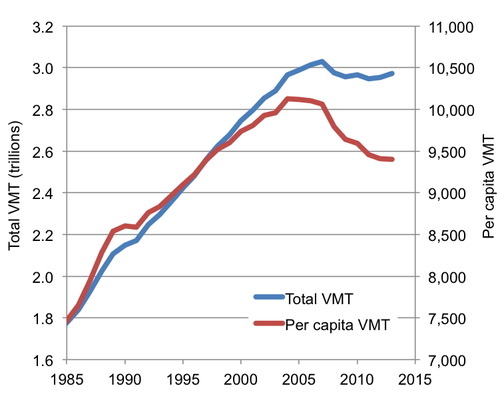
    What’s interesting about this, is that not only do I try and minimize the amount of driving I do here in Toronto, but I do it when I travel as well. And if you’ve been following the macro trends, you might know that many other people feel the same way. That’s why total Vehicle Miles Traveled in the US has been in falling since about the mid-2000s:
    image

    People are falling out of love with driving, and many believe that this shift is permanent. Here’s a recent report from the US PIRG Education Fund talking about just that:

    //platform.twitter.com/widgets.js

    I also think this shift is permanent – until maybe the nature of driving changes and cars start driving themselves. But at that point, it won’t be called driving anymore and there will probably be many other changes. So on this rainy Wednesday morning, my big bold prediction is that future generations will no longer drive.

    What do you think?
  • I left my heart in Jackson Hole [Video]

    I am back from Jackson Hole, but missing it. I fell in love with that town this past week. It’s a small one, but a special one. It’s filled with great food and 10,000 of some of the friendliest (and most fit) people I’ve ever met. Everyone seems to be living for the next big snow storm.

    I read somewhere before that all cities speak to us in some way. Each one has a pervasive belief system that influences us.

    Boston tells us to be smarter. New York tell us to make more money. And D.C. tells us to be more powerful. If Jackson Hole were to have a message for us, it would most certainly be to get out there and shred more powder. And there’s something to be said about that.

    It was sad to leave that kind of place, especially with 24”of snow expected this weekend. But I’m sure I’ll be back. Here’s the video we made of the trip. I hope you like it. We had far too much fun making it.

    In case you like the music, the first song is “There’s A Beast And We All Feed It” by Jake Bugg. And the second is “Fitzpleasure” by alt-J. We loved these songs so much that we played them in our gondola rides up the mountain.

  • The powder clause

    Jackson Hole has been on the top of my list of places to visit for a number of years now. And having just snowboarded it for the first time, I can honestly say that it lives up to the hype. It’s by far the most aggressive mountain I’ve ever had the pleasure of riding on. We also got lucky with 9” of fresh powder.

    But in addition to some great riding, I also learned of something new today: the “powder clause”. And from what we’ve heard from the locals, lots of employers in the region offer it. What it means is that if there’s a fresh dumping of snow, you’re allowed to take the morning off work so that you can go ski “the pow.” I think this is brilliant.

    If you’re from a big city (or you don’t ski), this may seem a bit absurd. But I think the “powder clause” underscores a growing trend happening in a lot of cities around the world. We’re seeing the rise of the consumer city. Historically, cities were all about agglomeration economies. But today, amenities matter. People choose first where they want to live and then look for a job (or start their own company).

    Some places are blessed with natural amenities. But for the rest of us, we have to work at creating our own. That’s where city building comes into play.

  • Toronto’s concession roads

    I’m late in writing this blog post because I was up in Collingwood for the day snowboarding. I’m exhausted, but I do have something to say.

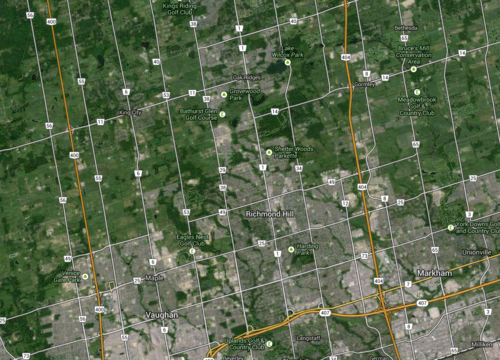
    One of the things I always find interesting when I’m driving north of the city is how far Toronto’s major north-south streets extend. Go out to Aurora or Newmarket and you’ll still come across many familiar faces such as Jane, Keele, Dufferin, Bathurst and Yonge Street. And the distance between each of them is exactly the same as it is in the city: 2 kilometres.

    This may not seem like much of a big deal, but have you ever wondered how this street grid was established?

    These streets are actually concession roads. And they were used to subdivide undeveloped land in Upper and Lower Canada into a grid that could then be further subdivided into farming lots. Each square of the grid is 2 km x 2 km, or 1,000 acres.

    Look at a map of the Greater Toronto Area and you’ll see it:

    image

    But what I find most intriguing about this grid system is that it was designed around farming—not our current use case. The intent was to further subdivide each 1,000 acre lot into smaller 100 acre farming lots. And these concession roads were for access—they weren’t city blocks.

    By comparison, there’s another city that’s famously run off a regular street grid. You may have heard of it. It’s called New York. And its street grid was established in the Commissioner’s Plan of 1811. Some even go so far as to say that it’s “the single most important document in New York’s development.” 

    But New York’s grid is much different than the one I’m talking about. Because of its smaller scale (20 blocks a mile going north-south), New York’s was decidedly urban. It was meant for city building.

    Now, in the case of Toronto, concession roads obviously never stopped us from developing a thriving city. We filled in each square to make them as urban as we needed them to be. But as planning ideals changed, so did the infilling of those squares. Our grid was flexible enough to accommodate everything from farm land to suburban subdivisions.

    But I can’t help but wonder how the Greater Toronto Area would have turned out had we, quite simply, chosen a different size of square. What if instead of 2 km x 2 km, we had made them 1 km x 1 km? Or what if we made them even smaller? What would the Toronto region look like today?

    Sometimes it may seem like a simple decision, but in reality the implications are huge.