
Daily insights for city builders, delivered every morning at 6 AM ET. I’m Brandon Donnelly — a Toronto-based real estate developer and founder of Globizen. I’ve been writing here since 2013.

Tag: snap

  • Our ambient computing future

    I noticed this week that Google has started to overlay augmented reality-type place markers onto Street View. The markers are designed to help surface the kind of local business information that you might otherwise find in search — phone number, hours of operation, and so on. Apparently not everyone is seeing them, but the feature is starting to roll out in certain cities. Above is a photo of Dundas Street West in the Junction.

    This transforms Street View into even more of a wayfinding tool, but it also offers up a glimpse of how the world might look with augmented reality. But to make this ultimately happen, you really do need to figure out how to get people to start wearing smart glasses. Lots of companies, including Google and Snap, have been trying. None of their products have really stuck — though Snap’s Spectacles are easily the best looking ones.

    However, last month Google did announce that it had acquired Canadian smart glasses company, North. I was invited to try out a pair of North Focals 1.0 glasses, which I wrote about over here. They were exceedingly cool, but definitely not ready for mainstream and daily usage. The sides were thick and you had to wear a ring joystick in order to navigate through its menus. Too much work. Too nerdy.

    But that’s okay because Google didn’t buy North for the Focals product. They bought them for talent, patents, and for probably a bunch of other things. They bought them to help Google invest in its “hardware efforts and ambient computing future.” The little markers you might now be seeing on Google Street View are likely part of that.

  • Would it be insider trading if Kylie Jenner traded on her tweets?

    Lately I have really gotten into Matt Levine’s daily newsletter about “Wall Street, finance, companies and other stuff.” Maybe that’s how I should describe this blog: Cities, real estate, design, and other stuff.

    If you aren’t familiar with Matt’s writing, here is an article that he wrote about Kylie Jenner’s recent tweet concerning Snapchat. You know, the one that wiped out $1.3 billion of market value because she revealed – using only 88 characters, I might add – that she was no longer using the app.

    https://platform.twitter.com/widgets.js

    The article was spurred on by this question:

    “Would it be insider trading for Kylie Jenner to buy short term out of money put options on Snap and tweet out that she’s no longer using Snap?”

    And this is the start of his answer:

    Insider trading, as I am constantly saying around here, is not about fairness; it is about theft. It is not illegal to trade on your own nonpublic knowledge of your own intentions. Warren Buffett can buy stocks before he announces that he’s bought them, even though that announcement will predictably make the stocks go up. 

    If I did describe this daily blog like Matt describes his daily newsletter, this post would clearly fall into the “other stuff” camp. But maybe you too will find it interesting. If you do, you can subscribe here

  • Google and Facebook show

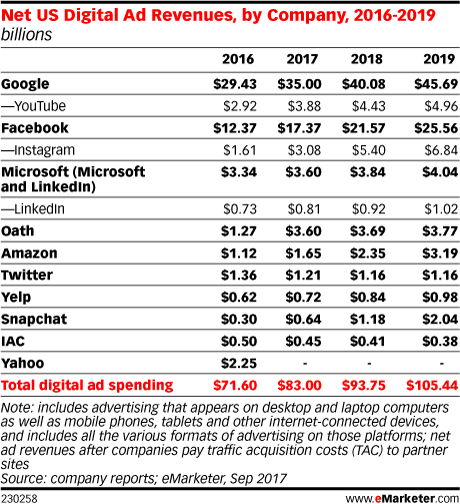
    This morning Fred Wilson posted this chart on his blog:

    image

    What is clear is that when it comes to US digital ad revenue, it’s the Google and Facebook show, followed by everyone else. Microsoft/LinkedIn is a distant third. Fred calls it “the digital advertising duopoly.” And his view is that the tech industry needs to figure out new approaches to monetization that still allow free content to be consumed. 

    I’ve said this before, but Facebook buying Instagram for $1 billion seems like a bargain when you look at a chart like this and you see what they were able to do with the platform. Instagram’s 2018 revenues are projected to be bigger than every other company on the list minus Google but including YouTube.

    Also notable are the flatlining of Twitter and the projected growth of Snapchat. 2017 was a rough year for $SNAP. But it appears that somebody believes they’ll be able to turn things around with their app redesign and reconstituted ad platform. Be that as it may, it’s still the Google and Facebook show – at least for the time being.

  • Crowd Surf

    When Snap Inc. announced its Q2 financial results earlier this month, it reported 173 million daily active users – an increase of 21% year-over-year. But this fell short of what was expected. Analysts were expecting 175.2 million DAUs

    (Snap defines a DAU as anyone who opens the Snapchat app during a defined 24 hour period.)

    Regardless of your position on this stock, one thing is clear about the company: they are very creative and they continue to innovate.

    The company is currently testing a new feature called “Crowd Surf.” What it does is automatically stitch together related Snapchat Stories from the same location to form seamless videos. 

    It made its debut at a concert in San Francisco. The real magic is how Crowd Surf was able to assemble a continuous audio track using an assortment of 10-second Snapchat Stories, all taken from different locations at the concert and all from different users.

    Click here and scroll down for a preview video.

    To accomplish all of this, Snap takes a “sound print” of the audio playing in a particular location from people’s Stories. It then filters each of the clips so they sound more alike and autogenerates a stitched together video.

    You obviously need a critical mass of users and content for this to work, which is why the feature was introduced at a concert. But it’s certainly a remarkable way of creating valuable content from decentralized user inputs.

    I guess the only question is: How long until Instagram copies this?

    Photo by Yvette de Wit on Unsplash

  • Snap Inc.

    Snap Inc. (Snapchat) nailed the launch of Spectacles. I want a pair.

    If you haven’t been following, it all started with a pop-up vending machine in Venice Beach. But like Snapchat itself, it was an ephemeral installation that eventually disappeared, moving on to Big Sur, California. At the time of writing this post, the countdown is on to discover where the vending machine will pop up next. It’s a viral marketing play that aligns very well with their brand.

    But there’s even bigger news.

    Earlier this week it was revealed that Snap Inc. has filed for an initial public offering. It plans to go public by as soon as March 2017 and expects to be valued somewhere around $25 billion. Remember when everyone flipped out because Evan Spiegel had rejected Facebook’s acquisition offer of $3 billion?

    Here’s their revenue story from Vanity Fair:

    Last year, Snapchat brought in $59 million in revenue—a low number that reflected the embryonic stage of its business. This year, however, Snapchat predicts it will generate revenues between $250 million and $350 million. And in 2017, the company estimates it will reach revenues between $500 million and $1 billion, based on “bullish sales targets.”

    I’ve been a Snapchat fan for awhile now, so I am thrilled to see the company going public. As Fred Wilson wrote on his blog this morning: “Snap is a great company led by a creative and ambitious founder and they have a loyal and growing use base. I think Snap can be an excellent public company.”

    If you’ve got people’s attention, you can figure out how to monetize it.