Daily insights for city builders, delivered every morning at 6 AM ET. I’m Brandon Donnelly — a Toronto-based real estate developer and founder of Globizen. I’ve been writing here since 2013.

Tag: smartphones

  • Why are people buying Apple Watches?

    I have been using an Apple Watch for a couple of months now. A lot of people ask me why I feel it is necessary to have a screen on my wrist, and I certainly get why some would see it as a massive distraction. You have to be selective with your notifications. Generally speaking, I find it very useful, though not necessarily invaluable.

    But every now and then I come across a new use case and think to myself, “well this is pretty cool.” I recently discovered that you can use it for boarding passes, which means one less thing in your hands at the airport. And this week I’ve been using it while snowboarding, which is helpful if you’re trying to manage a WhatsApp group chat and you don’t want to take your phone out on the lifts.

    The numbers also suggest I’m not alone in finding utility. Here are Apple’s sales numbers from Neil Cybart of Above Avalon:

    Apple has sold more than 90 million Apple Watches to date with 29 million sold in calendar year 2019. With an average selling price of more than $400, the Apple Watch is bringing in $12 billion of revenue per year, and that total is growing by 30% per year. After taking into account upgrade trends, the number of people wearing an Apple Watch has crossed 65 million. Based on my forward projections, the Apple Watch installed base will surpass 100 million people in 2021.

    In Neil’s view, the Apple Watch is indeed one of those paradigm shifts in computing. It is taking over tasks that our phones used to do and it is allowing for entirely new use cases. Neil cites three important features. We are now able to (1) seamlessly track/monitor aspects of our health, (2) intelligently receive small bits of information, and (3) augment our surroundings (“contextual awareness.”)

    For more on why the Apple Watch is / could be fundamentally changing mobile tech, click here.

  • Standing on the shoulders of giants

    “Every failed idea from the dotcom bubble would work now.”

    — Marc Andreessen

    Every year, Benedict Evans publishes a “big presentation” on the current trends in tech. They are always excellent and they help to put a lot of things into perspective. This year he covers everything from TV subscriptions to online mattress companies (there were 175 of them as of last year), and asks: What’s next in tech?

    New technologies have typically come in S-Curves (see above). They start out slow, see rapid growth, and then taper off. To use Benedict’s wording, they go from stupid to exciting and then to boring. Smartphones are currently in the boring phase. Each new year sees only incremental change. So, what’s next? That is still TBD.

    To download a full copy of the presentation, click here.

    Slide Image: Benedict Evans

  • 10x the scale

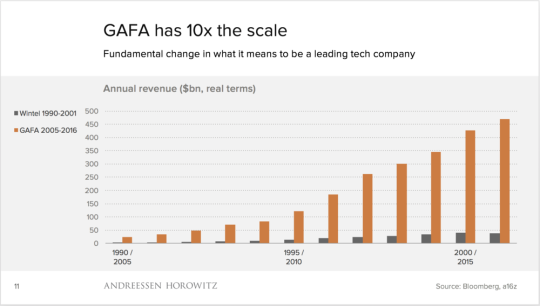
    Below is a chart from Benedict Evans comparing annual revenue from the Wintel era (Microsoft + Intel) to the current GAFA era (Google, Apple, Facebook, and Amazon). 

    His argument is that, today, “the scale of tech winners” is about 10x what it was during the previous cycle.

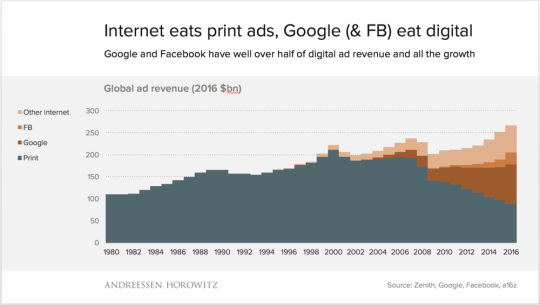
    And here is a chart, from that same post, showing how the internet ate print ads when it comes to global revenue:

    A lot of this has to do with the unprecedented growth of smartphones and the sheer number of people who came and are coming online. Mobile is 10x the PC market.

    But the other interesting narrative from the post is the argument that these companies (GAFA) have learned from previous generations just how aggressive you need to be to survive.

    The shift to mobile posed a structural threat to Facebook. At the time of its IPO, there were serious doubts as to whether the company would be able to pull off this transition.

    Which is why the founder went out and spent 10% of the company to acquire companies that would help with this transition and ensure its survival. That seems to have worked.

    In the words of Andrew Grove: “Only the paranoid survive.“ And in today’s tech world, the rewards for surviving are that much bigger.

  • Marginal cost = 0

    Earlier this week I wrote a post called: The pull from services to products. And in it I made mention of the fact that part of what’s driving this pull towards products is that the marginal cost of servicing additional users or customers is almost nothing in a world of internet services and products.

    Well the reality is that this phenomenon is driving a hell of a lot more. It could – and probably will – fundamentally change almost all aspects of the economy.

    I know that sounds like a pretty audacious statement, but if you watch the following 10 minute talk by Albert Wenger (Union Square Ventures) you might start to feel the same way. He outlines 5 changes being driven by the fact that in the digital world, marginal cost = 0. The impacts go well beyond tech, capturing sectors such as transportation and industrial real estate.

    [youtube https://www.youtube.com/watch?v=sVEtTzlqsoE?rel=0]

    If you can’t see the video, click here.

  • The threat to big box retailing

    image

    Earlier this week, I was having a conversation with a number of smart real estate people about the future of retail in today’s internet and smartphone world. This, of course, isn’t a new topic. The industry has been discussing it for years. And while internet retailing still accounts for a relatively small percentage of overall retail sales (~10%), we all know that change is coming.

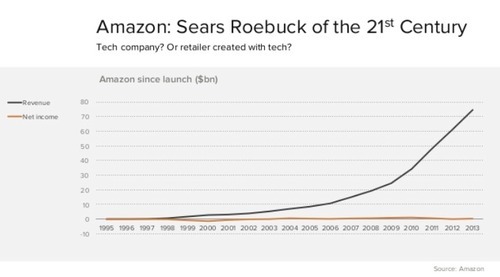
    One company that came up during our discussion was not surprisingly Amazon.com. But the initial comment was that they don’t make any money. Fortunately for me I had just gone through a presentation by venture capitalist Benedict Evans the night before called: Mobile is eating the world. And so I pulled out my phone and presented this slide:

    image

    The fact that Amazon operates with basically no net income is on purpose. Look at their revenue growth! So I wouldn’t dismiss them as being a fad. They may only account for 1% of all US retail sales today, but I’d put money on that percentage growing.

    The other reason I bring up Amazon is because, in some ways, I think of them as the online equivalent of a big box store. Just like a Walmart or Costco, where you can buy everything from tires to groceries to prescription drugs, I buy a lot of different things, besides just books, off of Amazon.com. You might do the same as well. And this is where I see the immediate threat to offline retailing and retail real estate: big box stores.

    In the second half of the 20th century, big box stores were incredibly disruptive to the retail landscape (and to cities). They used cheap land on the outskirts of cities, cheap buildings, and economies of scale to offer rock bottom prices to consumers. The value proposition was about cheap, not about differentiation. But as cheap as they may be, the internet can still do it cheaper.

    And retailers know this, which is why I think they all now sell groceries. Groceries have a very low online penetration. Basically everybody still buys groceries in-person. So if you offer that, you have a reason to draw people inside your store, where they will hopefully buy all the other stuff that they need. But as the online value proposition continues to get stronger, I think we’ll see many other, more significant, changes.

    Image: Flickr

  • What makes a city a smart one?

    There’s a lot of buzz around the idea of a “smart city.” IBM is involved. Cisco is involved. And so are many others. But what exactly is a smart city? 

    In the Electric City talk below, Adam Greenfield provides his definition, while at the same time being critical of the ones we currently use today, such as this one: It’s the missing link – the connective tissue – between the real estate and technology sectors. (Personally, I find this definition really interesting.)

    He also goes on to argue that the way we’re largely thinking about smart cities today is incorrect. We’re far too centralized and administrative in our thinking. Instead, we should be focused on leveraging the crowds of people in our cities that are now virtually all networked.

    He then goes on to list 5 technological preconditions to any smart city:

    1. Broadband connectivity
    2. Low-cost smartphones or personal devices
    3. Commitment to open municipal data
    4. Cheap public interfaces
    5. Cloud computing infrastructure

    If you’re interested in this topic, I suggest you watch his talk. It’s only about 10 minutes long. Click here if you can’t see it below.

    [youtube https://www.youtube.com/watch?v=9keDwTBmZ3o?rel=0]

    Update: This post was revised to reflect the fact that Adam Greenfield is “sharply critical” of the real estate + technology definition of a smart city.