Daily insights for city builders, delivered every morning at 6 AM ET. I’m Brandon Donnelly — a Toronto-based real estate developer and founder of Globizen. I’ve been writing here since 2013.

Tag: smartphone

  • Market power in tech

    Benedict Evan’s latest post on Microsoft, IBM, and anti-trust is excellent. In it he argues (reminds us) that market power during one generation of tech, doesn’t necessarily guarantee market power in the next. And that anti-trust intervention isn’t actually responsible for Microsoft missing out on, among other things, mobile. The rules of engagement simply changed. The PC is now a smartphone accessory.

    Here is an excerpt:

    The tech industry loves to talk about ‘moats’ around a business – some mechanic of the product or market that forms a fundamental structural barrier to competition, so that just having a better product isn‘t enough to break in. But there are several ways that a moat can stop working. Sometimes the King orders you to fill in the moat and knock down the walls. This is the deus ex machina of state intervention – of anti-trust investigations and trials. But sometimes the river changes course, or the harbour silts up, or someone opens a new pass over the mountains, or the trade routes move, and the castle is still there and still impregnable but slowly stops being important. This is what happened to IBM and Microsoft. The competition isn’t another mainframe company or another PC operating system – it’s something that solves the same underlying user needs in very different ways, or creates new ones that matter more. The web didn’t bridge Microsoft’s moat – it went around, and made it irrelevant. Of course, this isn’t limited to tech – railway and ocean liner companies didn’t make the jump into airlines either. But those companies had a run of a century – IBM and Microsoft each only got 20 years.

    For the full post, click here.

  • Death of the standalone camera

    I took the above photo on my Fujifilm X-T3 at the Museum of Contemporary Art here in Toronto. Obviously, it is a cast of David Bowie’s head. I’ve been using Fujifilm’s X cameras for exactly 3 years now and have already gone through 2 different models. I love them. But Om Malik’s recent post on why the future belongs to computational photography is, in my opinion, entirely accurate.

    For most people, taking photos on a standalone camera and dropping them into Lightroom is not only far too much work, but also unnecessary. Here is a chart from Om’s post showing total worldwide digital camera unit sales (in millions). Sales have fallen off a cliff from about 10 years ago and now look to be on the verge of dying.

    What is obvious is that we are all now just taking photos on our phones. Thanks to better chips, sensors, and software, the future of photography looks, again, destined to be computational. Apple is set to announce its new iPhone 11 (or whatever it will be called) this week and already the rumors point to a dramatically improved camera.

    This change in hardware has also changed our relationship to the photograph. We now take photos for the purpose of real-time sharing, which is another point that Om makes. When I post photos of things that have happened in the past — as I often do — people are commonly confused: “Where are you? When are you back in Toronto? Wait, is this a #latergram?”

    This has made photographic memories feel ephemeral. Once the moment has passed, we forget about them. They get drowned out in new real-time images and shares. As a society we are taking more photos than ever before. Not surprisingly, this lowers the gravitas of each individual one.

  • Bringing public transit into the 21st century

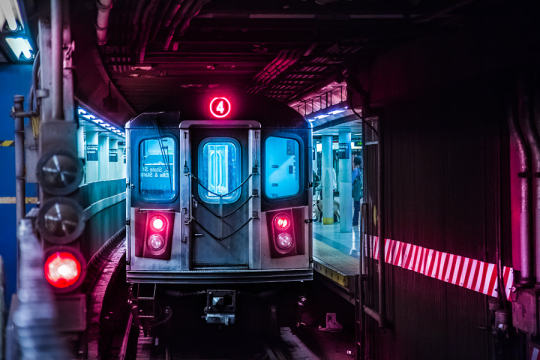
    New York Subway by Lok Yiu Cheung on 500px.com

    https://500px.com/embed.js

    I think we’ve hit peak millennial.

    Last Friday the Governor of New York, Andrew Cuomo, and the Metropolitan Transit Authority, announced that 30 subway stations will be redesigned and that “millennial-friendly amenities” would be added throughout the system

    As you might guess, this includes adding phone chargers in train cars and buses and wifi throughout all the stations (by the end 2016). They will also be replacing the MetroCard with an all digital fare system that will include mobile payments.

    But the reality is that this isn’t about being millennial-friendly. This is about joining the 21st century.

    Here in Toronto, we finally have our PRESTO card working on all streetcars and in almost 40% of the city’s subway stations. This is a huge improvement over our laughable and antiquated token system, but it’s not enough. I really hope the next rollout is a mobile app that will allow everyone to pay with just their phone.

    We also have wifi in about 30% of our subway stations, but again this is not enough. By the time you get authenticated (do you need to have Twitter now?), your train is usually arriving and then you enter a tunnel where no wifi exists. We need to be looking at the entire tunnel network. (Related topic: LinkNYC

    I say all this because I am a big supporter of public transit. Despite all the positive things I write about Uber, ridesharing, and driverless cars, I do not believe that they will eradicate the need for a strong transit backbone. This is fundamental to our city building efforts. 

    So let’s do our best to delight people when they take transit.

  • How I moved over the last 3 weeks

    At the beginning of this year I wrote a post about a mobile tracking app called Moves that I had heard about through my friend Sachin Monga. He had just published a beautiful set maps showing where he physically spent his time in both Toronto and San Francisco.

    His post spurred me to download the app and at the end of my post I promised to share my own set of maps once I had collected enough data points. It’s only been about 3 weeks, but already my maps are starting to fill out, so I thought I would do a release.

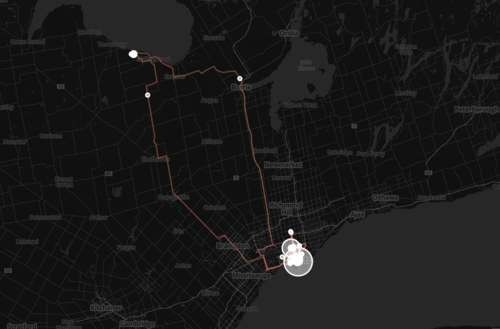
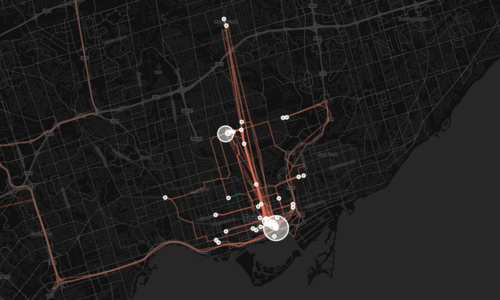
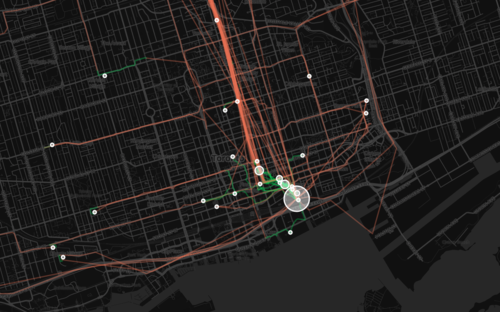
    The orange lines represent transport of some sort (car, subway, streetcar, and so on) and the green lines represent walking. I don’t cycle very often in the winter (I know, I’m a fair-weather cyclist), so you won’t see any of those lines just yet. However if I posted a map from the summer, I know it would look completely different.

    Here’s a first one showing a regional scale:

    image

    Here’s a second one showing the city of Toronto:

    image

    And here’s a third one showing mostly downtown:

    image

    What’s interesting about these maps is how much you can tell about me and the way I move around the city.

    For one, there’s a good chance I ski or snowboard given that I’m driving up to Collingwood, Ontario in the winter. You can also see how heavily dependent I am on the Yonge subway line, which is the thickest orange line in the middle of downtown. It’s also interesting to see how localized I am within my neighborhood (St. Lawrence Market). I walk to get groceries. I walk to the gym. I walk to coffee. And the list goes on.

    This is fairly typical for people living in urban neighborhoods, but it would be interesting to see where it applies in the city and where it begins to fall apart. I would also imagine that there’s a correlation to the area’s Walk Score, although this (Moves) might actually be a better measure since it’s usage data.

    Either way, imagine what cities could do if they had this sort of data for every resident. They would be able to see precise resident flows and then determine exactly where transit and infrastructure investments should be made instead of politicking to determine where they should be made.

    That time is coming.

  • Car or smartphone?

    I was browsing my Tumblr feed this morning and I found a link to an interview with Marc Andreessen posted by Fred Wilson.

    I liked Marc’s response to a question relating to people’s love of cars and so I decided to post it to Facebook. I then received an email notification from Fred Wilson’s AVC blog titled “The New Freedom.” Turns out that he liked the quote as well. With so much love for this quote, I figured it was worth reposting here.

    The interviewer started a question to Marc with, “But people love their cars.” This is his response:

    “Ask a kid. Take teenagers 20 years ago and ask them would they rather have a car or a computer? And the answer would have been 100% of the time they’d rather have a car, because a car represents freedom, right?

    Today, ask kids if they’d rather have a smartphone or a car if they had to pick and 100% would say smartphones. Because smartphones represent freedom. There’s a huge social behavior reorientation that’s already happening. And you can see it through that. And I’m not saying nobody can own cars. If people want to own cars, they can own cars. But there is a new generation coming where freedom is defined by “I can do anything I want, whenever I want. If I want a ride, I get a ride, but I don’t have to worry. I don’t have to make car payments. I don’t have to worry about insurance. I have complete flexibility.” That is freedom too.”

    This ties in well with the return to city centers and downtowns. When people live in walkable neighbourhoods, cars can be more of a liability (car payments, insurance, parking, and so on). In fact, I think of them as a liability all around. Banks think of them as an asset, but I like my assets to increase in value.

    The other interesting point that Marc makes about cars is that supply and demand are not very well matched using the current model. If you only use your car to drive to and from work, it sits idle 90% of the time. This is where the sharing economy comes into play: How can people better optimize that 90%?

    My smartphone certainly doesn’t sit idle 90% of the time.