Daily insights for city builders, delivered every morning at 6 AM ET. I’m Brandon Donnelly — a Toronto-based real estate developer and founder of Globizen. I’ve been writing here since 2013.

Tag: skyscrapers

  • Do great cities need tall buildings to help them thrive?

    In other words, are tall buildings a prerequisite to competing in today’s global economy? It’s an interesting question. And Jason Barr — professor of economics at Rutgers University-Newark — does think they are an important ingredient. So much so that he wrote a book on the topic called, Cities in the Sky: The Quest to Build the World’s Tallest Skyscrapers. While Jason does acknowledge that not every city needs them, he does suggest that not having them could hinder a global city:

    If you look at Paris’ global ranking in terms of its importance in the world economy, as measured by the size and number of international firms, it’s falling. Paris in 2000 was ranked fourth, and by 2020, it was down to eight, losing out to skyscraper cities such as Singapore and Dubai.

    In the last decade, Paris has shrunk by 122,000 residents. As reported by Forbes, “Many of those leaving are choosing either the suburbs or countryside around Paris, or they are relocating to France’s smaller cities such as Bordeaux, Lyon, and Toulouse.” By limiting its building stock, Paris is driving up housing prices, pushing out residents, and causing suburban sprawl.

    While I agree that tall buildings are important “geography-shrinking machines”, what we’re really talking about is using land more intensely. We’re talking about urban density. But you don’t necessarily need tall buildings to have high population densities. Consider Barcelona, which is one of the densest cities in Europe, and consider this comparison between Paris (few tall buildings) and Vancouver (more tall buildings).

    So is the argument simply that density is good for cities, and that tall buildings are one way to achieve that? Or is it that, now that cities like Paris are built out (albeit at very high densities), the only option for growth is to go up? I guess I’ll have to read his book.
  • And the award for the tallest building of the year goes to…

    The Guardian recently published an article on vanity height in skyscrapers. What this is referring to is the unoccupied portions of tall buildings which are built purely for vanity reasons – that is, to increase the face height of the building and claim some superlative title.

    Example: 

    The tallest building in the world is currently the Burj Khalifa in Dubai. It’s 828m tall. To put that into perspective, the CN Tower in Toronto is 553m. But according to the Council on Tall Buildings and Urban Habitat, 29% of the Burj Khalifa’s height is actually unoccupied or “vanity space.” In other buildings, such as the Burj al Arab (also in Dubai), the amount of unusable space is as high as 39%. 

    For the purists out there, this of course raises the question of what should should be counted when assessing building height. Should it only be spaces where humans typically inhabit? The CN Tower has a lot of unoccupied space, which is why it is frequently excluded from these sorts of ego rankings. 

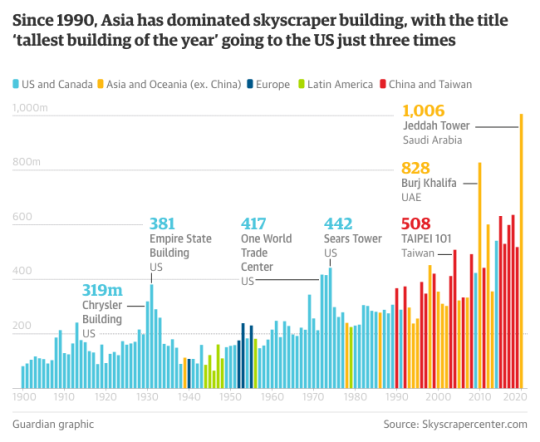
    But semantics aside, this is obviously not a new phenomenon and it’s interesting to think about this race to the sky as a proxy for what’s going on in the world. Below is a chart showing which regions have been able to lay claim to the “tallest building of the year” since 1900. 

    Since 1990, it has been all about Asia and Oceania and China and Taiwan…

  • Taller and skinnier

    Tall buildings will sway in the wind. And when they get taller and skinnier, the swaying becomes more pronounced.

    In seismically active cities, such as Tokyo and Taipei, “tuned mass dampeners” are often used near the top of tall buildings to offset the swaying caused by an earthquake.

    But tuned mass dampeners are also found in cities like New York, so that developers can build even taller and skinnier.

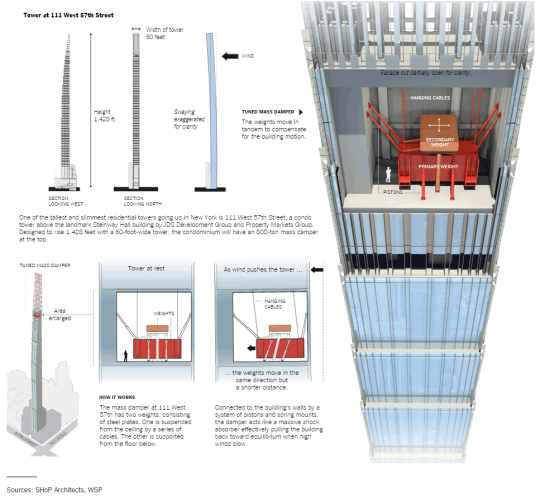
    Below is a diagram from the New York Times showing what one looks like and how it works. The example tower is 111 West 57th Street.

    Basically the masses are tuned to oscillate at a different frequency than the rest of the tower. So when the wind blows and the tower is moving one way, the weights are moving in the opposite direction and forcing the tower back towards some sort of equilibrium. 

    Neat. Structures was one of my favorite classes in architecture school.

  • Rethinking the tall building

    Back in February of this year (2015), Philip Oldfield, who is an Assistant Professor of Architecture at the University of Nottingham, gave the following talk at the Illinois Institute of Technology. Click here if you can’t see it below.

    [youtube https://www.youtube.com/watch?v=lOfkx39soIs?rel=0]

    If you’re interested in cities and how tall buildings might make them more sustainable, you’ll enjoy it. It’s filled with a number of interesting stats and takeaways, and it’s about an hour long.

  • Locations of the 100 tallest skyscrapers in the world

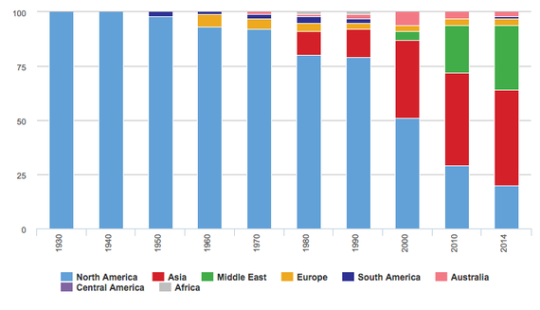
    This morning I stumbled upon the following chart (via The Atlantic) summarizing the locations of the 100 tallest skyscrapers in the world.

    As you can see North America dominated tall buildings for most of the 20th century. But then in the 1980s, Asia starting building. Then in the 2000s, the Middle East started building. And today, Asia and the Middle East are where the world’s “supertalls” sit.

    What’s fascinating about this shift is that in many cases, there’s absolutely no physical or economic need to developing so tall. Yes, rising land values can drive up the height of a building, but not to the extent that we’ve been seeing.

    Instead, building “the tallest building in the world” is more symbolic than anything else. It’s about ego. It’s about asserting your position on the global stage. And so while this is a chart about tall buildings, it’s actually a pretty telling chart about global ambitions.

  • The story of two urban giants

    This morning I stumbled upon an interesting documentary (via The Urbanophile) about two New York skyscrapers that were built in the 1930s as telecommunications buildings: the Western Union Building and the AT&T Long Lines Building. It’s fascinating to see how they have evolved along with technological change. Click here if you can’t see the video below. It’s only 8 minutes long.

    //player.vimeo.com/video/97945495

  • Mirvish + Gehry gets nod from City Council

    image

    Last week Toronto City Council voted to support planning staff’s recommendation to approve the landmark Mirvish + Gehry development on King Street West in the Theatre District. 

    The revised design now includes 2 towers (as opposed to 3) at 82 and 92 storeys tall. As a result of this change, 3 of the 5 existing buildings on the site will now be retained. I think this represents a good balance between (historic) preservation and progress.

    If you’re interested in a bit more of the backstory, Toronto Life published an article today called David Mirvish on the Edge. It talks about his father (Ed Mirvish), his upbringing, and how he got into the real estate development business.

    I thought you all might enjoy it.

    Image: Projectcore