Daily insights for city builders, delivered every morning at 6 AM ET. I’m Brandon Donnelly — a Toronto-based real estate developer and founder of Globizen. I’ve been writing here since 2013.

Tag: single family

  • A nation of apartment dwellers

    The Canada Mortgage and Housing Corporation (CMHC) recently published its latest data on housing starts, housing under construction, and housing completions. Here are a few of the highlights:

    • Canada saw 271k housing starts last year (2021). This includes single-detached housing and multiples, which captures semi-detached housing, row housing, and apartments (and other unit types). This is the highest number of annual housing starts that we have seen over the last five years. The range for the prior years has been between roughly 209-220k.
    • Ontario saw 100k (~37% of the country), Quebec saw 68k (~25% of the country), and British Columbia saw 48k (~18% of the country).
    • What I was curious about when I first saw these numbers was the split across the various housing types. Single-family homes, for instance, came in at 82k for all of Canada. So that’s about 30% of total housing starts. If you add in semi-detached and row, which I believe would also be all grade-related, you get to 124k or 46% of all housing starts.
    • Apartments and other unit types make up the balance at about 147k or 54% of all housing starts. This is kind of interesting because they now represent a majority.
    • Looking at Ontario, the percentage of apartments actually drops to 50%. But the numbers are much higher in both Quebec and BC at 69% and 63%, respectively. Again, this is kind of interesting.

    Despite all of our deference to single-family housing, the numbers suggest that we are actually in the midst of building a different kind of country — one that entails people living in “apartments and other unit types.” Maybe it’s time we got more granular with this line item.

    Note: CMHC defines “apartment and other unit types” to include not just apartments, but also stacked towns, duplexes, triplexes, double duplexes (whatever this is), and row duplexes. A number of these will, of course, be grade-related. But they still represent more intense forms of land use.
  • A mapping of single family home prices in Vancouver

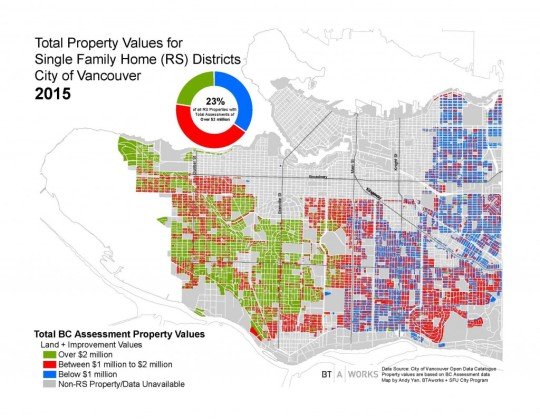
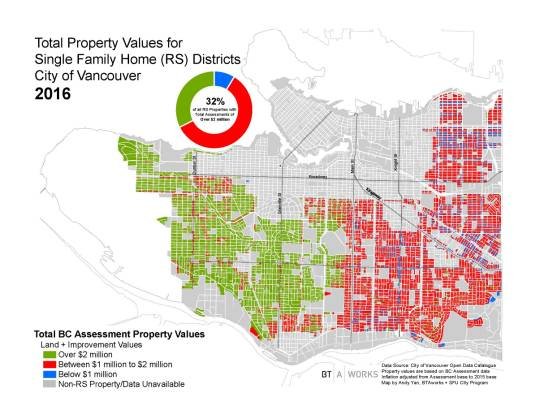
    Bing Thom Architects recently published a blog post looking at the property values of single family homes in Vancouver. The data was taken from the City of Vancouver Open Data Catalogue and is based on British Columbia Assessment data.

    The precise timing of the data is likely a bit off, but here’s how the city looked in 2015:

    23% of single family homes in the city had an assessed value over $2 million.

    A year later, this number increased 32% of all single family homes:

    It’s interesting to see how divided the city is along Main Street. But the big takeaway – thanks to BTA – is that $2 million seems to be the new $1 million.

  • The impact of Chinese buyers on Vancouver’s single family home market

    I have a new favorite blog that I think you might all enjoy as well. It’s called BT | A | Works and it is the “architectural and urban research and development division” of Bing Thom Architects in Vancouver. 

    I think it’s it’s important to have people in a firm who are researching and experimenting with ideas beyond the day-to-day tasks of a job. So I was excited to discover their work this morning.

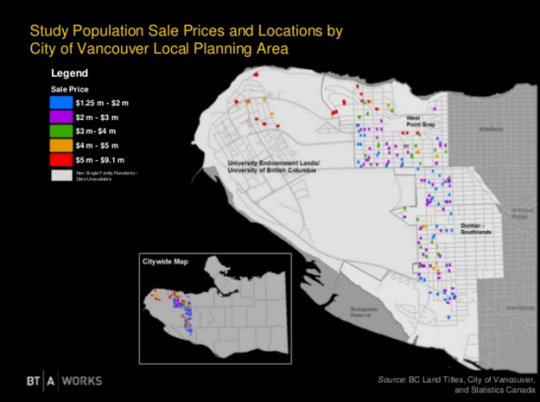
    Their most recent post is a look at ownership patterns of single family homes sold in 3 west end neighborhoods in Vancouver from September 2014 to February 2015 (a 6 month period). These are some of the most expensive areas in the city and, collectively, they found 172 properties sold with an aggregate value of around $520 million.

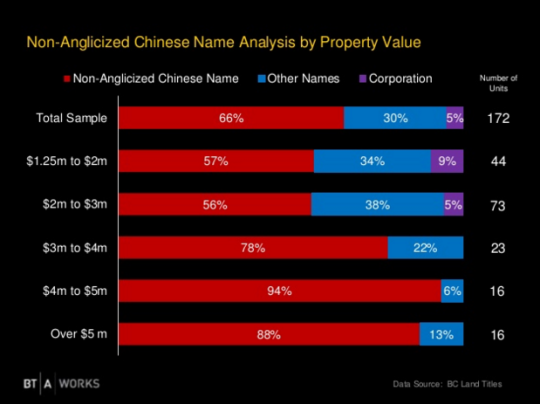
    Given the presence of foreign buyers in Vancouver’s real estate market, one of the things they then did was identify “non-anglicized Chinese names” on the title records. This means names like “Li Xian”, but not names like “Andrew Shui-Him Yan”, because the anglicized first name suggests that they are probably not a new immigrant or probably not living abroad.

    Here’s what they found:

    In total, 66% of the properties in the sample (172 properties) were associated with a non-anglicized Chinese name. And for properties over $5 million, the percentage jumps to 88%. The other interesting thing worth noting is that 23% of the registered owners declared their occupation as “homemaker/housewife.”

    I thought this would serve as an interesting follow-up to the post I wrote about a month ago called, Is Hongcouver better off than Vancouver? If you’d like to see the full BT | A | Works presentation, click here.

  • Multifamily vs. single family

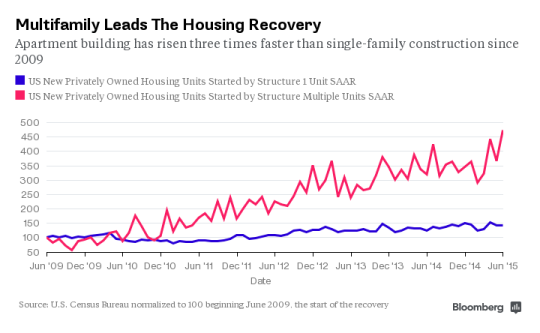
    Since 2009 when the U.S. economy started to recover, housing starts (i.e. new residential construction) have favored multifamily buildings over single family housing. Apartment/condominium construction has grown 3 times faster according to the U.S. Census Bureau (via Bloomberg).

    image

    A lot of this multifamily construction is assumed to be rental apartments, but this category also includes for sale condominiums. The classification has to do with building typology rather than housing tenure. (I would love to see how the above graph breaks down in terms of the latter.)

    The typical explanations for this trend often relate back to Millennials being poor and saddled with student debt. That’s why they’re delaying buying single family homes. But eventually the expectation is that they will resume doing

    (largely) what previous generations have done.

    Money and the economy, I’m sure, have something to do with the above trend. But I’m not convinced that it’s the whole story. 

    There are also shifts happening with respect to consumer preferences and with respect to how we plan and build our cities. That’s why I’m very interested in monitoring family formations and housing choices. 

    At the same time, I’m also a Millennial. And whenever I catch myself thinking a certain way, I assume that there are probably other Millennials out there who feel similarly.