Daily insights for city builders, delivered every morning at 6 AM ET. I’m Brandon Donnelly — a Toronto-based real estate developer and founder of Globizen. I’ve been writing here since 2013.

Tag: silicon valley

  • Is Toronto a world-class city?

    image

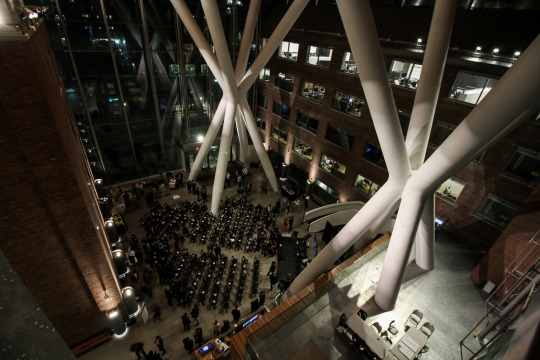
    Earlier this week I was on a panel discussion called Building Toronto Tomorrow. One of the questions was about whether or not Toronto is world-class city. It elicited a good discussion, so I thought I would talk about that today on the blog.

    Shamez Virani, President of CentreCourt Developments, responded by saying that he thinks Toronto is the greatest city in the world and that he wishes more people would just accept how incredible this city is. I agreed with him.

    I also responded by saying that I hate this question. I think it reeks of insecurity and I think it’s a bit of a red herring. It distracts from more direct and meaningful questions – questions such as our livability and our position as a global city.

    Because the reality is that Toronto is one of the most livable cities in the world and, in my view, we are the only true global city in Canada. We are an important node in the global economy for the flow of goods, people (we’re particularly good at this), capital, and now information. There’s a lot to be proud of.

    But that’s not to say that we’re perfect. Everyone knows we need better transit. And to name a few others (non-exhaustive list), I also think we need to:

    • Get a move on road pricing.
    • Loosen up our archaic alcohol laws and start using nightlife as a competitive advantage for attracting talent.
    • Acknowledge through our governance structures that cities are what drive today’s information economy.
    • Stop thinking about the Canadian/Toronto value proposition as being about cost savings. That is, buy this from us because our currency is weaker than yours. This is anti-innovation and there are much better ways to create sustainable value. (Innovation is still a weak spot.)
    • Focus on developing an information economy that leverages the unique talent and knowledge base of Toronto. For example, I think we’re in a great position for real estate + tech innovation.
    • Do everything we can to encourage big tech IPOs in this city. They are critical to developing the ecosystem.

    There’s a saying in Silicon Valley that you “make what you measure.” It means that whatever you decide to focus your attention on, is invariably what you end up making – regardless of whether or not you happen to be focusing on the right metric.

    In the context of Toronto, I think we’d be better served if we focused on and quantified our position in the global economy, as opposed to chasing some idea of “world-class.” The latter will grow as the former grows.

    I also think that this needs to be balanced against our livability. Sometimes there’s a tension. But there are cities – the best example is perhaps Tokyo – who have managed to pair a high quality of life with one of the strongest positions in the global economy.

    Is there anything else you think we should be doing? We can talk about it in the comments below.

    Image: Building T.O Toronto (BuzzBuzzHome Event)

  • Can starchitecture trump soul-crushing sprawl?

    Hunter Oatman-Stanford just published a longish read over on Collectors Weekly that talks about the history of suburban office complexes in America. That part alone makes it an interesting read.

    But he also makes the argument that innovative companies like Apple and Google are still stuck in a midcentury suburban mindset with their new mega headquarters:

    “I look at Apple’s Norman Foster building, and it’s 1952 all over again,” Mozingo says. “There’s nothing innovative about it. It’s a classic corporate estate from the 1950s, with a big block of parking. Meanwhile, Google is building another version of the office park with a swoopy roof and cool details—but it does nothing innovative.”

    Others have made this same argument. Back in 2013, Wired published an article talking about why Apple’s new Norman Foster spaceship could result in them losing the war for tech talent. 

    And if you read the piece in Collectors Weekly, you’ll see just how little, in some cases, the office environment has changed since the middle of the 20th century.

    Back then, we also had big name starchitects designing suburban head offices for innovative companies. Below is a photo from the GM Technical Center in Warren, Michigan. It was designed by Eero Saarinen and it opened in 1956.

    image

    There’s lots of research that suggests that, today, both entrepreneurs and capital are flocking to urban centers, instead of the suburbs. And I certainly don’t need to repeat that to this audience.

    But given this shift, I think we will increasingly view the suburban sprawl of places like Silicon Valley as a serious competitive disadvantage. I mean, I am sure these new buildings will be lovely, but I certainly wouldn’t want to work there. 

    Would you?

  • Getting distribution and how that is changing

    Aaron M. Renn recently published an article in The Washington Post talking about carless cities and driverless cars. It’s an interesting read, but I’m not going to talk about those topics today. So if that’s what you’re looking for, you’ll have to read his piece.

    I do, however, want to focus on one particular aspect of it. 

    In it, he talks about how Tesla is shifting the “locus of power in the auto industry” from Detroit to Silicon Valley and, at the same time, changing the way cars are sold. Tesla sells direct to consumers through its corporate stores, whereas franchise laws in almost every U.S. state mandate that new cars need to be sold through dealers.

    I’m not sure how these laws came to be, but it’s interesting to note yet another example of technology and the internet sparking disintermediation. That is, the removal of middle people, distributors, brokers, and so on. It’s the same thing that is happening as a result of companies like Uber and technologies like Bitcoin.

    I would imagine that lot of these legacy distribution models exist today because it was previously the most efficient option. If you were a car company based in Detroit, a network of local franchisees all across the country working to sell your cars was probably a great thing. But now there are other options, as is the case with many other industries.

    So what’s next? 

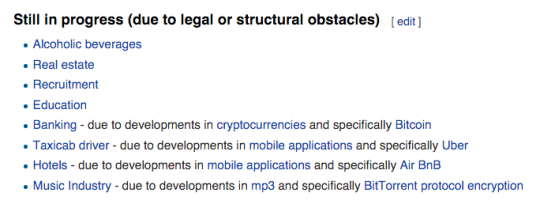
    Wikipedia calls out the following industries as still being in the midst of disintermediation:

    I bet you all know which one I’m watching closely.

  • Top 20 cities for venture capital investment

    The Martin Prosperity Institute here in Toronto recently published a new report that looks at worldwide venture capital investment by city. The report is called Rise of the Global Startup City.

    The data is from 2012, because that’s what was available from Thomson Reuters, so keep in mind that there might be some variation in the rankings if we were to look at more recent data. Some of the cities sit fairly close.

    Nonetheless, here are a few of the broader takeaways (from the report page):

    “The United States accounts for nearly 70 percent (68.6 percent) of total global venture capital, followed by Asia (14.4 percent) and Europe (13.5 percent).”

    “Just two broad regions — the San Francisco Bay Area and the Boston-New York-Washington Corridor — account for more than 40 percent of global venture investment.”

    “Global venture investment is highly uneven and spiky — it is concentrated in a small number of large cities and metros around the world.”

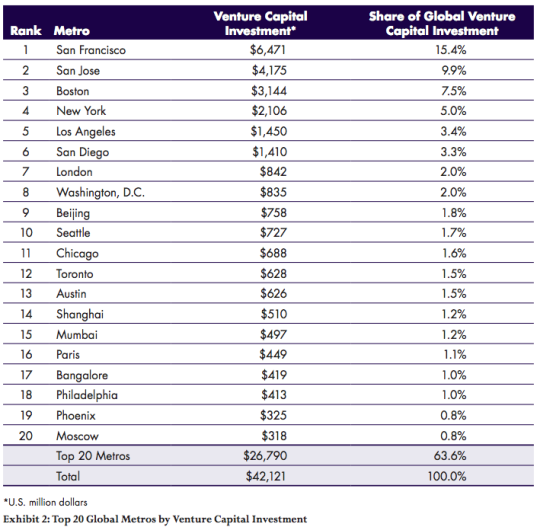
    Here are the top 20 cities by total venture capital investment (in USD millions):

    image

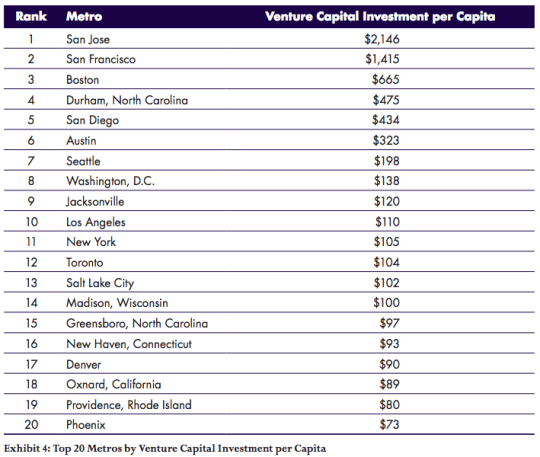
    And here are the top 20 cities according to venture capital investment per capita:

    image

    Given the variation in these two lists, you realize that some cities are largely benefitting from sheer size. London, for example, drops off the list when you look at venture capital investment per capita. 

    In fact, in this second list, 19 of the 20 cities are in the United States. The only non-American city that remains is Toronto.

  • Fred Wilson on where the New York tech ecosystem is heading

    Venture capitalist Fred Wilson is the poster boy for the New York tech industry. And this morning he posted an interesting video on his blog of a recent talk he did at Google NYC.

    At the 4:50 mark he begins talking about the evolution of the tech sector in New York and how it became what is probably the second most active startup hub in the United States.

    Given yesterday’s post on talent and the recent CityAge conference I participated in, I thought this video would make a great follow-up. There’s talk of lifestyle, diversity, gender equality, and talent within cities.

    Fred is heavily involved in growing and improving computer science education in New York, which is a perfect example of how cities can better leverage the people and talent they already have – as opposed to just focusing on bringing in new talent. Coding is a valuable skill to possess.

    I also found it interesting that Fred ended up in New York precisely because his wife wanted to live in New York. And that had a lot to do with all of the things you can do in the city, outside of work.

    If you can’t see the video below, click here.

    [youtube https://www.youtube.com/watch?v=_fZCrasNIfQ?rel=0&w=560&h=315]

  • Is venture-based real estate development coming to the Bay Area?

    Golden Gate Bridge by Mariusz Blach on 500px.com

    https://500px.com/embed.js

    Chamath
    Palihapitiya
    is a Sri Lanka born, Canada educated, venture capitalist in
    Silicon Valley, who made a boatload of money as one of the early employees of
    Facebook. He now runs a VC firm called Social +
    Capital
     and owns part of the Golden State Warriors.

    The other
    night he was interviewed at a StrictlyVC event in San Francisco and I think
    that many of his comments would also be of real interest to the Architect This City
    community. He’s super passionate in interviews and always fun to listen to.

    Below is what
    he had to say about the San Francisco startup scene. It really speaks volumes
    about what people will put up with in order to live in an awesome place/city that they love. All of his responses below are from this
    TechCrunch article
    .

    “The city has to be doing more, around
    transportation, around housing… You have to get rid of the nimbyism and you
    need to quadruple, if not quintuple, the amount of housing. You need to tell
    that engineer from the University of Michigan that he can live here on a salary
    of $80,000.

    [In the meantime], we look at our startups, and
    the minute that they start to spend more than 15 percent of their burn – good
    money that we give them – on rent, a huge red flag goes up. When they, on a
    per-head-count basis, are spending so much, we start looking at the
    productivity of the technical team. And if it’s good but not great and they’re
    spending this insane amount of money [versus] a different team in Redwood City,
    we start to ask ourselves: “Are you so convinced that success is going to
    happen in this city at 1.5x the cost?”

    Because for every dollar that someone in
    Mountain View or Redwood City is raising, you [in San Francisco] have to raise
    one-and-a-half to two times that just to get to the same point. So you’re cutting
    your half life in half. To prove that you can take an Uber from some fuckin’
    shitty bar to another shitty bar? Like, I don’t understand.”

    And here he
    talks about the possibility of his venture firm also getting into the real
    estate development business. I couldn’t resist blogging about this.

    “We made a big
    decision with our last fund to build an organization that looks really
    different than a venture firm, and that organization is going to be this
    hybrid, bastard stepchild of Berkshire Hathaway and Blackstone and BlackRock.

    What I mean by this is
    that we want to have a large permanent capital base and we want to make really
    long, discontinuous bets on companies and sectors and trends.

    And one of the things
    we talked about was having a real estate fund …[because] we owe it to our
    companies to alleviate some of these problems when no one else is going to. If
    we went and built one million square feet somewhere of mixed use, where you
    work and live, and we rethink what it means to have a modular living environment
    for a millennial cohort that wants to work at companies and doesn’t necessarily
    have kids, we can do that in a way and give that back to our CEOs as a benefit
    of working with us.

    And you can probably
    make the economics work. Because we only really care about the equity of the
    company anyways. And the equity in the real estate will take care of itself if
    you take the 30-year view. So we’re at the point now where we’re like, wow, we
    should raise a few billion dollars and get into the real estate business and
    solve this problem systematically for our companies. And maybe in that, it
    becomes a blueprint for how others should do it. We’re just basically going to
    act as our own city-state and decide how to do it ourselves.”

    It’s
    interesting to think about what the economics might look like if your primary goal is
    simply to provide space to your portfolio companies (entrepreneurs) so that
    they get more (financial) runway and, therefore, have a greater chance of success. I’d love to see that pro forma.

  • Are there enough nerds in Miami?

    image

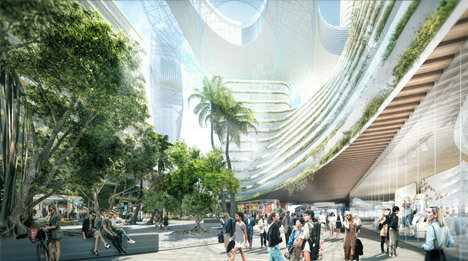
    I was browsing through my online reading list this morning (as I do every morning), and I stumbled upon this Dezeen article talking about a big new 6.5 million square foot development being proposed in Miami’s Park West neighborhood. 

    The goal of the project is to transform Miami into “Florida’s Silicon Valley.”

    This sort of thing is happening all around the world. From Buffalo to Lisbon, cities everywhere are betting on tech, startups, and entrepreneurship to grow their economy in the 21st century. And I personally think that’s really exciting.

    But as I was reading the article, I couldn’t help but think of an old essay that Paul Graham wrote back in 2006 called, How to be Silicon Valley. (Paul Graham is a famous Silicon Valley entrepreneur/investor).

    In his essay Graham argues that to be or to replicate the model of Silicon Valley in your city, you basically need two types of people: rich people and nerds. The idea, of course, being that the nerds work on the cool new ideas and the rich people then fund them.

    Using this logic, he specifically calls out Miami as a city where few startups happen and as a city not likely to become another Silicon Valley. Though there’s lots of money and rich people in Miami, there simply aren’t enough nerds. In Graham’s words: “It’s not the kind of place nerds like.”

    But that was back in 2006. 

    The iPhone didn’t even exist yet. Things have since changed. Now there are successful tech companies like Snapchat (valuation north of $15 billion) that are based out of cities like Los Angeles. And I think you could argue that Los Angeles and Miami do share some similarities.

    So while it may have seemed far fetched in 2006 for Miami to become a startup hub, is that really the case today?

    Image: Dezeen

  • Why Toronto-Waterloo needs all-day two-way urban rail service

    image

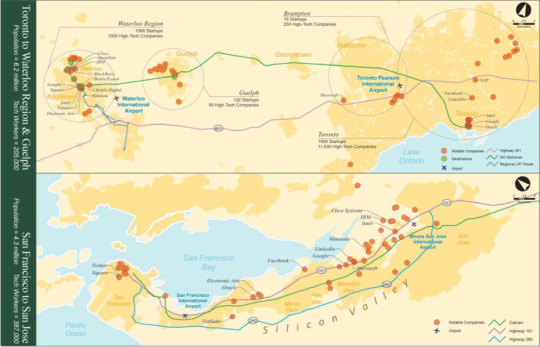
    This morning I stumbled upon an interesting Medium article talking about the need for an all-day two-way urban rail service between Toronto and Waterloo. 

    The argument is that along this corridor sits a technology ecosystem that is second in size only to San Francisco-Silicon Valley and that current connectivity levels represent a missed opportunity of epic proportions. Presently this rail service will feed you into Toronto during the morning rush hour and take you back out in the evening rush hour. But that’s it.

    According to this report prepared by the City of Kitchener (which is beside Waterloo), efficient train service would stitch together an ecosystem of approximately 12,800 technology companies, 2,800 startups, and 205,000 technology employees. It would also connect 6 universities and 4 colleges, many of which are ranked top in the world.

    There’s an argument here that this is exactly the sort of thing that governments should be doing to encourage innovation and entrepreneurship. Rather than trying to be heavily involved in actual startups, they should be creating an environment that maximizes output and then getting out of the way. 

    I think this makes a lot of sense. Don’t you?

    Image: The Innovation Express

  • John Maeda’s #DesignInTech Report from SXSW

    One of the most interesting talks that I attended while I was in graduate school at Penn was by John Maeda

    John operates at the intersection of design, technology, and business, and I find his work fascinating. He’s probably best described as a graphic designer, visual artist, computer scientist, academic, and author. And when I heard him speak in 2008, he was also President of the Rhode Island School of Design.

    More recently though, John has entered the world of venture capital by becoming a “Design Partner” at Kleiner Perkins Caufield & Byers (KPCB) in Silicon Valley. But what’s really interesting about this move is that when he joined KPCB in January 2014, he was the first designer to arrive on Silicon Valley’s legendary Sand Hill Road. No other VC firm had a designer in-house.

    And that’s because design hasn’t, at least historically, been considered that important. In fact, in some cases it was seen as being detrimental. Brian Chesky – cofounder of Airbnb – has gone on record saying that when they were first starting out, Silicon Valley didn’t think that a bunch of designers from RISD could build and run a company. Boy were they wrong.

    So that’s changing. As of this month (March 2015), there are now 6 other designers on Sand Hill Road. The venture capital community has seemingly woken up to the value of great design.

    John Maeda has branded this shift, #DesignInTech. And he recently gave a presentation on the topic at SXSW. It’s a great read, particularly if you’re somebody who cares about design. Click here if you can’t see it below.

    //www.slideshare.net/fullscreen/kleinerperkins/design-in-tech-report-2015

  • 21 largest venture capital investments in Canada

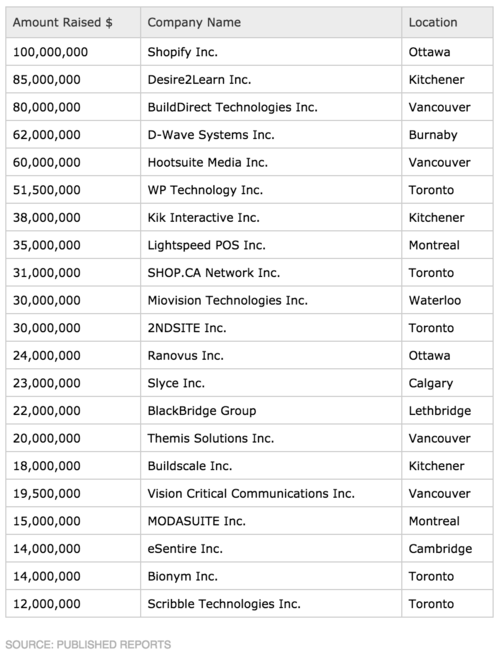
    The Globe and Mail published an interesting article this evening looking at the 21 largest venture capital investments in Canadian tech over the last 18 months. It’s called: Who needs Silicon Valley? Canadian startups scoring bigger deals.

    To put things into perspective, total venture dollars invested in Canada last year (2014) was around $1.9 billion. In the US, that number is estimated to be somewhere around $48 billion. So there’s a big spread here. But the Globe is arguing that there’s a shift towards medium-sized Canadian tech companies raising larger and larger rounds.

    Here are the top 21 largest venture capital investments made in Canada over the last 18 months:

    image

    At the same time, there’s also an attitude change that seems to be taking place. Confidence is growing. Here’s a quote from Mike McDerment of Freshbooks from the same article:

    “Our goal is to be an anchor tenant in Toronto. At Freshbooks, we want to build a global company that really contributes in some meaningful way to the city,” Mr. McDerment said. He touts the local schools and talent pool and downplays the Valley’s head start.

    “The money is shameless – it’ll just go wherever. It wants the opportunities,” Mr. McDerment said. “I don’t see why Toronto can’t beat Silicon Valley.”

    All of this is important because the medium-sized companies of today will hopefully become the large-sized companies of tomorrow. And that’s what you need to build a thriving startup hub. You need big successes. You need those companies going public and generating wealth for their employees and communities.

    Thankfully, that seems to be where we’re headed. The first company on the list above – Shopify – is already preparing for a dual US-Canada IPO.