Daily insights for city builders, delivered every morning at 6 AM ET. I’m Brandon Donnelly — a Toronto-based real estate developer and founder of Globizen. I’ve been writing here since 2013.

Tag: silicon valley

  • New York City isn’t dead

    I was speaking to some friends in New York City over the weekend and they said to me, “you know what Brandon, we don’t really go out at night anymore. It doesn’t feel safe. There are homeless people everywhere and they’ve started to get very aggressive, particularly against Asians.”

    They live in a good neighborhood in Manhattan.

    I was somewhat surprised to hear this, but at the same time, I don’t think for one minute think that New York City is dead. But some do, including James Altucher. James moved to Florida because of the pandemic and recently penned an article in the NY Post called, “New York City is dead forever.”

    That didn’t sit well with Jerry Seinfeld and so this morning he published a rebuttal op-ed piece in the New York Times. It has been making the rounds online today with people responding from both sides of the fence. Richard Florida responded with this tweet thread.

    If you’re a regular reader of this blog, you’ll know where I sit on this topic. I love technology, but sitting at home all day going from Zoom meeting to Zoom meeting is not the kind of life I aspire to live. I agree with Jerry. There’s no energy. In fact, it sucks the energy right out of me.

    With that, I’ll leave you with some more words from Jerry Seinfeld:

    There’s some other stupid thing in the article about “bandwidth” and how New York is over because everybody will “remote everything.” Guess what: Everyone hates to do this. Everyone. Hates.

    You know why? There’s no energy.

    Energy, attitude and personality cannot be “remoted” through even the best fiber optic lines. That’s the whole reason many of us moved to New York in the first place.

    You ever wonder why Silicon Valley even exists? I have always wondered, why do these people all live and work in that location? They have all this insane technology; why don’t they all just spread out wherever they want to be and connect with their devices? Because it doesn’t work, that’s why.

    Real, live, inspiring human energy exists when we coagulate together in crazy places like New York City. Feeling sorry for yourself because you can’t go to the theater for a while is not the essential element of character that made New York the brilliant diamond of activity it will one day be again.

    Photo by Florian Wehde on Unsplash

  • Building a new city in Colombia

    This month’s issue of Monocle Magazine has a feature on a new masterplanned community to the north of Cartagena called Serena del Mar. Currently under construction, the entire 971 hectare community is slated to be finished by 2030. When complete the developers believe it will house upwards of 200,000 people — effectively an entirely new city.

    It will also be entirely self-governing. There will be no mayor or city council. Revenue to operate the community will be collected through a mandatory monthly fee, though low-income residents will be exempt from paying it. As I understand it, large projects in Colombia have historically been mired in corruption issues, and so this is probably a response to that.

    But the approach has naturally caused a bunch of skepticism. Does this bifurcate the city between public and private? Is this a vote of no confidence on Cartagena’s current governance structures? Building a city from scratch is also exceptionally difficult (there’s a quote in Monocle from Toronto’s own Shawn Micallef on this). Cities usually take time to evolve and settle in.

    I don’t know enough (or anything, really) about Colombia, Cartagena, and this development project to comment specifically. And so I won’t. But these are the questions that are being asked of contemporary masterplans. There’s a reason most (or all) of the tech companies involved in large scale masterplans have banned the word “campus” from their lexicons.

  • Labor force and housing units across Silicon Valley

    I don’t love how this WSJ article starts. It seems to place the blame on technology companies for “pumping the west coast full of choking traffic and expensive homes.”

    But I do really like these charts:

    They show the gap between the increase in labor force and the increase in housing supply across the various cities in Silicon Valley.

    The solid line is the percentage increase in labor force since 2010 and the dotted (bottom) line is the percentage increase in housing units since 2010.

    The darker the color, the bigger the gap.

    Many new jobs. Lots of wealth created. Not nearly enough housing. And yes, there have also been a number of negative externalities.

    The full article is definitely worth a read. It’s about Google’s development plans for downtown San Jose.

    Charts: WSJ

  • Software eats real estate

    At the beginning of this year, a16z announced that they co-led a $175 million investment in the real estate company Loft. Based in São Paulo, Loft is doing in Brazil what Opendoor is doing in the US. They are bringing more liquidity to the residential real estate marketplace, and it turns out that the need for this is even greater in Brazil. That has apparently made Loft one of the fastest growing real estate companies in the world today. Here are some interesting facts about residential real estate in São Paulo. And here is a talk by Alex Rampell (general partner at a16z) on how software is going to eat the real estate world.

  • Zoning in Silicon Valley, New Haven, and Austin

    Robert C. Ellickson’s recent paper, titled Zoning and the Cost of Housing: Evidence from Silicon Valley, Greater New Haven, and Greater Austin, really holds back when it comes to the shortcomings of zoning ordinances. Here’s an excerpt:

    Zoning, as practiced in much of the nation, gravely misallocates resources. Some distortions are micro, such as the mediocre siting of Anton Menlo housing [a project by Facebook], and the lack of walkable neighborhoods in New Haven suburbs. Others are macro. If Silicon Valley were more populous, it would be a world tech center even more attractive to IT workers. The misuse of zoning squanders land, adds to the nation’s carbon footprint, warps interstate migrants’ choices about where to reside, and helps price poor households out of wealthier neighborhoods that would offer better life prospects for their children.

    The paper focuses on three metropolitan areas: Austin, Silicon Valley, and New Haven. Of these three, Austin is the most permissive in terms of allowing new and denser housing. Silicon Valley and New Haven, by contrast, have done a great deal to limit intensification by adopting exclusionary policies.

    In 1970, home prices in Silicon Valley were only slightly above the national average. Today, they are by far the highest in the United States, which is, of course, partially a result of high demand (tech salaries) and low supply (zoning ordinances). Ellickson’s paper examines the effects of the latter.

    If you’d like to download a copy, click here.

    Photo by Carlos Delgado on Unsplash

  • Is Toronto’s tech ecosystem too US-centric?

    The Wall Street Journal’s recent piece about “Silicon Valley invading Toronto” is, in my view, describing a generally positive outcome.

    We are one of the largest cities in North America (the exact ranking depends on where you draw the urban boundaries).

    We have more enlightened views around foreign and high-skilled workers (I was given a short window in which to leave the US after I finished my first graduate degree there).

    And we have a large and highly educated pool of tech talent (the salary differential discussed in the article looks to be, at least partially, a result of the weaker Canadian dollar).

    US companies are gobbling up office space in Toronto. And presumably, this is one of the reasons why 139 new flights were added between Toronto and Francisco over the last two years. (Source: WSJ)

    However, I do agree with the remarks from people like Jim Balsillie (Blackberry) and Harley Finkelstein (Shopify) that a better outcome would be the creation of more massively successful Canadian tech companies.

    As Finkelstein points out, there’s a big difference between 100,000 square feet of space for the HQ of a new and growing Canadian tech company and 100,000 square feet for a new branch or satellite office.

    The stats we read in the papers about the number of tech jobs being created in Toronto generally don’t speak to composition. Where in the value chain do these people sit? Where is the value accruing?

    The intellectual capital is here. And we should be doing everything we can to foster and finance new homegrown ideas and businesses.

    Image: WSJ

  • Algorithmic home buying — what’s the end game?

    Bloomberg recently published a good summary of Zillow’s business and their move into algorithm home buying and flipping. (They are trying to avoid the “flipping” moniker because of the negative connotations associated with it.)

    Zillow started buying homes directly from owners last spring. They charge the seller between 6-9%, so more than using a typical agent, but inline with their competitors. There’s clearly a segment of the market willing to pay a premium for the added convenience.

    The thinking used to be that discount brokerages were the way to disrupt the housing market. This is the opposite strategy.

    Interestingly enough, Zillow felt that they needed to make this pivot with their business model. It used to be about selling ads. They were definitive in that they were not a disruptor of real estate agents.

    But now:

    If getting an offer from an iBuyer became a crucial step in the selling process, they worried, Zillow could lose its audience and its advertising base. What’s more, market researchers kept finding that consumers said they’d pay a modest premium to get a cash offer. “People expect to press a button and have magic happen,” says Rascoff, a 43-year-old former Expedia executive who’d earlier started the travel search engine Hotwire, which he sold to Expedia for $700 million. Getting into the business of buying homes directly, Rascoff says, was “the only way to remain in a leadership position.”

    Here is a map of the companies in this particular space and the cities in which they operate:

    Some investors aren’t sold on this strategy and have begun short selling Zillow (according to the Bloomberg article). I keep getting the sense that there’s a greater end game in the cards here. It is about building up A (algorithmic home buying and flipping) in order to unlock B.

    But what’s B — a new end-to-end transactional model for the housing market?

  • A more distributed startup geography

    The Economist recently argued that Silicon Valley’s innovation hegemony is waning and that it is a product of two factors: there appears to be more innovation happening elsewhere (good news), but that innovation in general also seems to be harder to achieve (bad news). Here is an excerpt from the article:

    Other cities are rising in relative importance as a result. The Kauffman Foundation, a non-profit group that tracks entrepreneurship, now ranks the Miami-Fort Lauderdale area first for startup activity in America, based on the density of startups and new entrepreneurs. Mr Thiel is moving to Los Angeles, which has a vibrant tech scene. Phoenix and Pittsburgh have become hubs for autonomous vehicles; New York for media startups; London for fintech; Shenzhen for hardware. None of these places can match the Valley on its own; between them, they point to a world in which innovation is more distributed.

    Part of the problem, of course, is rising costs in the Bay Area. Everything from the cost of living to the cost of operating a business. The article cites a recent survey where nearly half of all respondents said they are planning to leave the Bay Area in the next few years. This is up from 34% only two years ago.

    I don’t doubt that rising costs are causing some people to look to other cities, as well as other countries in the case of draconian visa policies. But I am suspect of the claim that we’ve heat peak “innovation” – however you want to define that.

  • Top US metro areas for VC investment

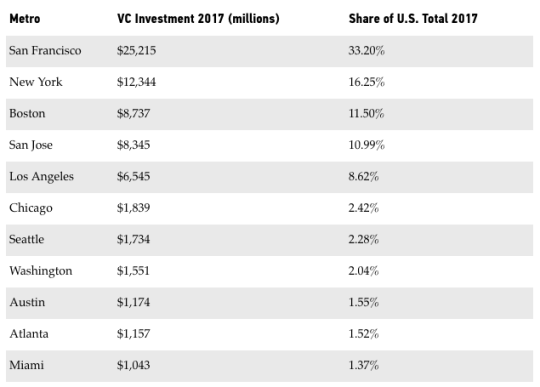
    Below is a list of the US metro areas that saw a billion dollars or more in venture capital investment last year (2017). It is taken from a recent CityLab article by Richard Florida where he talks about the “geographic inequality of high-tech venture capital.”

    image

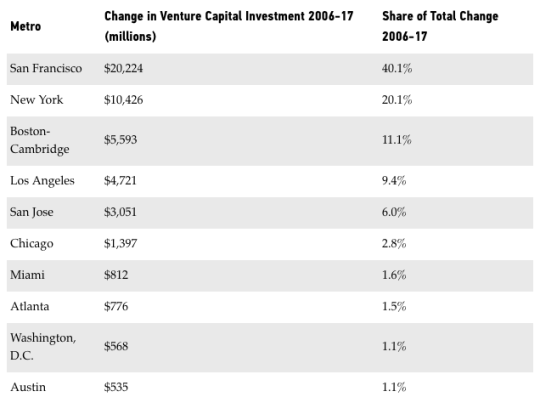
    It’s worth noting that San Francisco – not San Jose (Silicon Valley) – is at the top of the list with nearly 1/3 of the US total last year. It’s also interesting to note that when you look at each metro’s share of the total change from 2006-2017 (the chart below), you get Los Angeles now punching above San Jose. 

    image

    Florida also gets into which economic and demographic variables seem to be associated with higher levels of venture capital investment. For the rest of the article, click here

  • Are we entering a new era of tech-driven city building?

    Emily Badger of the New York Times published an interesting piece yesterday talking about the tech industry’s current obsession with trying to fix cities. And there are certainly many problems to fix.

    Staying true to tech and engineering parlance, there’s lots of talk of optimization. How do you technologically optimize a city, for things such as affordable housing?

    There’s no doubt that many of you will sympathize with this statement: 

    To planners and architects, all of this sounds like the naïveté of newcomers who are mistaking political problems for engineering puzzles.”

    But naïveté is not always a bad thing and with all of the money sloshing around in this industry, there’s also no doubt that this is likely a new era of city building.

    The article ends by quoting JD Ross, the 27-year old co-founder of Opendoor – a startup that we have discussed many times before on this blog and is now valued at over $1 billion.

    It is him saying that he wants to figure out how to put $100 million into this space as soon as he can figure out the right target to optimize for. “It’s better than buying a Bugatti.”

    Of course Sidewalk Toronto – which is mentioned a few times throughout the article – is already a perfect example of tech infiltration.

    But I think Dan Doctoroff gets it right when he posits that the real naïveté will come from disrespecting urbanist traditions.

    Photo by David Alacaraz on Unsplash